
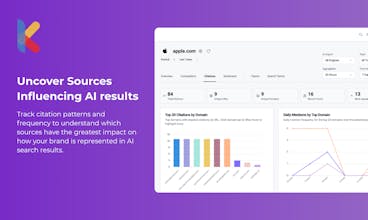
Monitor brand mentions and track brand visibility across generative AI platforms like Google AI Overviews, ChatGPT, and more. Our AI rank tracker uncovers which pages are cited in LLM responses, what answers are pulled, and how often your brand appears.




Tower – Git client for Mac and Windows
AI Visibility Rank Tracker
Hi everyone, I'm Benjamin from Keyword.com, the maker of this product 👋!
Thank you for taking the time to giving our tool a try! We're super excited to get feedback from you all 🎉.
If you have any questions, feel free to shoot them here and I'll be sure to answer them asap.
Also, feel free to add me on LinkedIn.
Smoopit
@benjamin_thornton Wow. How expensive was the domain? :D
Tower – Git client for Mac and Windows
@benjamin_thornton @rachitmagon 😃
AI Visibility Rank Tracker
@rachitmagon
Far too expensive 🥴 but we're proud to own it!
Smoopit
@benjamin_thornton hahaha! Upvoted & congratulations on the great tool you've built
AI Visibility Rank Tracker
@rachitmagon thanks a lot for your support, appreciate it! Please do not hesitate to reach out to me if you have any feedback on the tool.
@benjamin_thornton that's awesome! How do I use the data to improve the visibility of my website in AI search?
Sniply
AI Visibility Rank Tracker
@tim_heicks Thanks for the mention!
Content Writing Jobs
I've seen a few of these tools pop up, namely Peec and Otterly, what are the main differences between this tool and theirs?
AI Visibility Rank Tracker
@tomaslau Hey Tomas, thanks for asking this question. It's a good one.
Peec and Otterly are both great tools for tracking visibility in AI search. The features are roughly the same, but the main differences between them and Keyword.com are:
Peec and Otterly's pricing work on a prompt basis where whenever you launch a search, you automatically track that prompt across the different search engines that they propose, whereas for Keyword.com, it works on a credit system where you choose each AI search engine you want to track for each prompt. This gives you more flexibility in the AI engines you want to track, but it does add a bit more complexity.
Peec forces you to track your prompts daily and Otterly forces you to track prompts weekly, whereas Keyword.com's credits give you flexibility in choosing how often you want to track your prompts (hourly, daily, weekly, monthly, or on-demand).
Some of the AI engines provided by Peec (like Gemini 2.5 & GPT-4.0 for example) have to be purchased as addons, whereas you can track all AI search engines in any AI Visibility package for Keyword.com.
We don't restrict the number of countries you can track by package (all AI Visibility packages contain the same features/number of countries to track on ChatGPT for example)
Lastly, we provide 5 free Google organic keyword tracking packages for free with each AI Visibility package, so users can also see how they're ranking in Google to get a full picture of their online visibility.
Thanks again for your question!
Content Writing Jobs
@benjamin_thornton cool stuff, appreciate the detailed response.
@tomaslau @benjamin_thornton thank you for clearing up your USPs.
Next3 Offload
I’m an SEO guy, always on the lookout for solid LLM SEO tools, and this looks like a promising one. Do you plan to include historical trend data or SERP snapshots to help track visibility shifts over time? That would really help with long-term strategy.
AI Visibility Rank Tracker
@shahriardgm Great questions! Happy to hear your positive early feedback on the tool, please give it a try and let me know what you think! To answer your question:
We already include historical trend data for tracked terms, for example you can track the visibility score of your brand over time to measure your performance over time. We offer historical trend data for Visibility Score, Average Position, Sentiment Score, Detection Rate and Top 3 Visibility.
Regarding the SERP snapshot, this is already included as well. If you click on the details of a prompt and go to Spyglass, you can actually find the search result for that prompt:
My Financé
how does this work? like how do you get the data?
congrats on the launch btw!
@catt_marroll Hi Matt,
We’re currently using LLM APIs to process user-defined prompts across different AI platforms. Basically, you can set up specific queries or scenarios you want to monitor like "best project management tools" or "top cybersecurity solutions" and we’ll feed those prompts into LLMs like ChatGPT, Claude, and others to see when and how your brand gets mentioned.
Our system captures the full context, not just whether your brand appeared, but which specific pages or sources the AI cited, what exact information it pulled about your company, and in what context your brand was presented to users. We then aggregate all this data into clear metrics and trends so you can see your “AI visibility” for the prompts that matter most to your business.
We’re also working on expanding this with direct scraping functionality, which will give us additional insights into how your brand appears in AI-generated content.
The end result is basically like SEO analytics, but for the age of AI — you get to see how visible and accurately represented your brand is when people ask AI assistants the specific questions you care about tracking.
Hope that makes it clear!
My Financé
@abrezhniev got it! neat! I've seen some things in this space cropping up but i wasnt really sure how they worked. appreciate you taking the time to write this up! will keep your product mind when i get to the point of "AEO" focus!
I find this tool super useful for brands to track their presence in AI-generated search results like ChatGPT and Google AI Overviews. Would love to see support for more platforms in the future.