DocMe

DocMe

Your health, from a selfie

7 followers

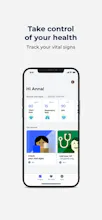
With DocMe®, now it’s easier to measure, monitor and access your essential health information in one place. With our deep learning models, you can take a selfie and receive vital signs monitoring in real-time with incredibly accurate data anytime, anywhere.
DocMe gallery image
DocMe gallery image
DocMe gallery image
DocMe gallery image
DocMe gallery image
Launch Team
Auth0
Auth0
Start building with Auth0 for AI Agents, now generally available.
Promoted

What do you think? …

Slava Bobrov
Wow, this looks amazing... What is the age range that it can accurately work with?
Pratyay Poddar
@slava_bobrov Currently, we have designed a clinical trial for 18-30yrs old subjects. However, we've tested our algorithms internally and it works for 18-60yrs pls range, not clinically tested though. What's your thought on that? :)
Hunter Carter
@slava_bobrov @ppoddar Better make that super fucking clear to every user. Ethically.
Pratyay Poddar
@slava_bobrov @school_4_ants it is clearly labelled in the website as well as on the app when you take the selfie. Maybe try the app and let us know what you think about it? :)
Pratyay Poddar
I worked on this product from the very beginning. I'm incredibly proud of being supported by an amazing team that brought DocMe - a medical device - to market in under six months.
Benoit Chambon
Good job! How do you deal with personal data and GDPR? :)
Pratyay Poddar
@benoit_chambon We only send non-identifiable parts of a face on AWS for processing. Also, most of the personal data is stored on device + when your phone is locked with a passcode, Touch ID or Face ID, all of your health and fitness data in the DocMe app is encrypted. Your health data stays encrypted while in transit and at rest.
Jack Davis
Wow I can't believe it can do all of that just by looking at a photo of you😳🔥!
Pratyay Poddar
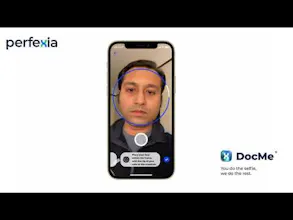
@jack_davis7 Well, we use video selfie of 15s in 60FPS (i.e. 900 frames/images). DocMe uses a novel variant of remote photoplethysmography (rPPG) technology to extract blood flow information from imperceptible colour changes in the face that are captured in those images. Our technology uses time-series data to get certain physiological signs through a series of signal processing methods to measure five vital signs viz. heart rate, respiratory rate, heart rate variability, peripheral tissue oxygen saturation and blood pressure with medical-grade accuracy.
Nichole Elizabeth DeMerè (Eithiriel)
This is really interesting. How does it work? (At least, what can you share about how it works?)
Pratyay Poddar
@nikkielizdemere Sure. Our technology relies on the scientific principle called remote photoplethysmography (rPPG) which is a contactless technology that measures the volumetric variations of blood circulation by detecting the variance of red, green and blue (RGB) light reflection changes from the skin. The rPPG wave describes these periodical changes in the attenuation of light energy in the light wave’s pathway, and can thus be used to detect the periodical changes in blood flow.
Pratyay Poddar
DocMe doesn't require any new external hardware devices or wearables. This is a radically new approach that means DocMe takes advanced research in AI/ML (computer vision, convolution neural networks, transformer mechanism etc.) and leverages them in a simple and attractive app that even my grandmother can figure out (she uses DocMe to check her heart rate and respiratory rate and doesn't need to use a finger-clip SpO2 monitor anymore).
Yevhenii Peteliev
Wow! Looks very useful. Great job! I can't wait when I try it. Congratulations!
Pratyay Poddar
@peteliev Thanks very much! If you love the app, don't forget to rate us on the App Store pls! :)
Pratyay Poddar
@peteliev Did you have a chance to try the app? How did you like it?
1234
Next
Last