

todai is your personal AI guide for mental clarity and emotional balance. Track your mood, uncover patterns, and get science-based tools — anytime, anywhere.
Over the past weeks since our launch, we've received tons of feedback, feature requests, and fresh insights from users.
And it's reshaped a lot in how we see todai and where it s headed next.
We're currently working on a major shift in the product: new functionality that will make todai even more useful as a daily thinking companion for people navigating emotional balance, stress, and wellbeing.
But before we go further, we want to talk to the right people.

@ngorgiashvili So glad that intention came through — that “end of a messy day” moment is exactly what todai was built for 🤍
As for learning: while the AI doesn’t build a long-term memory yet, it does analyze context within your current session and surfaces patterns through your Happy Lifestyle Index over time.
We're actively working on ways to let todai adapt more deeply to your recurring states and reflection styles — without getting too heavy or invasive. More personalization is definitely coming!

Hey everyone — I’m Gosha, I run operations at todai.
A year ago, we started todai with a simple question:
What if self-reflection was less vague — and actually actionable?
Most tools we tried were either:
– too shallow (“How do you feel today?”)
– too clinical
– or too focused on productivity over perspective
So we built todai as a daily AI companion that helps you think clearly, especially when your inner noise gets loud.
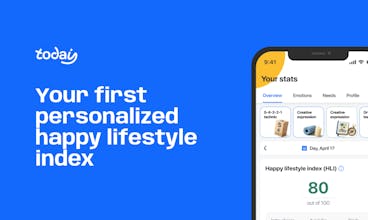
At the core of todai is something we call the Happy Lifestyle Index — a simple way to track where your emotional energy is going, and what you can adjust to feel better, not just do more.
Here’s what you can do inside the app:
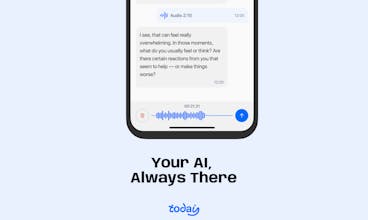
✅ Start a daily check-in — write or voice
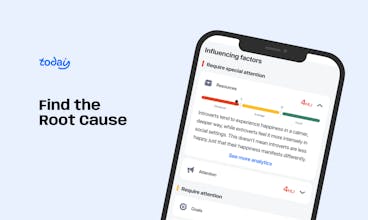
✅ Get feedback from AI on what’s behind your state
✅ Use tools like “Reframe” and “Reset” to shift mindset
✅ Track changes over time via your personal HLI
✅ Reflect on decisions, patterns, emotional triggers
✅ Build a habit of mental clarity (without writing essays)
It’s built for moments when everything feels urgent and important — but you need help cutting through the noise and focusing on just one thing that truly matters.
Or those end-of-day spirals where it feels like “nothing got done” — todai helps you spot real wins and reframe effort as progress, not failure.
Our approach isn’t just another AI wrapper on top of journaling. The core methodology behind todai was developed in collaboration with a psychology faculty member — an associate professor with deep expertise in self-reflection and emotional regulation. Together, we designed a structured system that helps users move from vague feelings to concrete insight, without needing to be “in therapy mode.” It’s built to be practical, respectful, and grounded in real psychological frameworks.
We’re not trying to replace therapists or optimize your life into a system.
We just want to give a space where they you pause, think, and refocus.
Appreciate you checking it out — happy to answer anything here.
Let us know what resonates (or doesn’t).
We're listening.

@goshatirov Cool! The Happy Lifestyle Index is such a clever way to track emotional energy—definitely something I wish I had when I was juggling multiple projects. Congrats!
@victoria_wu Thank you! That means a lot.
The HLI really came from that exact feeling — juggling too much, losing track of how you actually feel underneath it all.
Glad it resonates — hope it helps others stay a little more grounded too.

todai looks awesome.
I love the fact that you worked with an actual psychology expert to build this and have set clear parameters to define the "Happy Lifestyle Index" which clearly sets you apart from other apps.
This is also probably the first AI self-help app that I feel can easily integrate into our routine.
Congrats on the launch team!
@theanimeshs Thank you — this really means a lot to us.
Collaborating with a psychology expert was core from the start — we didn’t want todai to be just another feel-good app, but something grounded, respectful, and actually usable in daily life.
So glad it feels like something that could fit naturally into your routine. That’s the best kind of feedback 🙌


The app looks so neat, great job guys! 🎉
Are you maybe considering an option to have a peek at other users' results and probably discuss them? something along the lines of a leader board/ community chat room :)

great product @goshatirov ! how much does it track on itself vs me having to put in data?
@andrew_white_13 Thanks so much! 🙌
Great question — todai is designed to do the heavy lifting with you, not because of you.
The more you share (via journaling, check-ins, voice/text), the smarter it gets at spotting patterns and offering insights.
But even with minimal input, it can help you reflect through guided prompts and emotional cues — without overwhelming you.
Think of it as a conversation, not a spreadsheet 🙂

Just loved the intentionality behind todai. Out of curiosity — how do you balance between helpful AI suggestions and not overwhelming the user with too much interpretation or “fix-it” advice?
@lak7 Thank you — that means a lot! 🙌
That balance you mention is exactly what we obsess over.
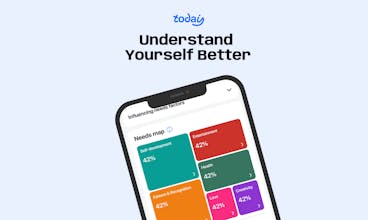
We believe clarity > control. So instead of trying to "fix" things, todai helps users see what’s going on — emotional patterns, blind spots, needs — and offers gentle prompts or reflections, not prescriptions.
Our AI is trained to support self-awareness, not override it.
Because sometimes, what you really need isn’t a solution — it’s the right question at the right time.

Love the concept and the actionable items! I am curious, what AI models are you using for this? Are they changeable?
Good luck with the launch!
@aeromaniax Thank you — glad the actionable side resonates!
Right now, we’re using a blend of GPT with our own prompting system and context layering on top — basically shaping how it listens, responds, and adapts to emotional nuance.
At this stage, the model isn’t changeable by users, but we’re definitely exploring ways to let people tune the “tone” or depth of interaction in the future (e.g. more coach-like vs. more reflective).
Appreciate the question — and the support!

@huan_leo Thank you — really appreciate the thoughtful words!
That’s exactly what we’re aiming for: making self-reflection feel grounded, not vague.
As for the AI feedback — great question. We designed it to guide, not diagnose. It looks at your language and tone in real time, then uses structured prompts to help unpack what’s underneath — while always keeping you in control of the interpretation.
The feedback is rooted in our reflection framework (developed with a psychology advisor), so it’s less about “telling you how you feel” and more about asking the right next question to help you clarify things for yourself.

Congratulations on the launch of todai, 🎉 @goshatirov A year of building something meaningful around self-reflection is no small feat, and the focus on actionable insights rather than vague check-ins sounds really thoughtful.
I'm curious about the Happy Lifestyle Index you mentioned - how did you and your psychology collaborator approach designing that framework? Was there a particular psychological model or research that influenced how you structured it to track emotional energy patterns?
The distinction between "cutting through noise" versus traditional productivity tools feels important. Looking forward to seeing how users respond to this approach!
@ajay_kumar_yadav4 Thanks so much — truly appreciate the thoughtful words.
You nailed the core of it: we didn’t want todai to just “track moods,” we wanted it to help people make sense of what they’re feeling — and do something with that insight.
The Happy Lifestyle Index (HLI) grew out of a year-long collaboration with a psychology faculty member specializing in self-reflection and emotional regulation. Rather than build around clinical diagnostics, we focused on four core emotional-energy dimensions that tend to shift most day to day:
Clarity, Effort, Resources, and Needs.
This structure is loosely inspired by CBT-informed models and behavioral activation theory — but simplified into a reflection-first format. The goal wasn’t to replicate therapy, but to create a usable mirror that encourages small shifts and self-awareness over time.
And yes — “cutting through the noise” felt like the most honest north star.
We wanted todai to be the space between performance and collapse — the moment where you pause and ask, “What’s actually going on here?”
I'd love to hear your thoughts as you try it out.





todai
So glad you’re enjoying the feel of the app — that means a lot!
And yes, you’re right: as you use todai, the Happy Lifestyle Index starts shaping around your responses, patterns, and emotional energy shifts.
That said — we’re also working on making the onboarding → clarity connection more transparent. Appreciate the feedback, and excited to hear how it evolves for you!