Launched this week

buildpipe
Compose, run and automate multi step AI developer workflows
121 followers
Compose, run and automate multi step AI developer workflows
121 followers
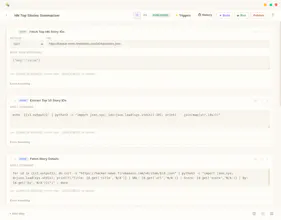
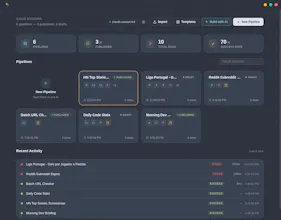
A local-first pipeline automation app for developers powered by AI, running natively on your machine. Think of it as a local Zapier or n8n, built specifically for developers who want to chain shell commands, AI calls, HTTP requests, and file operations into reusable pipelines then trigger them on a schedule, on a file change, or via webhook.



buildpipe
Product Hunt
buildpipe
@curiouskitty I have not added any auth flows yet. Your llm api keys are encrypted and stored locally. Adding auth flow to the app in the next version I didn't feel it was a top req for v1. The goal was local pipes as a desktop app and I wanted to focus on that.
Thank you for the feedback!
the AI calls step in the pipeline is the one i'd want to understand better. chaining shell commands and HTTP requests is well-understood territory. adding AI calls introduces non-determinism into the pipeline which changes how you think about error handling and retry logic. if an AI step returns something unexpected does the pipeline fail, retry, or branch? and how do you define what unexpected means for a step that's inherently probabilisti
buildpipe
@ansari_adin I would define json outputs to everything so that you can measure with a field that there was a success in atleast processing the ai request. A score of confidence as well. It is upto you and how you decide to write your pipeline.
Local-first pipeline runner is a smart positioning. I've lost count of how many one-off shell scripts I wrote to chain API calls and then forgot where they lived. The {{step_id.output}} referencing pattern feels natural — similar to how n8n handles it but without the cloud dependency. One thing I'd want before adopting: can pipelines be versioned in git as plain files, or is the visual graph the only source of truth?
buildpipe
@xiaosong001 thank you. Currently there is no versioning but a history of logs and individual runs are stored. I love the idea though. I will start working on versioning tomorrow. Maybe keep the last 5 versions ?
hey buddy!
The idea looks very interesting for productivity.
Just my concern for recurring workflows like Hacker News summaries or daily briefings, do you maintain a searchable history of previous runs?
For example, if I saw a story in the morning and later wanted to revisit the ai summary or outputs, having run history would be super useful. It is what we usually do.
But at the same time, storing every pipeline output/log long-term could also become a storage challenge locally specially for heavy AI workflows.
buildpipe
@naresh_chandanbatve great question...yes the logs are stored of each run under the .build-pipe folder in your user directory :)
Multi-step AI workflows are powerful when they include clear checkpoints. Can a buildpipe workflow pause for approval before a step changes code, posts externally, or calls a paid API?
buildpipe
@cyrus_elmtalab great suggestions currently there is no approval process but I'll add it to the roadmap. Thank you for the suggestion.
The file-watch trigger is interesting — curious whether buildpipe can handle asset pipelines where the output is binary files rather than code. For instance, running a font build step that produces WOFF2 files and then pushing them to a CDN as a chained step. Is the pipeline model flexible enough for arbitrary file artifact workflows, or is it currently more focused on shell/AI/HTTP steps?
buildpipe
@sunnyallan Great question the short answer is yes, this works today, but you'd be doing it through shell steps rather than a dedicated artifact primitive.
The pattern would be: file-watch trigger on your source fonts → shell step running your font build tool (outputting WOFF2s to a known path) → HTTP or shell step pushing to your CDN, with {{step_id.output}} passing the path between them. Since everything runs locally on the same machine, binary files are just files no serialization needed.
Binary/asset pipelines are definitely on my radar as a first class use case. Would love to know is the missing piece mostly the artifact store, or is there something about the step model itself that feels limiting for this workflow?