Launching today

Agentic Website Builder 2.0 by Lokuma
Design, build, and run your site with a design agent harness
289 followers
Design, build, and run your site with a design agent harness
289 followers
Lokuma 2.0 is a design-aware agent harness for websites. Most AI builders can generate a first draft. But real sites need structure, taste, brand consistency, editing, publishing, forms, and ongoing updates. Lokuma connects planning, design, style, assets, site state, edits, and publishing into one agentic workflow — so your website feels designed, not just generated. Design, build, and run your site with agents.




Agentic Website Builder 2.0 by Lokuma
Hey Product Hunt!
Tech lead at Lokuma here.
The core shift in v2.0: we replaced the fixed "generate-once" pipeline with a real agent loop — the model plans, writes code, inspects output, and self-corrects until it's satisfied. That's what makes the quality jump feel so dramatic.
A few things under the hood we're proud of:
1.Plan-first — the agent drafts a build plan before writing any code. Users approve it before execution starts.
2.Targeted patching — edits use find-and-replace on the specific changed section, not full file rewrites. Faster and more predictable.
3.Live preview — updates as the agent works, not just at the end.
We built this because we were tired of AI builders that look great in demos but break the moment you customize. Lokuma 2.0 is meant to be a real collaborative builder.
Happy to answer questions about the architecture — looking forward to your feedback!
Design Agent by Lokuma
@big_claw Couldn't have done this without your vision on the agent architecture. The plan-first loop, the patching strategy, the live preview — all your shape on the codebase. Founder gets the marketing slot; you solved the hard problem. Grateful.
Best,
Mu
Congrats on the launch. I tried it out and the onboarding questions stood out to me.
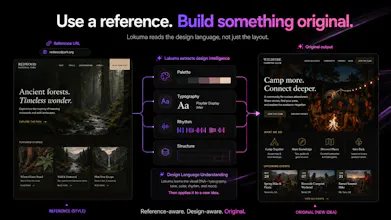
The best part for me was being able to paste in websites for design inspiration. That made the process feel more grounded because I was not just describing a site from nothing. I could give it examples of the style I had in mind and let the builder work from there.
I also liked how descriptive the questions were before generation. For a website builder like this, those first inputs seem really important because the more clearly the agent understands the user’s taste, references, and intent upfront, the less cleanup and back-and-forth the user probably has to do after the first design is generated.
Excited to see where this goes. The product feels like it is trying to make the design process more collaborative instead of just generating a first draft and leaving the user to clean it up.
Design Agent by Lokuma
@danush_singla Danush, thank you! You've put your finger on the design thesis exactly.
Most builders treat intake as a form to skip past. We treat it as the place the whole project's design DNA gets set — taste, references, intent, all captured upfront so the agent isn't guessing on iteration 3 what you meant in iteration 1.
The reference URL paste is the move I'm proudest of. "I want it to feel like X" is how designers actually think — making it the first input instead of an afterthought changes the whole arc of the build. Glad it landed.
Best,
Mu
The concept of a 'design agent harness' is intriguing. Does the agent iterate based on high-level feedback (e.g., 'make it more professional'), or does it require specific UI instructions?
Design Agent by Lokuma
@rivra_dev Actually both,but high-level feedback is the interesting case.
"Make it more professional" gets resolved against the design system the agent built first: type scale, spacing, palette, hierarchy. So vague intent becomes concrete moves inside an existing grammar, not a fresh guess.
Specific UI instructions work too, and the agent will flag when one breaks the system rather than silently complying.
The harness exists so the agent has enough context to interpret intent. That's the whole point.
Design Agent by Lokuma
@rivra_dev On top of what Qi An shared - Without a harness, "make it more professional" is a fresh guess every time. With a harness, it's a move inside an existing grammar — tighten leading, drop saturation, lift hierarchy contrast. Same words, different category of result.
what if I'm an agency building 5 different client sites?
Can the agent learn from one site's design system and apply lessons to the next one, or is each site starting fresh?
Design Agent by Lokuma
@boyuan_deng1 Great use case, and one we hear from agencies a lot.
Right now each site is its own world — the agent has full memory within a site (brand, structure, iterations, live code), but nothing carries across. That said, you can still enforce consistency today through visual templates and instructions — set the design language once, reuse it as a starting point.
An agency-level layer where taste and components travel across client work natively is something we're actively designing. If you're open to chatting, we'd love to hear how your team would want it to work.
Design Agent by Lokuma
@boyuan_deng1 +1 to Qi An. One specific trick: every project auto-keeps a "design notes" doc as the agent works — style, brand rules, decisions made along the way. For client #2, paste the relevant bits into chat and agent uses it as your baseline immediately. Crude but real. Boyuan, this kind of use case shapes our agency roadmap — drop me a DM if you want a deeper convo.
Best,
Mu
I like the move toward targeted patching instead of full file rewrites. Whenever I use AI tools available for UI work, they usually break existing CSS while trying to add a single new button. Does this agent actually understand my existing design system and tokens before it starts patching, or is it still guessing a bit?
Design Agent by Lokuma
@ritikgupta_01 Ritik, short version: we don't trust the LLM to remember your design system. We make remembering free.
Design tokens are structured per-project state the agent sees every iteration. The Tailwind config is locked — agent can only compose with existing tokens, can't invent new ones. Patches are find-and-replace, not rewrites. A pre-build audit catches the slips.
Not 100%, but "one button breaks the system" shouldn't happen.
Best,
Mu
The real test will be long term edits most tools can generate a good first version but maintaining design integrity after 10–20 changes is where things usually break.
Design Agent by Lokuma
@gabriel_brooks1 Gabriel, agreed entirely. A polished v1 is table stakes; long-term integrity is the real test. Our long-running internal stress tests show the design system still holds across heavy edits — not pixel-perfect, but the "system collapses" failure mode shouldn't happen. Take a swing at it.
Best,
Mu
Triforce Todos
Great one team, BTW, if someone eventually wants to hand this off to a developer or export it cleanly, what's the code quality like?
Design Agent by Lokuma
@abod_rehman Thanks! Yes, full export anytime.
It's agent-written code — modern stack, readable, componentized. Not hand-crafted by a senior engineer, but clean enough for a developer to pick up without a rewrite. The targeted-patching approach in v2.0 actually helps here: edits stay localized, so the codebase doesn't drift into spaghetti over many iterations.