
AGINE Academy
A story-driven game for learning Claude by doing
92 followers
A story-driven game for learning Claude by doing
92 followers
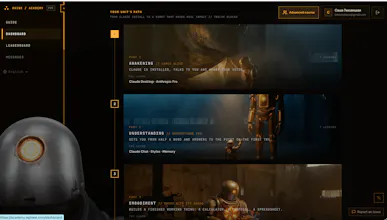
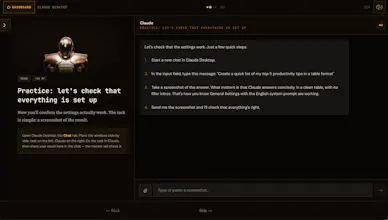
AGINE Academy makes learning Claude a story-driven game. You finish real missions inside Claude, from Desktop automations to Claude Code and your own products, with an AI mentor kept to each lesson. Every lesson leaves you a working result.



@thys_beesman Good questions. The restriction is on purpose: the moment UNIT just hands you the answer, the lesson stops teaching. Your lesson 12 because of lesson 3 case is the exact tension we keep working on. Right now the mentor stays inside the current topic, and pointing people back to the specific earlier lesson they missed is something we're still tightening, not something I'd call solved yet.
On shipping: every lesson ends with a working result you build right there, so the making happens as you go, not after. The bigger things people mentioned, like the review auto-reply bot or the scheduled morning briefs, are what folks grew out of those building blocks on their own projects. So the core skill is built lesson by lesson inside the game, and the ambitious stuff is where they took it next.
How do the tasks get graded? An open prompt has a hundred passable answers, so if a model is scoring them, players quietly learn what the grader likes rather than what works. We ran an LLM judge over our own agent output for a few weeks and it turned out to be rewarding longer answers, which took ages to spot because the scores looked healthy the whole time. Is UNIT leveling up against a rubric you wrote, or against a model's opinion?
@dipankar_sarkar This is the sharpest question in the thread, and your LLM-judge story is exactly the trap we wanted to avoid. Progress is tied to producing a working result, something that actually runs or does the job, not a model scoring your prose. A broken automation doesn't run no matter how nicely it's written, so there's far less room to quietly learn what the grader likes. Where a model does help is hints and feedback inside a lesson, not gatekeeping the level-up. We're still hardening this, so if you've got war stories on rubric design I'd genuinely take them.
Learning by doing through a story format is a smart way to lower the intimidation factor of picking up Claude. How much of the "story" adapts based on what the learner actually does, versus being a fixed narrative path?
@ark_y_k The arc is a designed path: you move UNIT from installing Claude up through Projects, connectors, Code, and building your own stuff, and that order is fixed on purpose because sequence matters when you're learning. What adapts is the material. Every mission runs on your own real task, not a toy example, so two people finish the same lesson with completely different working results. The story is the rails, the work is yours.
@konstantin_konovalov1 A fixed sequence makes sense pedagogically — jumping straight to "build your own stuff" before understanding Projects/connectors/Code would probably leave people missing context they need later. Sounds like the design trusts the process over letting people skip ahead.
Story-driven learning for AI tools is actually smart approach, way more engaging than docs or tutorial videos. Is the content focused on Claude specifically or will it cover other models too?
@abdurrahman_fakhrul It's built specifically around Claude, so the tasks use its real features (Projects, connectors, Code, artifacts) instead of staying generic. The underlying skill, briefing an AI clearly and checking what it hands back, carries over to any model. But we went deep on one tool on purpose instead of shallow on five. It's a lot easier to get a real win when every step lines up with the same system.
Learning-by-doing through a story framework is a smart way to teach something as open-ended as agentic coding — most tutorials just walk through static examples that don't transfer well to real, messy codebases. I've been building my own product with Claude Code this month, and the actual skill gap isn't syntax, it's learning to write context-rich prompts and briefs. Curious how much of the game focuses on that "how to talk to the agent" skill versus more traditional coding concepts.
@abhineetarora You just named the whole point. The game leans way harder on how to talk to the agent than on syntax. Almost every mission is you writing a real brief, seeing what Claude gives back, and fixing the brief, not memorizing coding concepts. The Claude Code part is in there, but even there the thing we drill is context and intent, which is exactly the gap you hit building your own product this month. Out of curiosity, what tripped you up more, writing the brief or knowing when to stop trusting the output?
@konstantin_konovalov1 Honestly, writing the brief was the harder skill to build, and it's not close. Trusting/not-trusting the output became fairly intuitive once I had a clear enough spec to check against — if the brief was tight, I could tell immediately whether the output matched intent. The failure mode I kept hitting early on was vague briefs producing technically-working code that solved a slightly different problem than I actually meant, which is worse than an obvious failure because it looks fine until you dig in. Once I started writing explicit "what NOT to change" sections and exact file paths/branch targets, that problem mostly disappeared. Sounds like your game is teaching exactly the right instinct — the specificity of the ask matters more than almost anything else.
@abhineetarora this is the most useful kind of feedback, thank you. That exact failure mode, a vague brief producing code that works but quietly solves the wrong problem, is what a lot of the missions are built around. The "what NOT to change" habit and naming exact files and targets gets drilled early, because it's the cheapest way to turn a fuzzy ask into something you can actually check the output against. Sounds like you got there the hard way on your own product, which is honestly the best teacher there is. If you ever poke at the game, I'd genuinely like to hear whether the later missions line up with how you arrived at it.
Are these prompt design challenges?
@carlos_mendez16 Partly, yeah, but they lean less on "write the perfect prompt" and more on "get a real thing working." Each mission has a concrete outcome, an automation that runs or a tool you keep, and the prompt work is what gets you there. So it's prompt skill in service of a result, not prompting as a puzzle for its own sake.