Bruce gives AI coding agents the cross-repo context they can't see on their own. An open-source CLI, backed by a hosted dashboard, Bruce tracks breaking changes across your APIs and databases and tells whichever agent is about to touch affected code exactly what broke, how severe it is, and what to do instead — called mid-task, a tool that fits to the existing development workflow when using AI.
Hey guys,
I'm excited to finally share a side project I've been building.
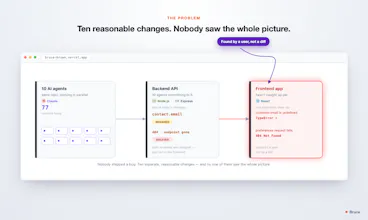
Backstory: this started with a friend who was running ten AI agents in parallel on their startup's codebase — something like a hundred commits a day. Genuinely impressive throughput. But two of those agents, working independently on the same day, made two unrelated changes: one renamed a field the frontend depended on, the other deleted an endpoint the frontend was still calling. Both changes were reviewed and shipped correctly — nobody did anything wrong. The frontend just broke, twice, in front of a user, because nothing told it either time.
AI coding agents have made this dramatically more common. Not because the agents write bad code — because the volume of change any one person, team, or department can now produce is enormous, and the blast radius is often bigger than any single agent's context window can hold. What's missing isn't code-writing ability. It's awareness of what else depends on the thing you're about to change.
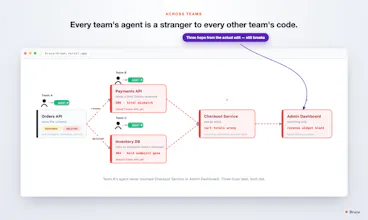
Your agent usually can't see the full effect of what it just changed — not every repo is in its context, it often has no visibility into your database, and third-party APIs are a black box entirely.
And even in the rare case where it could see everything, actually tracing every cascading effect by hand takes real time — time an agent mid-task won't spend unless something explicitly tells it to.
That's why I built Bruce: an open-source CLI, backed by a hosted dashboard, that your AI agent can call mid-task. It tracks breaking changes across your APIs and databases, and tells whichever agent is about to touch affected code — precisely — what broke, how severe it is, and exactly what to do instead. Not a changelog to read. Not a wiki to search. A direct answer, scoped to exactly the fields that matter, delivered the moment it's about to write code that depends on them.
Would love for you to try it and tell me where it breaks.