
ClawTeams
The first goal-driven, proactive AI team for e-commerce
1.4K followers
The first goal-driven, proactive AI team for e-commerce
1.4K followers
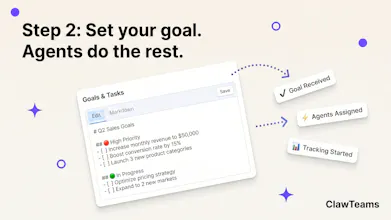
ClawTeams is an AI employee platform for e-commerce sellers. Instead of hiring specialists—or doing everything yourself—you get a coordinated AI team that thinks, plans, and executes like real employees. One goal. One team. Zero micromanagement. Tell your team lead what you want—"Increase Q4 revenue by 20%"—and they break it down, assign specialists, and run the plan. You get updates in Slack or Discord. High-stakes decisions wait for your approval. Everything else just happens.




Free Options
Launch Team / Built With


Framer AI AgentsDesign and publish professional sites with AI
Promoted


Hey Product Hunt! 👋
I'm Steven Cen, and today we're launching ClawTeams — an AI team platform
built specifically for e-commerce operators.
The frustration that led to this: we kept seeing smart sellers use AI tools and still
end up doing all the coordination work themselves. They had AI assistants — but they
still had to be the manager. That's exhausting.
So we built ClawTeams around a different idea:
→ You set the goal. The AI Team Lead manages the rest.
Get 800 bonus credits ($8 value) with your first top-up of any amount. No minimum required.
We'd love your feedback — especially from sellers who've tried other AI tools and hit
walls. What made you give up on them? What would make an AI team actually useful?
@s_cen To answer your questions, I lose interest when using the tool feels like another job, if I spend more time using the AI than the work then I just stop using it. However, I like what you're solving so I'm wondering if your users noticed that they're saving time by using your product.
the approval-boundary answers in this thread are solid, but they're all about controls you set. the risk I don't see addressed is the platform side - Amazon/Shopify etc flag bulk automated listing or pricing changes as suspicious and can suspend a seller account over it, independent of whether the change itself was a good idea. does ClawTeams rate-limit or pace its actions to stay under those platform-level detection thresholds, or is that entirely the seller's problem to monitor?
@s_cen that's a genuinely thoughtful answer, the staggered timing + auto-backoff on 429s is the right instinct. one thing I'd add to your radar if it's not already there: since account history/IP reputation is unmodelable per your own answer, would it be worth ClawTeams flagging when a seller's account looks "young" or thin on history, and defaulting to more conservative pacing there automatically, rather than applying the same rate logic to a brand new store as a 5-year-old one with deep trust built up?
@s_cen @galdayan That's a sharp suggestion and honestly a gap worth closing — since account age/reputation is the unmodelable part, defaulting new or thin-history stores to more conservative pacing automatically (rather than applying uniform rate logic) is the right instinct. It's going on our radar as a concrete next step for the pacing engine. Really appreciate you pushing the thinking here.
@s_cen @tony_tan10086 glad it's useful, and one more thought while it's on the radar: consider surfacing that conservative-pacing mode to the seller as a visible state, not just a backend safety mechanic. "new account, we're pacing carefully for the first two weeks" builds trust with the seller instead of just quietly throttling them and having them wonder why things feel slower than expected. the alternative is a support ticket from someone who thinks the tool is underperforming when actually it's protecting them.
The per-action approval controls look well thought through. The harder problem with goal-driven agents is the goal itself: "increase Q4 revenue 20%" can be hit in ways you'd hate — deep discounts that gut margin, or heavier email that lifts this month's revenue and burns the list next quarter. Each step can look low-risk and pass its guardrail while the sum quietly optimizes the wrong thing.
Curious whether the Team Lead is measured only against the stated goal, or against guardrail metrics too — a margin floor, a send-frequency cap, brand constraints — so it's steered away from technically-correct-but-bad paths, not just blocked on individual high-stakes actions. That constraint layer feels like where the trust actually lives. Congrats on shipping, Steven.
Congrats on the launch, the goal decomposition flow is clean.
The question I keep coming back to with agent teams is what the team lead remembers between runs. Planning is the easy half. The expensive half is not re-litigating a decision a specialist already made last week, and not acting on stock numbers that went stale two runs ago.
Does the team carry state forward across goals, or does each new goal start from a clean context?
I run a small fleet of Claude agents that operates my own product (eng, QA, growth), so this is close to home. The problem that bit me wasn't planning or approvals — it was rule drift: every incident adds a constraint to some agent's instructions, and months later the rules contradict each other in ways no single edit caused. Does ClawTeams reconcile new seller-added constraints against existing ones, or does the Team Lead's rulebook just grow? Congrats on the launch.
@mystoryland Great question, and you've named the real failure mode — rule drift is exactly the kind of thing that creeps up silently. The way we handle it today: rules and requirements are set per AI team, and when a new rule conflicts with an existing one, we flag it to you and let you decide whether to override the prior rule rather than silently stacking constraints. So the rulebook doesn't just grow unchecked — conflicts surface as an explicit decision. Thanks for the kind words on the launch!
@tony_tan10086 Conflict flagging at add-time already puts you ahead of most agent platforms I've seen. One thing my own fleet taught me: the sneaky failures aren't literal conflicts — they're rules that are each fine alone but over-constrain together. A periodic whole-rulebook review caught more of those for me than add-time checks ever did. Good luck with launch week!
@mystoryland This is a really valuable distinction — you're right that add-time conflict detection catches literal contradictions but misses the over-constrained-in-aggregate case that only shows up downstream. A periodic whole-rulebook health check is exactly the kind of thing we want to add on top of the current reactive check. Thanks for sharing what worked on your own fleet — that's genuinely shaping how we're thinking about it.
@tony_tan10086 The thing that'll make or break it: keep the output actionable. A health check that says "your rulebook is over-constrained somewhere" just becomes noise people learn to skip — the one that earned its keep for us named the specific minimal set of rules to cut or reconcile, not just that tension existed. And it landed better fired right after a batch of new rules, while whoever added them still remembers why, than on a cold schedule. Excited to see where you take it.
The "self-heal first, then flag a human for hard blockers" split you described to Priya is a good pattern, I ended up at a similar split building an AI Chief of Staff for founders running more than one business, except mine is read/advise-only rather than action-taking. The rule-drift question from Olga is the one I'd push on further though: even with conflict-flagging at add time, over-constrained-but-individually-fine rules are the harder failure mode, and they don't show up until something downstream breaks. Do you do any periodic whole-rulebook health check, or is it purely reactive to the next conflicting rule someone adds?
@stacywycof83995 Great question, and you've put your finger on exactly the gap. Right now our conflict detection is reactive — we validate the whole rulebook for conflicts whenever a new rule is added, but we don't yet run a periodic whole-rulebook health check. You're right that the over-constrained-but-individually-fine case is the harder failure mode, since it only surfaces downstream. That's genuinely on our radar as a next step. Would love to hear how you're thinking about it on the read/advise side of your Chief of Staff product.
@tony_tan10086 Good question. Since I'm not action-taking, my version isn't scheduled, it's more that priorities re-rank against the full current state every time instead of trusting yesterday's flags. Where it's bitten me: a founder's "always flag X" rule for one business quietly overriding the real priority from a different business, each one fine alone, bad in combination. I lean toward continuously re-evaluating the whole set rather than only on new-rule-add, cheaper for me since I'm not executing anything if I get it wrong. Curious if a lighter periodic pass, weekly instead of real time, would be worth the compute for you given you actually have to act on it.
@stacywycof83995 This is really helpful, thank you. Since we do act (not just advise), a continuous whole-set re-evaluation is heavier for us — so a lighter periodic pass (weekly, or triggered after N rule changes) is probably the right trade-off, giving us most of the drift-catching benefit without re-evaluating on every run. Your "always-flag-X for one business quietly overriding another's real priority" example is exactly the failure we want to catch. Appreciate you talking through the economics of it.
The goal-driven framing makes sense for e-commerce where outcomes are measurable. What I would want to understand before running this on live inventory: when multiple agents work toward the same goal — say, repricing aligned with a marketing campaign — how do they coordinate? Is there a shared workspace where agents see what the others have done, or do they operate independently and a supervisor layer reconciles outputs before anything gets pushed to the store?
@noctis06 Great question — and coordination is exactly where a lot of multi-agent setups fall apart. It's the supervisor model: agents don't push to your store independently. The Team Lead maintains a shared workspace where every specialist's output is visible, and it reconciles conflicting actions (e.g. a repricing move against a campaign discount) against your goal and guardrails before anything goes live. So repricing and marketing stay in sync rather than fighting each other, and store-facing changes only happen after that reconciliation step — with high-stakes ones waiting for your sign-off.