
Launching today

Devaito
Build, launch, and grow your business on autopilot
243 followers
Build, launch, and grow your business on autopilot
243 followers
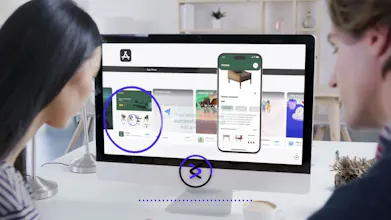
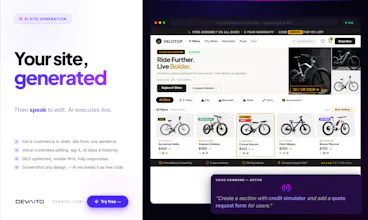
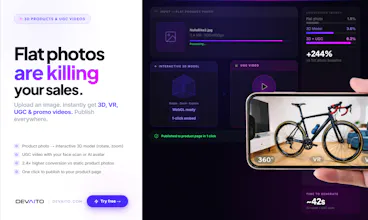
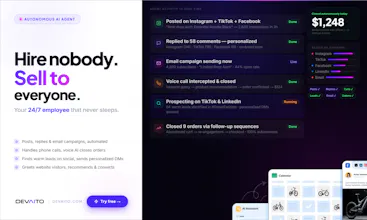
Describe your business and Devaito launches the essentials for you: website, store, mobile app, SEO, blog, social media, customer support, and sales automation. Unlike traditional site builders, Devaito doesn’t stop at setup. AI agents keep working behind the scenes to help you attract customers, answer questions, create content, and scale without adding more tools.



Hey Product Hunt 👋 I'm Symo, founder of Devaito.
I ran a digital agency for years. Every week, someone walked in with a brilliant idea. They needed a website, a brand, a store, an app, SEO, marketing. I'd quote them weeks of work and thousands of dollars. I'd watch their face drop.
I didn't lose clients. I lost believers.
That's the day Devaito started. Not as a company, as a promise: no one should ever need permission, money, or technical skills to bring their idea to life.
Today, you describe your idea. AI plans everything, site, store, app, branding, SEO, content, marketing, sales, support. You review. You approve. AI executes. You stay in control, AI does the work. 24/7.
We didn't build a tool. We gave every idea the power to become a business.
Dream it. Approve it. Devaito builds and scales it.
If AI could take over ONE part of your business tomorrow, what would you hand over first?
@ryanwmcc1 Fair question, the one I'd ask too.
The trap you're describing is real, and it happens for a specific reason. Most "all-in-one" platforms are really one main product surrounded by add-ons. A site builder plus a mail app plus a CRM plus a support widget, all bolted on. Devaito is not built that way. It is one system that shows different surfaces. The site, the store, the support, the content are not separate products connected by APIs. They are views of the same underlying business logic. That is why improving one improves all. It is also why a single surface cannot quietly degrade without the others catching it.
3 months in, the pattern is simple. People who came looking for a better single tool leave. People who stop thinking in tool categories stay. I am not going to tell you every surface beats a specialist. It does not. What keeps users is that nothing in the stack talks past itself.
That is the whole bet.
@symo Good points, thanks for explaining! And thanks for the honesty. I'll definitely advocate it for you!
@ryanwmcc1 Thanks Ryan. The “I don’t beat every specialist” point is usually where founders try to avoid the truth, and in my experience that costs more credibility than being direct ever does.
Really appreciate the signal boost, especially coming from someone who initially challenged it.
Really nice! But you say “no one should need permission or money to start”, so how do you balance that with the reality that distribution (not building which is realtively easy based on idea) is the hardest part today??
@lak7 You're right to push on this, it's the real question. Removing permission and money was the easy bet. Distribution is the actual wall today, and we knew that if we only solved "build", we'd just be generating ghost businesses nobody sees. That's why Devaito doesn't stop at the site. Content, SEO, social, email, support are part of the same system, not bolted on after. Is it fully solved? No. But it stops being the wall where most people give up.
Curious about your take though. Where does distribution actually break for most founders you've seen? Channels, voice, or consistency?
@symo I think distribution depends on many factors like luck, amount of money you are willing to spend and different channels etc. But one thing that has worked for me is definitely consistency, cause then probability of getting lucky increases. ig most founders have to be their own biggest cheerleaders and marketers
@lak7 Consistency is the most underrated answer. Most founders don't lose because the idea was wrong, they lose because they stop showing up on month 3. And you nailed the quieter part. Being your own first audience is the part no tool will ever replace.
Viseal
hi Symo, congrats for the launch. I find this concept very nice especially the readiness of ios and android app comes along with the web stores. Could you explain more about the payment part, is it also fully integrated with built-in stripe or other alternatives?
@hwellmake Thanks, glad the mobile side stood out, that took a while to get right. The app isn't a separate product, it inherits the branding, tone and content from the site automatically and stays in sync with the store, the marketplace and the POS. Same inventory, same customers, same voice everywhere.
On payments: Stripe and Paypal is integrated by default, other providers supported depending on the region, so users outside Stripe markets aren't blocked. Checkout, refunds, subscriptions and payouts all live inside the same back-office.
Is there a piece of the stack (Vocal Ecommerce app, POS, marketplace sync) you'd want to dig into more?
this is interesting - the "AI agents keep working" part caught my attention. most no-code builders dump you after setup, but ongoing automation for content and customer support could be huge. what kind of tasks are the agents actually handling day-to-day? curious how hands-off it really gets after launch.
@piotr_pasierbek Good catch, that layer took the longest to get right. Day-to-day, the agents answer customer questions with real context (orders, inventory, returns), write and schedule social posts, publish blog articles in the brand voice, run outbound on leads, and handle follow-ups that usually fall through the cracks. Not background automations, they operate with the business logic in front of them.
Hands-off works for repetitive tasks. For positioning, pricing or strategic calls, agents propose, the founder decides. "Autonomous everything" was tempting but the moment a founder feels out of the loop, trust collapses.
the all-in-one approach makes sense for solo founders who don't want to juggle 10 different tools. we've seen clients struggle with connecting their site builder to their email tool to their analytics... having everything work together from day one sounds like it could save months of integration headaches.