
dot.
The feedback layer for anything you build with AI.
169 followers
The feedback layer for anything you build with AI.
169 followers
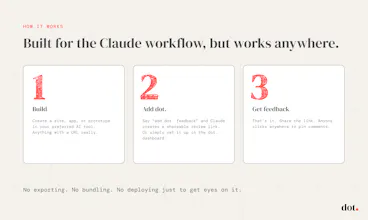
dot. is the fastest way to get feedback on anything you build. Paste any URL, or ask Claude to create a review link, then share it. Anyone clicks anywhere on the live page to pin a comment. No signup, no extension, no screenshots in Slack. Reviewers are always free.




Hey Product Hunt 👋
I'm Muni, founder of dot.
The feedback loop for most builders in 2026: build something, screenshot it, paste in Slack, type "thoughts?", get "looks good 👍", ship it, find out three things were broken. Every week.
Now everyone's building faster than ever with Claude, Lovable, Cursor, v0, but the feedback loop hasn't caught up. You still bundle files, deploy somewhere, paste screenshots, and lose all the context.
dot. fixes that. Create a project for any URL or Claude artifact, anyone can click anywhere on the live page and pin feedback. No signup, no extension, nothing to install. Built something in Claude? Say "add dot. feedback to my artifact" and dot. turns it into a shareable page, nothing to deploy. Iterate your artifact and the review link stays the same; feedback stays attached to the version it was left on.
The part I'm most excited about: dot. is in the official Claude connectors directory, trending #8 today on it, and since going live two weeks ago, 1,200+ people have connected it. Inside Claude, you say five words and get a shareable project with feedback. Build → get feedback → iterate, all in one place.
Reviewers are always free and never need an account, you only pay for the people creating and managing projects (solo or a shared team workspace).
For Product Hunt: use code PRODUCTHUNT for 1 month free on the Individual plan.
I'll be here all day, would genuinely love your feedback 🙂. What's the most broken part of your feedback process right now?
— Muni
@marcus_mark Spot on framing Marcus. dot. is designed for the pre-action signal, you build something, share the review link before shipping, and collect feedback while you can still act on it. The whole point is catching "I wasn't sure about this" before it becomes "I approved this and then it broke." That's why the no-signup reviewer flow matters so much, the lower the friction to give feedback, the more likely people actually flag hesitations instead of just saying "looks good" and moving on.
Congrats on the launch! Love the "no signup, pin anywhere" model — feels like the same instinct behind CancelKit (capture the reason right at the moment/place it happens, not a follow-up form later). Curious how you handle pin anchoring on pages that re-render client-side (React/SPA) — do you snapshot a DOM selector at pin time, or something more robust to layout shifts?
@cancelkithq Thanks Yakup! Pins use a hybrid of percentage-based coordinates and DOM element anchoring, so they hold up well across re-renders and layout shifts. The overlay runs on top of the page via iframe, so it's fully decoupled from the app's own DOM. Appreciate you checking it out!
The "no signup, reviewers just click anywhere to pin a comment" flow is exactly what kills the screenshot-in-Slack loop for me. Day-one question: when I paste a Claude artifact or URL and then ship a change to the underlying page, do the existing pinned comments stay anchored to the right element, or do they drift/detach once the DOM moves? And can I mark comments resolved or export them into a clean punch-list, or does all the feedback just live in the thread?
@leo404 Great questions Leopold. On anchoring: pins use a hybrid of percentage-based coordinates and DOM element anchoring, so they hold position well through most changes. For Claude artifacts specifically, we just shipped versioning, iterate your artifact and the review link stays the same, but feedback stays attached to the version it was left on. So you get a clean history per iteration rather than old pins drifting on new layouts.
On managing feedback: yes, you can mark comments resolved directly in the dashboard (and reply to them). Resolved vs active are separate tabs so it works like a punch list out of the box. Export isn't live yet but it's on the roadmap, appreciate the push on that!
Pinning feedback to the version it was left on is the right call — old pins drifting onto a new layout would be worse than losing them. The thing I'd hit on day two: if I iterate an artifact three times and each version keeps its own thread, how do I see what's still unresolved across all of them without opening each version in turn? Does the active tab roll up open pins from every version, or is the punch list scoped to whichever version I'm looking at?
@leo404 The active tab shows all unresolved feedback across the project in one list, and each comment shows which screen/version it belongs to. There's a version filter along the top of the feedback panel so you can scope it to just v2's open items without clicking through each version individually, for example. Exactly the workflow you're describing.
the anchoring question already got asked below so I won't repeat it. my worry is more about the "reviewers always free, no signup" model itself - if a review link leaks or gets shared outside the intended circle, what stops a public page from getting spammed with junk pins from randoms who aren't actual testers? is there any gate on who can leave feedback, or is it fully open once someone has the link?
@omri_ben_shoham1 Valid concern. A few layers of control: you can set a PIN on any review link (so only people you give the PIN to can leave feedback), restrict access to specific email addresses, or set visibility to private. By default it's open to anyone with the link, which works well for small trusted circles, but the PIN and email-gating options exist exactly for the scenario you're describing. Rate limiting on submissions is also live to catch spam bursts.
Just tried this with a landing page I'm building in Claude, said "add dot. feedback" and got a shareable link in seconds. Sent it to a friend, they pinned 3 comments directly on the page without creating an account. This is how feedback should work. The fact that reviewers don't need to sign up is a huge deal.
@tahiyat_hassan That's exactly the workflow we optimized for, build in Claude or any prototyping tool, add feedback, share, done. No deploy step in between. Glad the no-signup part landed for your friend too. Thanks for trying it out!
The no-signup reviewer flow feels right for AI-built prototypes. One thing I’d want as a builder is a tiny feedback receipt after a review: what page/state the comment was pinned on, what changed since that link was created, and whether the reviewer saw the latest version or an older artifact.
That would make comments easier to trust when Claude/v0 iterations are moving fast.
@grace_lee26 Really smart suggestion. We actually just shipped versioning for artifacts, feedback stays attached to the version it was left on, so you can see exactly what the reviewer saw even after you've iterated. The full "receipt" idea (what changed since, which version they reviewed) is a natural extension of that. Adding it to the roadmap. Thanks Grace!
Interesting idea.
Do you think AI products need continuous user feedback built in from day one, or only once teams start scaling?