


Customer.ioAutomate Messaging Everywhere — Startups Get 12 Months Free
Promoted

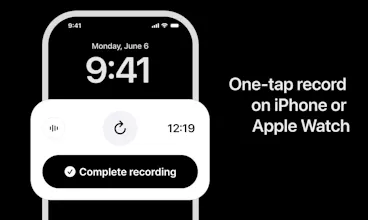


the framing of "one repository" for conversations across contexts is the useful part, most notetakers only cover video calls and leave in-person meetings as an afterthought. using the Watch as the recorder means you're not fumbling with a phone on the table, which actually changes whether people forget it's recording at all
would like more visibility into what happens to the audio after it's recorded, especially for meetings with people who never agreed to be recorded. a quick heads-up mode or auto-disclosure prompt when Ellis detects it's picked up a new voice would make it easier to actually use in group settings without having to explain it every time

👋 Hey Product Hunt!
I'm Robin, creator of Ellis — a personal AI notetaker for in-person meetings.
What is Ellis?
Ellis is a simple consumer-first AI notetaker (iPhone and Apple Watch) for in-person meetings. It works anywhere being in the same room matters: coffee meetups, on-site sales meetings, therapy, doctor visits, interviews, or even your teacher-parent conference.
When the meeting ends, Ellis matches your voice against your saved voice profile, gives you a full transcript with an easy way to assign speakers, and writes notes in the format you pick.
Why Ellis? 🤔
Unlike other notetakers that are built for your org, Ellis is built for you as an individual. You can record lots of different in-person conversations, ask questions across them, and find common traits and trends spanning both your professional and personal contexts. Yes — I might want to know how my sales meeting went AND how I navigated a difficult conversation with another caregiver. Two different use cases, but one repository, built for me.
Key features 🤩
Getting "who said what" right. Telling speakers apart in a real room is harder than online — every voice hits the same microphone. Ellis solves this with voice enrollment and diarization, plus a fast way to tag yourself and others.
Ask anything about a conversation. Pull up what was said, decisions made, or anything you want to revisit from a meeting — just ask.
Find it by place. Forgot a name or a detail? Ask by location — "what did we agree on during our walk in Fort Greene?"
Private by default. Recordings are automatically deleted once transcription is complete.
Happy to answer questions — and I appreciate the support. 🙏

@robingreenwood Meeting notes that actually capture context is gold. Are you using transcription + summarization or something smarter? Curious if users trust it more for action items vs general notes.

@robingreenwood What makes this better than Evernote?

the noisy-room questions are all covered, mine's about consent instead - you list therapy and doctor visits as use cases, which means the other person in the room is being fully transcribed and analyzable without necessarily agreeing to that. recording is auto-deleted but the transcript sticks around indefinitely. a lot of US states are two-party consent for recording, does Ellis do anything to prompt "hey, tell the other person" or is that entirely left to the user's judgment
@galdayan yes! I'm adding an info message before the start of each recording to remind users of consent. I live in Germany, where it's even more pressing :)
When it comes to therapy in particular, I've found that many therapists actually recommend their clients to take notes/record. But that's a very trusted relationship.
Do you have specific thoughts here?

@galdayan @robingreenwood I think the useful move is making consent part of the recording flow, not just a reminder before it. For sensitive contexts like doctor visits, therapy, caregiving, or interviews, I’d trust it more if each recording began with a simple “I have permission to record this conversation” confirmation and then kept retention/deletion settings visible after transcription. The recording disappearing is good, but the transcript is still the durable memory, so that layer needs to feel just as intentional.
@galdayan @robingreenwood Yes, something in that direction, but I’d make it per recording rather than a general toggle that stays on. Before capture starts, the app could ask for a simple permission confirmation for this conversation, and after transcription keep deletion and retention controls visible on the transcript. That ties the consent moment to the durable note, not only to the audio recording.

The noisy-room question has a nastier cousin: true overlap, two people talking at the same instant. Diarization picks one speaker per frame, so the quieter voice doesn't get mislabeled, its words just vanish, and nothing in the transcript tells you a sentence went missing. That's harder to catch than plain noise because the output still looks clean. When people talk over each other in a fast brainstorm, does Ellis mark the overlap or just pick a winner?
@dipankar_sarkar ooh this is a great question. Short answer: Ellis just picks a winner. Diarization returns one speaker + text per utterance.
I'm really curious though, for you is this a problem worth solving using tech or meeting cadence? in other words, does this frequently come up?

The in-person angle is what sets this apart, but recording therapy or doctor visits is also where the privacy question gets sharp. Does the audio and the diarization run on-device, or does the recording get uploaded to a server to transcribe and match against my saved voice profile? And since everyone else in the room never installed the app, is anything about their voice retained, or is it all local to my phone?
@hi_i_am_mimo Short answer: server. Nothing about other speakers' voices is retained.
I see you have an interest in local-first apps and privacy. Curious, would this be a non-starter for you? Thanks!
Honestly, server-side is not a non-starter for me on its own — what decides it is the boundary. Given nothing about other speakers is retained, the two things I would want to verify: is my own audio deleted once the transcript exists, or kept for model training, and is the transcript encrypted at rest so only I can read it? A clear processed-then-discarded policy I can actually check is workable even without full local-first.

How well does the speaker identification actually hold up in a noisy room with overlapping talk? Wondering how often I'd need to go back and manually fix who said what.

@luki_notlowkey I'm using AssemblyAI which models are getting better and better. Do you attend conferences?

Love that you're focusing on in-person meetings
Most AI note takers are optimized for virtual calls. Being able to capture discussions with just an iPhone or Apple Watch feels really convenient. Curious, how well does Ellis handle noisier environments like conferences or busy cafés?
@worksforme well, and getting better. Using AssemblyAI under the hood. Curious about your conference use-case. Have you tried other notetakers in the past?


Ellis
Thanks for your review @omri_ben_shoham1
Just to make sure I understand, is your main ask that the app detects other speakers in real-time during a meeting, and prompts the user to ask for "new" consent?
To answer your question here, the audio is deleted as soon as transcriptions are set. Speakers are identified as anonymous others, unless you edit their names.