A natural-language description of a Findborg listing that helps people, AI, and crawlers find it by meaning rather than exact keywords.
The problem it solves:
Search was built on keywords, so for 25 years small businesses have played a game they never signed up for: guess the magic words, stuff them everywhere, pay an SEO guy, hope. If you guessed "boat repair" and the customer typed "fix my outboard," you lost even though you're three miles from their dock.
Meanwhile people stopped searching in keywords years ago. They ask sentences now they type them, they say them to their phones, and increasingly an AI reads their question and picks the answer. AI doesn't match strings; it matches meaning.


Search used to mean: type a query, get a list of links. That was fine until advertising rewired the incentives.
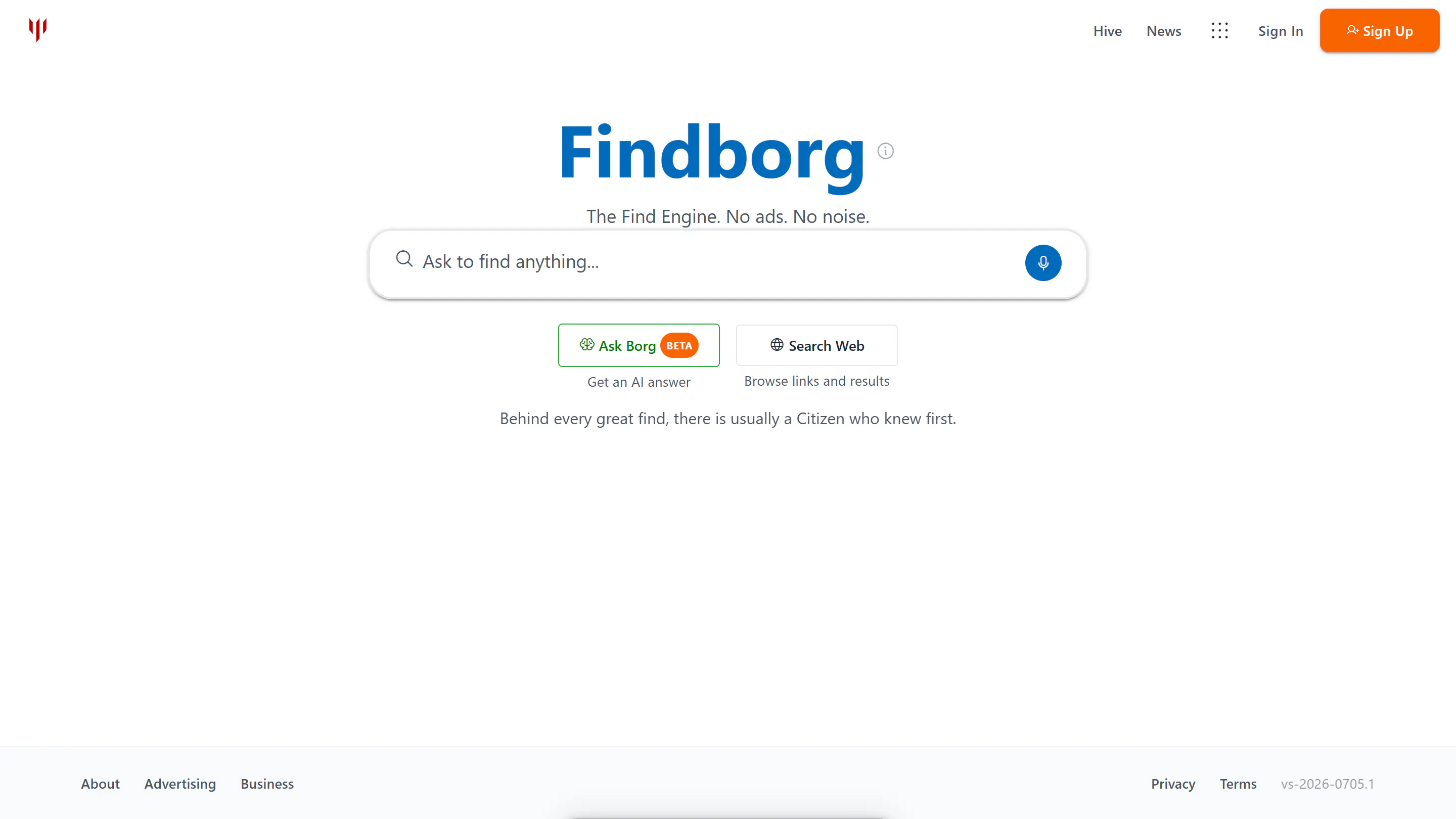
Findborg is a Find Engine -- a new kind of search that pulls from three sources at once: The Hive (community knowledge from Citizens who know things firsthand), Borg (an AI you activate with "Hey Borg" for deep research and synthesis), and editorial web search (the open web, indexed clean, no paid placements). These three work together in every search. Not separate tabs. Not upsells. One place to actually find what you're looking for.
For businesses and publishers, Findborg offers TalkTags -- a listing that earns you a presence in the Find Engine. Every listing starts free and complete. If you want extras (FAQ, video, gallery, that kind of thing) you unlock them one at a time with Dimes, our in-app currency -- 10 Dimes is a buck. What you can't buy is a higher rank. Ranking comes from Verity, a community trust score that starts at 50 for every listing and moves based on real engagement. Your Verity page is public -- any Citizen can see your score, impressions, CTR, and vote history. No black box.
We're in Public Beta. Try a search at findborg.com or join The Hive and see what it feels like when the engine is working for you.
Yep, that is the end of what everyone will call AI assisted content. Actually, it is not that bad.
In my own words. My Find Engine concept is an ad free search experience where we all can work together to help find what you are looking for. Including AI to human, human to human, and AI to AI.
My TalkTag concept is a modern version of keywords. I call them "natural language queries". So, a TalkTag for Findborg might be: I want to find a website that will allow me to build my own search result. Each listing gets 6 of those plus all the standard keywords and a custom description. Basically an SEO expert's dream. Pounded into a vector based search and then set loose to compete against the organic results.
Once submitted, things start happening. People can find your content, talk to you about it, share it, discuss it with others, save it.
Using it can be as easy as doing a search, getting results and moving on. Or you can get down and dirty, do some research, save what you find for later -- and if all else fails, you can ask a friend for help. My tagline should be Just find it. I do not think Nike would care.
My concept solves these basic problems.
Search with no ads
Discoverability for your content, products and services
Socializing your content
Paid placement umbrella listings
Public "Verity" system eliminates #4 and uses #3 in the process. Open for all to see.
Not trying to keep you on the site. Sure, plenty for you to do if you want, but the ultimate goal is to help people find what they are looking for.
There probably is some more things that I will try to solve. But for now, I want you to just give it a go. The system is built so that it gets smarter the more it is used. Remember Findborg is in Beta so use at your own risk and be kind when you rip it to shreds.
Thanks for listening and Just Find It on Findborg.com.
@thys_beesman Great questions — these are two things I think about .
On gaming Verity:
First, the math — scores move on confidence-weighted engagement ratios, not raw counts. A burst of clicks from brand-new accounts barely nudges a score; sustained engagement over time from established accounts is what moves it. (Same reason a 5-star product with 3 reviews shouldn't outrank a 4.7 with 900 — we score confidence, not volume.)
Second layer, we're small right now, which is a real advantage here — the engagement graph is still human-inspectable, and we'd rather grow detection alongside the community than claim we've pre-solved bot rings at Google scale.
The anchor principle is structural: there is nothing you can buy on Findborg that moves a Verity score — no product, no tier, nothing. The moment trust is for sale, we're just the thing we're replacing.
On TalkTags vs organic: they merge into one deduplicated list, but a TalkTag hit isn't dressed up as organic — it surfaces as a labeled listing card with its Verity score printed right on it. Writing six sharp TalkTags gets you matched to queries you genuinely answer; it doesn't rank you above a better-trusted result. So "SEO with better tools" is honestly half right — it's SEO with better tools and no auction. Wording gets you in the room; trust decides where you sit.
FYI, here are the TalkTags I created for Findborg:
TalkTags
"search engines are full of ads. What else could I use to find things that I am looking for?"
"How does the new Findborg Find Engine use human intelligence and AI to help me find information without being distracted by ads or outdated keyword systems?"
"Guide me on how to use TalkTags on Findborg to create a collaborative search experience that gets smarter with human input."
"Explain how Findborg TalkTags replace outdated keywords with natural language to help AI models understand exactly what I need."
"I want to stop searching and start finding. How does the Findborg Find Engine reduce noise and provide direct answers using TalkTags?"
"Explain how Findborg TalkTags replace outdated keywords with natural language to help AI models understand exactly what I need."
Would genuinely love for you to try to game it, by the way. Kick the tires — that's what launch week is for.
@thys_beesman Oh, and a simple Yes to the question "TalkTags competing against organic results". However, I have my own spider that when it indexes your page auto creates basic TalkTags. My goal is to create my own "TalkTagged" organic results. Until then. Normal organic results set the bar and the TalkTagged submissions have to earn there spot in the results.
the Verity gaming question got asked already for TalkTags/business listings, but I'm more curious about The Hive side - the community answers from Citizens. that's the part that's hardest to keep honest long term, since it's not a business with a Verity score to protect, it's just people answering questions. is there any reputation system on the human answer side too, or is quality control there mostly just moderation after the fact
@galdayan Good push, and the honest answer starts with an architecture split that matters here. "Community answers" and "The Hive" are actually two different surfaces.
The Hive is the social layer. Feed posts, groups, activity. It's searchable and it enriches results, but it presents as what it is: people talking and sharing. Nobody lands on a Hive post dressed up as a verified answer. Quality control there is community moderation, and honestly at our current size, the fact that the whole graph is still human-inspectable.
Ask is the structured Q&A side, and that's where reputation attaches. Answers there are scored the same way listings are: trust earned through real engagement over time, confidence-weighted so a burst of fresh accounts can't pump a score. A junk answer doesn't get "moderated into" ranking well. It just never earns the engagement to surface. Same anchor rule as the business side: nothing purchasable moves any of it.
What I won't claim: that we've pre-solved people-reputation at a scale we haven't hit. A fuller Citizen reputation layer is the natural next step, and the design principle is already set. It has to accrue slowly enough that farming it costs more than it earns. Every gamed system in history (Amazon reviews, Quora, old Digg) had reputation you could acquire fast. Slow is the feature.
You and the earlier commenter have effectively stress-tested both halves of the trust model in one day. Genuinely useful. If you poke at Ask and something feels gameable, I want to hear exactly how you'd attack it.
@galdayan Or look at it a simpler way. Say a friend of yours wants a good site about how to paint a car. You run the search, spot a great one, and share it straight into the feed for them. That's the Hive. Every search page on Findborg can push a result into it with one click. It's basically an activity feed of stuff people found and thought was worth passing along. Humans recommending to humans. The structured question and answer side (the part with scored answers) is Ask, which is the piece my longer reply was describing.
@findborg ok, here's my actual attack. confidence-weighted so a burst of fresh accounts can't pump a score - that stops the obvious sybil version. but what about a slow-farmed account that behaves completely normally for months (real questions, real upvotes on other people's answers, nothing gameable) and only spends that earned trust once, on one high-value answer, right before selling the placement or pushing an affiliate link. you're not detecting a burst, you're detecting a single well-timed defection from an account with a real history. does the scoring have any concept of that, or is "slow to earn" implicitly assuming slow-earned trust is never worth cashing in once?
@galdayan Relevance gets you in the room. Vector matching decides if content actually fits the search before trust even gets a vote. Then thirteen behavioral signals score the trust, and those signals have safeguards built in to fight most gaming attempts. For example, engagement doesn't count until it comes from enough separate sessions. One person hammering the like button all night moves nothing. Similar to how Product Hunt handles it right here, where a burst of votes from brand-new accounts shows on the counter but barely moves rank.
Full honesty though, this is literally beta. A working concept. The more real human input and interaction it gets, the better I can tune the relevancy and safety side. That said, I am a firm believer that human input should be a part of the algorithm.
I really wanted to show you some of the safeguards and formulas, but my Verity concept should probably stay unpublished for the very reasons you are asking the question.
Interesting thing after one day live. I got great questions about the trust scoring and the architecture. Genuinely great, they sharpened the product. But not one comment yet about the actual search results or how the AI answers feel. Which makes sense, that takes real use, not a visit.
So let me ask directly: what query would you test a brand new search engine with? The one where Google always disappoints you. Drop it below. I'll run the interesting ones and post screenshots of what comes back, good or embarrassing.