
AI YC interview with Gstack agents
AI specialists that join your Google Meet and gives feedback
180 followers
AI specialists that join your Google Meet and gives feedback
180 followers
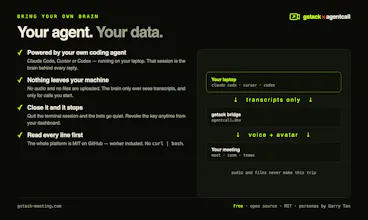
Garry Tan's open-sourced gstack specialists — CEO, CSO, QA Lead, a YC-office-hours partner and 15 more — join your real Google Meet as voice bots with 3D avatars. They open in-persona, take turns, critique your shared screen out loud, and drop notes in chat. Free, MIT, and the brain is your own coding-agent session. Built on AgentCall.


@anand_balakrishnan5 This looks awesome. Congratulations on the launch and best of luck with the momentum! 🚀
The local brain running on your own machine is the detail that actually matters here — most meeting AI tools quietly route everything through their infrastructure and call it 'private.' The open MIT license on the personas is a nice architectural choice too. The part I'd dig into as a developer is the AgentCall API: when I bring my own agent into a call, does it receive raw transcript chunks in real time, or does gstack buffer and parse before the agent sees anything? The latency and chunk boundary design determines whether a custom agent can stay coherent during a fast conversation.
@hi_i_am_mimo This project code is available in Git. GStack skill is also available on GitHub. You can analyse the code and run it locally on your PC. You can also just ask your claude code to use agentcall.dev skills (available on git) and gstack from Garry to join the meeting. And it should work well.
If you want to run it completely private on your own PC, use heyski.io to talk to claude code completely on your PC. AgentCall streams the transcript from its own services in realtime and doesn't retain data unless asked explicitly to. Else it is in-memory and discarded after each call ends.
Realtime streaming with in-memory only and discard-on-call-end is the right call for a privacy-first tool. The in-memory model means the latency question I had mostly answers itself: if chunks stream live, a well-implemented custom agent can respond in near-real-time without waiting for a full parse. Practically useful to know. The heyski.io path is interesting too, fully on-device speech plus local Claude Code session closes the last external hop. One follow-up: for the shared-brain case where multiple gstack personas are in the same call, does the transcript stream to all agents simultaneously, or does one agent act as a relay that forwards relevant chunks to the others?
Having agents critique a shared screen in real time is a strong idea. Can each persona retain context across multiple meetings, or does every call start fresh?
@adityaharish2002 Brain is your Claude Code session. If you resume the same session, it will retain all the previous context.
@anand_balakrishnan5 Nice, very cool product, great work!
the local-brain / no audio leaving the laptop detail is what would actually get this past a company's security review, most tools in this space cannot say that honestly. curious about the live-meeting etiquette side though - when a persona jumps in to critique the shared screen out loud, how does it know not to talk over an actual human who started speaking at the same moment. is there a turn-taking signal or does it just wait for a pause
@omri_ben_shoham1 For a completely local experience, install the gstack skill in your claude code and the heyski.io voice, which will let you talk completely local and on-device.
In gstack x agentcall.dev, the brain is currently shared by the agents in the demo. So, they know when someone else is speaking. It is also possible to have individual brain for each agent. In that case, there is barge in prevention in the agentcall skill, which will prevent the interruptions properly.
Hey all 👋
Quick update: we’re seeing heavy usage and the shared brain pool is currently at capacity.
For now, please clone the repo, create your own brain, and run it locally.
Also, this is a self-learning agent. If you run into problems, just ask it to resolve them and it will work on fixing them.
Interesting idea...slightly robotic to begin with....but it does provide value.