
Hemory
Keep listening. Searchable memory for your AI agents.
640 followers
Keep listening. Searchable memory for your AI agents.
640 followers
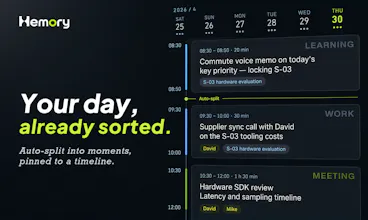
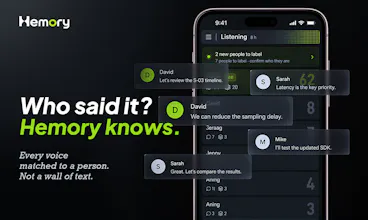
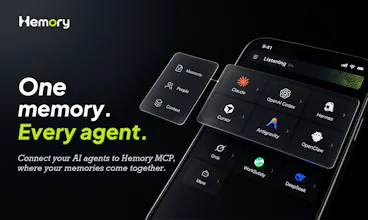
Hemory comes from Hear + Memory. It's not meeting transcription: Hemory listens on the phone or Apple Watch you already own, and keeps every conversation as memory. Your day is auto-split into moments with speaker labels, then settles into a private, searchable memory. Connect it to Claude, Codex, Cursor, or any agent over MCP, and your AI finally has real context to revisit what you heard and build on it.
I’m Yingqi, founder of Hemory.
I spend half to two-thirds of my workday in meetings, yet I kept forgetting to start recording—or leaving it running and ending up with several conversations merged into one giant transcript. Even with meeting summaries, piecing together what we’d discussed across different days was still manual work.
So we spent nine months building Hemory: continuous listening that turns everyday conversations into searchable, reusable memory.
Here’s how it works:
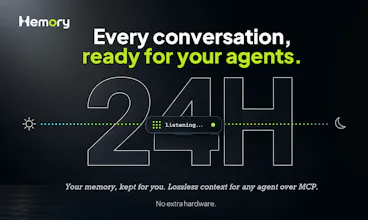
- Listen for up to 24 hours: Start with one tap and keep listening in the background with Max.
- Conversations organize themselves: Hemory separates conversations by activity in real time.
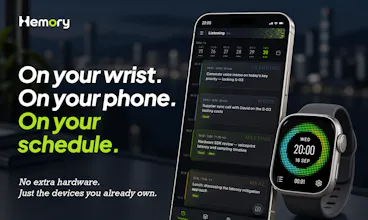
- No extra hardware: Use the iPhone, Android phone, or Apple Watch you already own.
- Give your AI real context: Connect Hemory to Codex, OpenClaw, or other compatible AI tools through MCP.
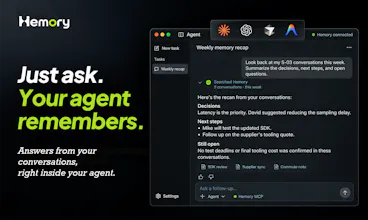
The moment it clicked for me was asking Codex to work with those memories:
“What interesting things did you hear yesterday?”
“Write my half-year review based on what you’ve heard.”
“Pull together our pricing discussions from this month.”
Watching it connect conversations across time and turn them into useful work gave me goosebumps.
Only detected speech counts toward your usage quota.
Our mission: remember what you’ve said and heard—and give your AI the context it needs to help.
Try Hemory at hemory.com, and tell us: what would you ask an AI that remembered your conversations? I’ll be here in the comments all day.
Thank you for your support! If you'd like to learn more about our story, here it is: https://www.hemory.com/blog/why-hemory/
@wang_yingqi looks incredible, how well does Hemory handle distinguishing between multiple voices in a crowded room?
@priya_kushwaha1 Thanks! The iPhone and Apple Watch mics pick up sound really well. In a normal meeting room with 6-8 people talking, speaker separation stays clear.
Listen for a day → connect your AI → ask anything.
@wang_yingqi Curious how this feels after a month of use. Does the searching old conversations stay the fast and accurate??
Congrats launch team!
@vipul_kumar1280
I'm months in, on by default every working day, and the opposite of what you're worried about happened: the older it gets, the more useful it gets. Yesterday's conversation is just yesterday's conversation. What still surprises me is pulling a decision from four months ago and getting who said it and why they said it. One honest note: retrieval is keyword + time, and your AI does the connecting. It stays fast because nothing has to be re-summarized — the actual words are still there, instead of somebody's compressed version of them.
@wang_yingqi nice launch! i like the idea, but I'd probably keep it off most of the days only use it during work hours, a really good scheduling experirnce would matter of a lot to me....
@amrita_prajapati2 That's exactly how I run it — I set my working hours and it minds its own business outside them. I'll go further: you should keep unrecorded space. Some of my best thinking happens on a walk with nothing listening, and a tool that demanded all 24 hours of me would be a worse tool. Scheduling isn't a checkbox we added late; it's the setting most of our team actually lives in.
That's great! I have two questions. I use an iPhone:
1. How well does the phone get hot and how much does it drain the battery?
2. Will recording be interrupted when other apps use the microphone?
@yongqiang_zhou Thanks for the great questions!
On my iPhone 17, 12 hours of listening uses about 20% more battery than usual, and neither the phone nor the watch gets hot. On an Apple Watch Ultra 3 with other notifications turned off, I still have over 50% left after 12 hours.
Yes, calls or video meetings can take over the iPhone mic. That's where the Apple Watch shines, since it keeps listening on its own mic.
@yongqiang_zhou Thanks for asking! On heat and battery drain, I’d want to give you measured results rather than guess a percentage. Which iPhone are you using?
And yes, a call or another app taking over the microphone can interrupt recording. Hemory alerts you when that happens and tries to resume automatically once the interruption ends. You can also tap the notification to resume. There will be a gap while the microphone is unavailable.
Congrats on launch! Continuous listening is interesting, though privacy would be the first thing I’d want to understand.
@sandy_liusy Thanks so much! Privacy is a top priority for us. By default, we don't store any of your audio files, and you can turn listening off anytime with one tap.
@wang_yingqi Got it, thanks for clarifying 🙌
@sandy_liusy Thanks! That’s a fair concern, especially with continuous listening. You control when Hemory listens and can stop it anytime. Original audio stays on the recording device; audio sent to the cloud for processing is discarded after processing. That doesn’t mean everything stays on-device, though—the resulting memories are stored so you can search them later.
Congrats on launch! How do you handle moments someone doesn’t want recorded? ?
@ll_wen Thanks so much! You can turn listening off anytime with one tap. And if something was captured that you don't want kept, you can delete it completely anytime.
@ll_wen Thanks! If someone doesn’t want to be recorded, you can stop listening in Hemory anytime. If you’ve already captured something they’d rather keep off the record, deleting that memory also removes its associated audio from the recording device. We’d always encourage asking before recording a conversation.
@ll_wen colleagues covered the buttons, so here's the part that isn't a feature: I ask first. Continuous listening quietly hands you information the other person doesn't have, and that asymmetry changes a relationship long before anyone ever "gets caught." Worth knowing too that some places — several US states among them — require everyone's consent, so telling people isn't just manners. One tap off, and I do use it.
Maker here — and the person who uses it most.
What got me is how much good stuff just evaporates. A meeting finally gets going, someone says the one line that lights you up, you reach to save it — and by the time you have it, the room has moved on without you. One spark saved, ten smothered. I did that for years and called it diligence.
Now my team writes nothing down. We just talk, because everyone knows Hemory is listening. At night it turns the day's conversation into what we should actually build, we ship overnight, and by morning most of yesterday's brilliant ideas are dead on contact with reality. A bad idea dies in a day instead of a quarter. (Some of that code got written at 5am. My cofounder keeps telling me to go home and sleep.)
I carry nothing extra for it — my iPhone and my Apple Watch are enough. I live by "know more, carry less," and this is the first memory tool that doesn't make me a liar.
The best part isn't a feature. It's the archive nobody wrote: ask why we decided something, and you get who said it and how the call went down.
Recordings aren't stored in the cloud — transcribed, then thrown away. Your words stay yours.
You say ten times more than you type. Now you keep all of it.
I jot down some inspirations in Notes, but I feel like I'm not capturing everything. Can Hemory just take over and replace my memo? And can it connect to Codex to generate ready-to-use scripts directly for me, right?
@jojo_fang
Thanks! Yes to both. Just say your ideas out loud and Hemory captures them, no typing needed. Connect it to Codex over MCP and ask it to turn those ideas into ready-to-use scripts.
Listen for a day → connect your AI → ask anything.
@jojo_fang Here’s how I use it: after a meeting, I jump into my Codex chat with Hemory already connected via MCP, ask about what we discussed, and get the key takeaways. Then I bring that context straight into whatever I’m working on with my agent. It saves me a ton of time.
@jojo_fang Yes on capture — but let me be precise, because this is the part I care about. Hemory takes over the catching: say the idea out loud and it's kept, no typing, no "I'll write it down later" (you won't). What it doesn't take over is the thinking. The writing where you actually chew on an idea is still yours, and should be. I still keep my own notes — they just stopped being a graveyard of half-finished fragments.
This looks awesome! How much storage would all this listening data take up, does it save the context to the cloud and then delete the recordings, or does it just work off recalling information from the recordings itself?
@santiago_puig Thanks! It works the first way. Hemory processes the audio into text, and then the original recording is deleted. So it doesn't keep taking up storage on your phone or watch, even if you're listening all day. Everything you recall later comes from the text memory in the cloud, not from raw recordings. That's also what makes it fast to search and easy for your AI agent to work with. Text takes up very little space, and there's currently no storage limit, so you don't need to manage anything.
@jasper_z Thank you for the response! Congrats on the launch as well.
@santiago_puig Thanks! Audio gets transcribed and then discarded by default, so what's kept is just text. That's tiny, so storage isn't something you'll ever have to think about. Everything your AI recalls comes from the text, not the recordings.
Listen for a day → connect your AI → ask anything.
@wang_yingqi Thank you for the reply. 2 founders responded!! Great timing guys. Congrats on the launch too.
@santiago_puig Hemory doesn’t store the audio recordings—it organizes information from the transcripts instead. Personally, I’ve found that replaying recordings takes a lot of time, and I rarely get much value from keeping them. Digging through long transcripts can be just as tedious. For me, the best way to use Hemory is to let an AI agent pull out what I need.