
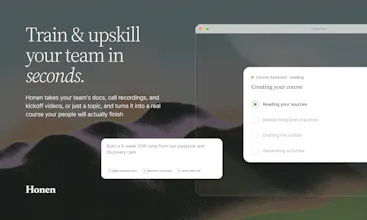
Create employee training that keeps up with your company. Honen turns team knowledge into interactive AI-led courses in seconds, complete with adaptive lessons, simulations, and learner insights. When your docs, tools, or processes change, courses update automatically.



Free Options
Launch Team / Built With


EneyProactive AI for Mac. Free test, 20,000 credits.
Promoted
Hey Product Hunt 👋
I'm Ryan, one of the makers of Honen, and I'm pumped to finally share what we've been building!
Quick backstory: at StudyFetch, we've helped 8 million students understand everything from first-year history to advanced healthcare topics.
So we took everything we learned and brought it to businesses and the workforce. That's Honen.
The problem we kept seeing: Companies are spending billions on generic training that teaches outdated material and leaves people behind. By the time a course is finished, the skills it teaches are already half-stale.
What Honen actually is: A platform that automates a company's entire learning and training infrastructure, so businesses can teach new skills faster and adapt their people to an ever-changing world.
How it works:
🟢 Building a course starts in seconds. Drag in your existing training docs, connect to internal knowledge sources, or just type a topic. Honen acts as a researcher and curriculum designer at the same time, it reads your material, understands the subject, and builds the full course structure. You pick how interactive and how deep.
🟢 Ship it instantly. Send the course to any learner with a link, or sync into your existing LMS / HR system.
🟢 Built for engagement, not just completion. Our AI teacher guides learners through visuals, interactive artifacts, podcasts, games, and flashcards, each personalized to the learner's interests and preferences.
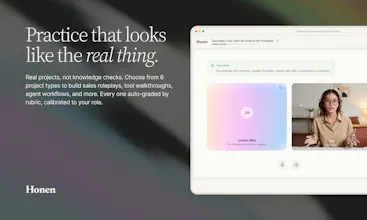
🟢 Hands-on projects, not just videos. Live scenarios where a learner runs a mock virtual client meeting and is graded on how they handle it. Screen-share projects where the AI teacher walks them through setting up and using 3rd party software in real time.
🟢 Admins get a real-time view. You can ask the course agent anything — "my learners are struggling with this topic, what's going on?", and Honen visualizes the answer, then uses what it knows to auto-adjust the content or teaching style.
🟢 One knowledgebase, two kinds of learners. Drag any file into Honen's knowledgebase or write new ones with the Workspace Assistant. Then turn that knowledge into courses for your people and serve it to your AI agents over MCP. We call it parallel training, a single source of truth that teaches your team and gives the agents working alongside them the same context and skills, so everyone in your org stays in sync.
Launch news: As a first step, we're collaborating with NVIDIA to bring professional AI training to students and professionals, starting with 250,000 high school students nationwide.
Our goal with Honen is to let every business, whether you've got 10 employees or 10,000, invest in their people in the most efficient and scalable way possible. So learning actually continues across someone's entire career, not just during week-one onboarding.
Free to try at honen.com, no card needed. Your first course takes about 30 seconds.
Hanging in the comments all day, ask us anything 🙏
@ryan_trattner congrats on the launch Ryan, how do you deal with assessment and post course retention so this isn't just a tick box tool?
@zolani_matebese We're taking a lot of the ways we track mastery and learning from our flagship product studyfetch.com and applying them here on the new product. The goal is hopefully learners "Actually know" what they just took, project based learning which is inside of honen helps a lot.
Honen supports assignments and assessments for instructional teams out of the box with different settings for completion and grading.
@zolani_matebese @ryan_trattner I think the key is a step beyond completion too. We're focused on measuring mastery, application, and where learners get stuck. The long-term vision is for courses to continuously improve based on learner outcomes and changes in company knowledge.
@zolani_matebese @ryan_trattner Hi Ryan, how is project based learning created in the platform, what are the the different ways to configure a project and how long does it take one to spin up?
@ryan_trattner Congrats. A little curious about how do you make sure your courses aren't just another check on a list? Also, how do you make sure it doesn;t teach something that's either outdated or misaligned or just wrong?
@swati_paliwal We've learned a lot about what it takes to master a topic through our work on studyfetch. The #1 thing has always been "doing" not just taking a test, so theres a large focus on project based learning (for example scenarios) on Honen, and we will be adding more over time. For the misalignment, it structures courses based off the knowledge in your team knowledgebase (like documents you already have) and can also do research on the web for the newest up to date practices on how things are taught.
@swati_paliwal @ryan_trattner One thing we're excited about is that courses don't have to stay static anymore. If your processes change, your products change, or the industry changes, the course can evolve with it.
Historically, training gets created once and slowly becomes outdated. We think learning should be much closer to a living knowledge system that continuously reflects how the company actually operates.
@swati_paliwal @ryan_trattner Hi, The knowledge base feature is really cool. I agree that it is very easy for a team to be able to store all teaching and training material in one place, you are also able to integrate into thrid partiy tools like Google Drive and make files stored there your knowledge base
@ryan_trattner Very cool product - congrats on the launch AND Nvidia collaboration!! I just sent this to one of my Clients who does training and SOPs in the restaurant industry. She's also very low tech (in her words) so something easy and user-friendly like this appears to be, would be great for her! Curious what pricing will be like for the Solo/small biz folks? I can see this being useful for several Clients of mine.
@anna_ludwinowski Thank you so much! We're trying to get the product to be as easy to use and simple as possible, and or it to do most of the work for you! If you're buying for your team as a small biz pricing can be just under $10 / seat / month! Feel free to schedule a demo and we're happy to walk you through it https://honen.com/contact
@ryan_trattner Ok wow, that's super reasonable - great to hear. I'll mention the demo to her, thanks!
@ryan_trattner @anna_ludwinowski
Thanks for the question! Ryan covered pricing so, I want to speak to the "low tech" piece because that's the part that usually decides whether a tool like this actually lands with an operator your client's profile.
The hurdle for a low tech operator isn't learning a new platform, it's that most training tools assume you already have clean source material to upload. Many small businesses just don't. What they have quite frequently is the real-world version. A printed SOP binder behind the host stand. A video the old GM recorded two years ago. A phone video of the espresso workflow. A Google Doc that's half outdated. Tribal knowledge from the people who have been there the longest. The work of turning that into something usable is exactly the work your client doesn't have time to do, and it's where most tools fall apart.
The shift we made with Honen is treating that mess as the input, not the blocker. Snap photos of the binder, drop in a video, point at a Drive folder, or just record a manager walking through a station on their phone. Honen pulls structure out of it and dedupes the overlap. What comes out the other side isn't a PDF or a slide deck, it's a living course with simulations and scenarios built from her actual operation, not a generic hospitality template. When the menu changes or a process updates, she updates the source and the course can follow seamlessly, instead of going stale the day after launch.
The unlock for a low tech operator is that the hour she spends getting the mess in is the last hour she has to spend on it. Every new hire from then on onboards on the same standard, in the company's language, all of which can be personalized to them.
Happy to jump on a quick walkthrough with you and her if it'd help, you can see it run on her actual binder.
@ryan_trattner Congrats on the launch, this looks powerful. Quick question: with companies having very different learning needs and levels of trust in AI, how do you balance automation vs. human oversight when a course contains critical or compliance-sensitive material? What safeguards or review workflows do you recommend so admins feel confident shipping AI-generated curricula to their teams?
@ryan_trattner @dayal_punjabi Thanks! Great question, and it's one we hear a lot from teams in regulated spaces.
Ultimately, Honen automates the heavy lifting of course creation, but a human stays in control of what actually ships. Nothing goes live to learners automatically, unless you prefer it be that way.
AI builds the course structure and content, but every course is a revision that an admin reviews and explicitly deploys. You can edit anything before it goes out, and you control which cohort gets which version.
For compliance-sensitive material, courses reference items in your Honen knowledge base rather than free-generating. When a source doc changes, the dependent course flags it, but the update is gated behind approval, so an admin reviews the change before it reaches learners.
And since every revision is tracked, you can roll back to a prior version if something needs correcting, and keep learners mid-course on a stable revision while you stage updates for the next cohort.
For critical or compliance material specifically, our recommendation is to treat AI as the drafter and a subject-matter owner as the approver. Let Honen generate and keep the content current, but route changes through a named reviewer before deploy. You get the speed of automation without shipping anything no one signed off on.
@curiouskitty Great questions! (you might know a thing or two about AI courses haha)
These are some important things that we've taken into account when designing Honen.
We think of course maintenance in two ways on Honen:
The first is our course creation, management, and editor experience, which is built with full version history. Each course is a revision, you can deploy, rollback any version. This allows you to deploy a specific revision to a cohort of learners (via assignments), so you can choose wether you want to update a course mid-flight while learners are taking it, or only for the future students.
For the documents, we centralize knowledge in something called the Honen knowledge base. This allows you to connect external sources or upload documents, or craft knowledge manually. When courses depend on knowledge they can reference the knowledge base item, when that item changes it flags, and the course agent can update the course (subject to approvals).
@curiouskitty @ryan_trattner
Worth naming the reason maintenance is the killer in the first place, because it's a people problem dressed up as a tech problem. Content rots faster than anyone budgets for, and the person who built v1 is not often the owner six months later. Most tools assume a maintainer who keeps state in their head about which lessons depend on which doc. Centralizing the source of truth in the knowledge base is what makes the system, rather than a specific person, responsible for surfacing the work when it's needed. That's the part that decides whether a course is still accurate two years from now or quietly out-of-date six months in.
The auto-updating piece is the real standout, internal courses always go stale because nobody maintains them, having the course rewrite itself when the source docs change solves the exact reason corporate training fails the version history with rollback per cohort is a smart touch too, most tools would just push changes live and break things mid-course, one question, how do you handle the case where a doc gets updated badly or with wrong info? does a human have to approve before it reaches learners or can a bad edit silently propagate?
@imoluuu Thanks! Yes a human always approves and releases the draft. They can make changes in seconds using the course editor if something feels off.
@imoluuu @ryan_trattner We view AI as a thought partner, and the goal is to make updates nearly effortless while still keeping humans in control of what reaches learners.
@imoluuu @ryan_trattner
Another issue worth raising. The approval flow catches bad edits, which is the failure mode @imoluuu names. The harder failure mode, and the one most training tools ignore, is when the source of truth was already wrong before a human (or in this case) AI ever touched it. Most companies have SOPs that were drafted by someone who left two years ago and never got updated. When you wrap a stale or wrong doc in a polished course with simulations and assessments, you don't just propagate the bad info, you give it credibility and make it more memorable for the learner. The lever for that isn't tighter approvals on the AI output, it's whether the system surfaces ambiguity in the source, flags where it had to make a judgment call, and gives the operator a reason to audit the source itself, not just the generated lesson. The diff review catches recent damage. The harder question for any tool in this space is whether it helps you find the broken knowledge sources you didn't know you had.
The other side of this is incentive. A knowledge base usually rots because it serves one use case, like new-hire onboarding, and nobody owns it after launch. What changes the calculus is when the same source powers multiple things, courses for employees, AI agents your team uses day to day, customer-facing assistants, anything else you power with Honen's MCP server. Once a doc is feeding five workflows instead of one, the cost of leaving it stale shows up everywhere, and someone actually has a reason to maintain it.
The auto-adjust loop is the part I keep coming back to. When the course agent flags "learners are struggling with topic X," how does it tell apart why? E.g., is it weak content, a missing prerequisite, or just disengagement? Those three need opposite fixes, so how confidently it diagnoses the cause before it rewrites the lesson. Feels like the whole thing lives or dies on getting that read right.
@and_bayleaf Great Question, we've done a lot of work on our studyfetch.com product understanding specifically what leads to mastery and giving the system enough information to properly edit and change the course based on that info. For example, for pre-requisites it can look at topics /pre-diagnostics that other students taking similar topics took before looking at the material and how they performed. For engagement we have statistics on time spent, engaged time, revisiting time, conversations with the tutor and can use that to determine based on different modalities students prefer what could be more engaging. We refine and focus based on the course as a whole, and have personalization applied on top of that so we're mostly looking at cohorts which gives more data.
the 'turns team knowledge into courses in seconds' claim covers a wide range of quality. seconds to generate something is easy. seconds to generate something an employee would actually learn from is much harder. what does the course quality look like on a topic that requires nuanced judgment rather than factual recall, like how to handle a difficult customer or when to escalate a support ticket. that's where the gap between AI-generated and expert-designed training usually shows up
@ansari_adin Totally fair point. We think the answer is beyond content and all about practice. The best people aren't valuable because they memorized docs, they are valuable because they know how to apply it in situations that may be new or not obvious exactly what to do. That's where simulations and real-world scenarios become very important.
@ansari_adin Fun fact we're actually using Honen knowledgebases to power both our support for millions of users on studyfetch.com and train the teams who run it! So handling a difficult customer + escalation is being taught by honen to both AI and people!
We will publish an internal case study on this next week haha
The stale training problem is very real. Course generation is useful, but the stronger part is keeping courses connected to the knowledge base so updates don’t depend on someone remembering to fix onboarding docs later.
@farrukh_butt1 Thanks for the feedback! Appreciate it!
@farrukh_butt1
Honestly this is the kind of thing that sounds minor on a feature list but quietly saves teams from a ton of avoidable confusion down the line.
@farrukh_butt1 @daniel_hossa Agreed here, and I think a lot of training problems are really knowledge management problems in disguise. Keeping the course aligned with how the company actually operates, for example, six months later, is super important
@farrukh_butt1
We also wanted to address the stale knowledge problem by making the knowledge base have more jobs than being a repository for information to create a more powerful incentive for people to keep it up-to-date by being AI-native from day 1 with Honen's MCP capabilities.
hold upppp!!! it's so incredible that it turns source into sections/lessons so that I won't be swamped with unstructured docs & resource. I really like it
what's your take on honen positioning vs notebook LLM?
btw I found some text/title is hard to read. some tweak there and should be good to go.
andddd when will we have dark mode? I'm a night learner and would love it!!!
congrats on the launch! it looks promising
@nathan_tran2 Appreciate you trying it out and thanks for the feedback (we just fixed those colors!).
Notebook LM is a great product, Honen is created to perform a different type of job:
Notebook LM operates more as an individual / group study experience where you drag in something and learn it, Honen is built to be a system that a company can use to up-skill / train its whole workforce similar to an LMS with built in assignments / roles / analytics etc.
As for the courses: Honen courses are very structured and lead the learner down a path while Notebook LM focuses more on input to output. Course creation and managing are more tailored towards instructors creating very robust courses for learners to use, while Notebook LM would likely feed of an already created material.
@nathan_tran2 @ryan_trattner
Adding a bit more color here. NotebookLM is very much a personal research tool. You feed it docs and it helps you understand them faster, great for one person making sense of a lot of material.
Honen is a course creator + learning management system + centralized source of truth. One or more people takes source knowledge and deploys courses to a team of people, with assessments, simulations, projects, completion tracking, version control, and analytics on how they're performing. The job to be done is totally different. NotebookLM answers "how do I absorb this." Honen answers "how do I make sure 50 people actually know this, can apply it, and have an AI that understands my business."
@nathan_tran2 Also you can access dark mode by clicking on your profile in the bottom left corner!