I’ve previously balanced running heavy, native desktop software synthesizers (like Xfer Serum, Vital, or Arturia Pigments) against cloud-based collaborative sequencers like BandLab, Soundtrap, or classic browser modular racks like Audiotool. Desktop VST plugins provide unmatched, CPU-optimized audio fidelity and massive modulation matrices, but they operate as completely solitary sandboxes with no native way to share the knobs in real time.
On the other hand, mainstream browser-based DAWs are great for arranging pre-made audio loops or tracking linear timelines, but they treat software instruments as isolated tracks rather than open, multi-user sound-design labs. Jamboree cars out a highly creative, accessible alternative lane. It strips away the heavy installation overhead and file-sharing friction of native plugins, delivering an immediate, high-leverage workspace perfect for remote writing camps, interactive classroom labs, and real-time electronic jam sessions.

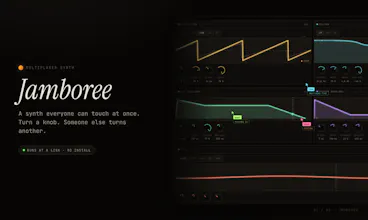

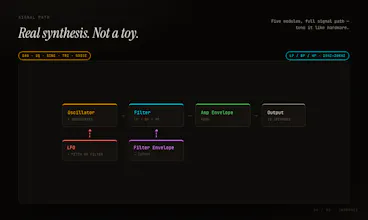


true peer-to-peer with no relay server is the part I'd want to stress test. WebRTC p2p usually works fine until someone's behind a symmetric NAT or a locked-down corporate/school firewall, at which point the connection just fails silently unless you have a TURN relay as fallback. does Jamboree have one, or is it strictly "if peers can't find each other directly, no jam session"? curious how much of the weekend went into handling that edge case vs the synth itself
@galdayan It's mentioned on the website but I'm using Matchbox for the p2p networking which does do hole punching, but I am also running a coturn server on digital ocean as a backup in case people are on stricter connections (but from my stats it's not being used much). Most of the time spent was with the networking stuff for sure, the synthesizer itself is not too complicated to implement!
@kartiknair good, that's the answer I was hoping for. a self-hosted coturn fallback for the stricter-NAT minority while staying p2p for everyone else is exactly the right tradeoff for a weekend project, most people would've either skipped it entirely or over-built a full relay-first architecture. nice work
I’m not a sound designer, but I really like tools that make creative work feel collaborative instead of lonely. sound design usually feels like someone tweaking knobs alone for hours, so the multiplayer/live cursor angle makes it immediately more playful. The peer-to-peer part is also a nice technical detail. for something browser-based and real-time, keeping it lightweight instead of building a huge backend around it feels right.
Also, SoundFont export makes this feel less like a toy and more like something people can actually take into their DAW afterward :)
Curious if you imagine Jamboree more as a serious collab tool for musicians, or more as a fun “jam with friends” experiment for now?
@andrasczeizel Currently not too serious, just something fun to mix up the creative process with friends!
SoundFont export from a browser-based synth is an unexpected feature to include at launch, most tools in this space stop at WAV or MIDI. Curious what the use case is there, are people expected to pull patches into a DAW workflow or is it more for archiving presets in a portable format?
@ansari_adin My main use case was to design sounds collaboratively and then pull them into your DAW to use for actual music making. Having an archive where people can share sounds does sound interesting though, will think about it more!
@kartiknair If the main flow is design collaboratively then pull into a DAW, the interesting question is where the session lives between those two moments. Right now is a Jamboree session something you can save and return to with the same collaborators, or is it ephemeral and the SoundFont export is essentially the only way to preserve what you built together?
This is a really interesting take on sound design. The multiplayer angle stands out to me — most synth tools feel very solo, while this makes patch-building feel more like a shared creative workspace.
Curious how collaboration works in practice: can multiple people edit the same patch at the same time, or is there some kind of turn-taking system to avoid conflicts?
@longway1 It's all live multiplayer like in Figma, last action takes priority in case of people tweaking the same thing at once.
Really interesting concept. Collaborative creativity is still underexplored in music tools. I'd be curious to know whether users tend to design patches together from scratch or iterate on someone else's sounds more often.
A multiplayer synth right in the browser is exactly the thing I'd open mid-call to mess around with a friend without either of us installing a DAW. The day-one thing I'd want to know: after a jam, can I actually save or export what we made (an audio bounce, or MIDI/stems), or does the session vanish once everyone leaves the room? And when two of us play at once, is the timing locked to a shared clock, or does remote latency smear the groove?