
Launching today

Katzilla
Easy goverment data access for citizens, optimized for AI
51 followers
Easy goverment data access for citizens, optimized for AI
51 followers
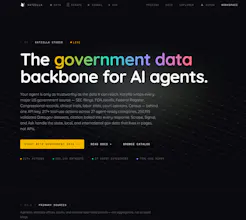
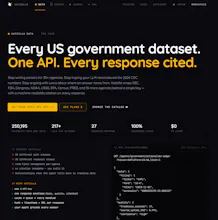
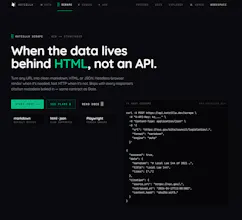
Access to over 250k datasets of 30+ US and foreign government agencies with one unified API. Get structured JSON response for AI agent ingestion. Each response carries a structured citation (source URL, retrieval timestamp, SHA-256 hash). Additional tools like Scrape, Watch, and Brief to get information related to data and keep track on updates or changes.

Katzilla
Viseal
@paul_vongjalorn if we give the docs of Katzilla to AI agents, and want to retrieve information whose sources needs to come from more than one government sites. I saw that in the current design, the api calls are all indivisual per source type. does it mean it will cost multiple credits? Do you consider to integrate a join space to take in a request, then use AI to breakdown and decide the list of sources and then get the info in parallel and return the complete result in json in on go? thanks, and nice concept btw!
Katzilla
@hwellmake Hi there! Great question.
Short version: yes, Katzilla has natural-language API calls that fan out across multiple government sources in a single request — one credit. But this is on a different end-point/separate product. Your question did bring up a good point and opportunity for improvement. By the time you see this, our main product's end point /v1/nl will route to multiple actions when the prompt implies it!
1. /v1/nl is now multi-source
Previously, our NL endpoint picked exactly one best-matching action per call. You were right — that meant a query like "FDA recalls for pharma companies with recent SEC filings" would either misroute or force the agent to make N separate calls at N credits.
Now, Claude's router returns 1–3 routes per call and we fan them out in parallel. One credit, multi-source result:
{ "query": "compare US inflation with unemployment trends in 2024", "execute": true }
→ {
routings: [
{ agent: "economic", actionId: "fred-series", params: { seriesId: "CPIAUCSL" } },
{ agent: "economic", actionId: "fred-series", params: { seriesId: "UNRATE" } }
],
data: {
"economic/fred-series": { ... }, // keyed dict, easy to index
...
},
results: [ ... ], // per-source detail + citations
meta: { sources_queried: 2, sources_successful: 2 }
}
Single-source queries still return the legacy routing field, so existing integrations don't break.
2. /v1/ask/answer — synthesized cross-source answer
For cases where the agent shouldn't have to synthesize client-side, we added a new endpoint that takes raw parallel results from the router and runs a final Claude pass to produce one prose answer with inline [1]/[2] citations:
{ "q": "pharma firms with Class I FDA recalls and recent 10-Q disclosures", "max_sources": 3 }
→ {
answer: "Three firms posted Class I recalls since January [1], and two of them flagged related product-liability language in their latest 10-Q [2]...",
citations: [{ id: 1, source: "openFDA", citation: {...} }, ...],
results: [ ... ]
}
Both endpoints charge one credit per call regardless of fan-out — same billing model as /v1/ask. The docs page at katzilla.dev/docs now has a tier guide so agents pick the right endpoint:
/v1/nl — plain English, single or cross-source, Claude routes
/v1/ask — keyword-routed multi-source (cheaper, no LLM on our side)
/v1/ask/answer — multi-source + synthesized prose answer
/v1/compose — you already know the sources
Thanks for your question, cheers!
minimalist phone: creating folders
This is so complex, what kind of data can we know, e.g. about citizens? Is it compliant with their private information?
Katzilla
@busmark_w_nika Hi, thanks for your question!
What kinds of data about people can you find through Katzilla's government sources?
Short version: lots — but almost all of it is about people in public roles, public transactions, or aggregated populations. Not private individuals.
Broken down by category:
Public-role identities
Federal lawmakers + staff — names, committee assignments, voting records, sponsored bills (Congress.gov, GovInfo)
Federal judges — opinions, case assignments, court, bench history (CourtListener)
Registered lobbyists — name, client, spending, quarterly filings (Senate/House Lobbying Disclosures, Secretary of State feeds via state OD portals)
Federal candidates + campaign finance — candidate names, committees, donors above threshold, disbursements (FEC)
Federal grant recipients (PIs) — principal investigator names, institution, award amount (NSF Awards, NIH RePORTER)
Patent inventors + assignees — inventor name, institution, patent history (USPTO PatentsView)
Healthcare provider identities
Licensed providers — NPI, name, specialty, practice address, taxonomy (NPPES NPI registry)
Medicare Part B providers — billing patterns, services rendered, per-provider (CMS)
Clinical trial PIs + study sponsors — names, contact info, organization (ClinicalTrials.gov)
Court / legal
Parties to federal cases — named plaintiffs, defendants, attorneys in public dockets (CourtListener, RECAP)
Sanctioned persons + entities — OFAC / OpenSanctions lists with names, aliases, DOB fragments, nationality
Patent litigants — parties named in USPTO proceedings
Scholarly + research
Paper authors + affiliations — arXiv, PubMed, Crossref, OpenAlex, Semantic Scholar, SHARE/OSF
Citation graphs — who cited whom, co-authorship networks
Aggregated / statistical (individuals not identifiable)
Census demographics — population by age/sex/race at tract/block group level (Census Bureau)
Labor market statistics — employment, wages by occupation + geography (BLS)
Health outcomes — morbidity/mortality, disease prevalence by county (CDC, CMS)
FDA adverse events (FAERS) — de-identified patient age, sex, reactions by drug
Consumer complaints — CFPB complaints with de-identified narrative
Crime statistics — FBI UCR/NIBRS by jurisdiction, not per-person
Explicitly NOT in the Katzilla corpus
Private individuals (non-public-figures) — no name lookup, no background checks
SSNs, home addresses, phone numbers, financial account numbers, medical records — none of this is in any government open-data feed we wrap, and we wouldn't expose it if it were
Real-time location tracking of people
Voter rolls with voter-level detail — not wrapped; some states publish, but we don't aggregate
Criminal records per individual — we surface court opinions and dockets (public filings), not rap sheets
One rule of thumb
If the person is named because of an action they took in a public capacity — filed a bill, wrote an opinion, received a grant, registered as a lobbyist, authored a paper, filed a patent, sued or was sued in federal court — you'll find them. If you're trying to look up a private individual by name, Katzilla isn't the right tool and no government open-data feed would be either.
You can explore the full source catalog at katzilla.dev/sources or ask Katzilla directly: POST /v1/nl with a question like "what's the campaign spending for candidate X" and it'll route to the right agency feed.
Cheers!