Makersclaw is an operating system for work done by agents. Ask for an outcome and it builds an app, agent or automation that runs it for months, on your tools, on a budget you set. Today it runs go-to-market. Next: every job a company repeats.
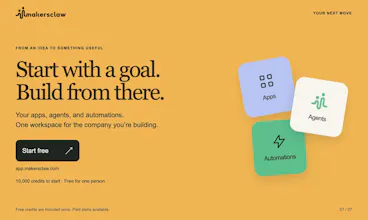
MakersClaw 2.0 turns a goal into the apps, agents and automations needed to get it done.
We originally launched MakersClaw as AI employees that lived in Slack, Teams and Telegram. We rebuilt it around a different idea: instead of hiring an agent for a role, tell MakersClaw what you want done. It builds the tools for the job, runs them continuously, remembers the work and operates within a budget you set.
Today it starts with go-to-market
Two jobs, both real, both on GPT-6 Astra.
Building. When a founder asks for an outcome — "set up cold email for us", "watch our competitors' pricing", "send me Monday numbers" — the platform agent turns that sentence into a working artifact: an app with an agent inside it, an agent you talk to, or an automation on a schedule. It designs every screen, creates the tables, connects the tools, and fixes what it broke, because every console error comes straight back to it while it builds.
Running. Once the artifact is on the desk, the same model becomes that artifact's own agent. For cold email that means every Monday it finds ten seed-stage founders who fit, writes one draft each in the founder's voice with a why-them line, sends from the founder's inbox, handles replies, books the meeting when one lands, and logs every run with its cost. It stops and asks only when something falls outside the pattern the founder approved.
Hey Product Hunt 👋 Shreyans here, maker of MakersClaw.
We first launched MakersClaw here in June as AI employees you could hire into Slack, Teams and Telegram.
Today we're relaunching as part of Astra Day, after rebuilding the product around a different idea.
MakersClaw is no longer primarily a chatbot you give a role to. You give it a goal.
MakersClaw figures out what needs to exist to pursue that goal — an app, an agent, automations, or some combination of them — builds those things into your workspace, connects them to your tools and runs the work.
Sometimes that means a research agent. Sometimes it needs a lead inbox, CRM, approval queue or recurring workflow. Instead of forcing every job through chat, MakersClaw can build the interface appropriate for the work.
Why we rebuilt it
AI made building software dramatically cheaper. A founder can ship a product in a weekend. But selling it is still weekly, repetitive, tool-heavy work.
We thought agents should be able to do much more of that work.
The problem with the agents we were using was that they were still session-based. They'd complete a task, lose context, ask to be restarted and wait for another prompt.
MakersClaw 2.0 is built around work that continues.
Tell it something like:
"Help me find and reach our first 50 customers."
You can watch the first run, inspect what it built, approve the important decisions and set a budget. After that, it can keep running and come back when it needs you.
Company files, decisions and results live in shared workspace memory, so agents can pick up where previous work left off rather than starting from scratch.
Today we're starting with go-to-market: research, content, outbound, follow-ups and the surrounding workflows. The App Store is still small and there are integrations we haven't tested deeply yet.
That's part of why we're launching now.
Try giving MakersClaw one real growth job you need done this week. If it gets stuck, builds the wrong thing or asks you to do something it should have handled itself, tell me here.
I'll be around all day.
Report
Hunter
@shreyans_assistiv I hunted this because it answers a question I keep hearing from founders and have never had a good answer to: the product is built, so who sells it?
Makersclaw isn't another chat assistant. You describe a growth job “set up cold email for us", "watch our competitors' pricing" and it builds a working app, agent or automation for that job, on the tools you already use. Then it keeps running it every week, on a budget you set.
The detail that made me hunt it instead of bookmarking it: every run is a fresh session that reads the artifact's own page and database. So the thing you set up doesn't quietly rot the way most agents do after a couple of weeks.
@shreyans_assistiv is here all day. Ask him the hard ones - data, pricing, what it can't do yet. He's been unusually straight with me about the last one. :)
@rohanrecommends Thank you so much for hunting us again :) Love you support for the Makersclaw project. With every version Makersclaw is evolving with only one purpose to make startup building a little easier.
I am here all day, ready to answer some questions!!
@shreyans_assistiv@rohanrecommends taking you up on that. "on a budget you set" is the part I'd push on - what actually happens when a running agent hits that ceiling mid-task? does it pause and wait for approval to continue, hard-stop and leave whatever it was doing half-done, or degrade to a cheaper model to finish the job? for something that's supposed to run unattended for months, the failure mode when it runs out of runway matters as much as the happy path.
@galdayan we have both - we have autorouting inbuilt and agent knows the budget so tries to complete within if possible. If the budget is insanely low, then waits for user to increase the budget or reset. This is still something we are experimenting with and should get better with time 🙏
@shreyans_assistiv makes sense, appreciate the honest "still experimenting" answer. Given a runaway agent could quietly burn budget on a task that was never going to finish, does MakersClaw show a trace of why a run cost what it cost after the fact, or is that also still on the roadmap?
As a solo founder, selling is the part that never gets cheaper, so this looks very interesting. How does it adapt over time: does it tune its own outreach based on what gets replies, or does it surface that to me for my ultimate approval? Good luck today!
@tery_emilson The agents are self learning, they adapt and grow as time goes on. Of course user is a big part and the agent can reach out to the user if intervention needed. Thank you for your support :)
@tery_emilson Shreyans covered the learning side, so I'll give you the boundary. It tunes on its own, but the decisions that matter come to you, and early on more of them will: it doesn't know your company yet, and the first runs are where that gets fixed.
Hey Product Hunt, Sachin here, the other half of MakersClaw 👋
Shreyans covered what it does, so I'll cover why it looks the way it does now.
Our first launch here in June looked like a pure win from the outside: #3 Product of the Day. Then the feedback came in. People loved the promise, opened the app, and got lost. We had built power before we built a path. The most useful lesson of my year: a leaderboard cannot tell you why users leave. People telling you to your face can.
So v2 started from one question: what is the smallest thing a founder should have to give us? The answer we landed on is a goal. Not prompt engineering, not workflow builders, not agent configs. You write "help us reach our first 100 customers" and the system works out what that needs: the research, the briefs, the apps, the automations, and it keeps them running inside a budget you set.
What we're still honest about: it plans and executes, but it won't close your deals, and the first runs deserve your review while it learns your company. We'd rather tell you that here than have you find out annoyed.
Two things I'd genuinely love from this community:
1. If you get lost anywhere in the product, say exactly where. That kind of comment is what rebuilt v1 into v2.
2. What's the first goal you'd hand to a system like this? Your answers here genuinely shape what we build next quarter.
Thanks for having us back.
Report
How do you decide which runtime the agent should use?
Do you guys plan to have a broader agent runtime ecosystem?
@ankita_singh27 We built our own, Ankita. The existing ones are built around a conversation one long thread, context growing every turn, cost growing with it. That works for chat and breaks for a job that runs for longer.
Ours runs longer because there's no thread to rot: every wake is a fresh session that reads the employee's own page and your workspace database. It runs cheaper because each job loads only what it needs, models are routed per task, and a workspace keeps one machine instead of one per session.
@ankita_singh27 Shreyans covered the runtime itself, so I'll take the second half of your question. Everything runs on ours today, and that was a deliberate call: we wanted one thing we could make cheap and keep alive for weeks before we opened it up. Supporting other runtimes is on the list, and the useful thing you could tell me is which one you'd actually want to bring.
@kseniia_ponomareva Yes crazy day, openai day always brings the competition. We onboarded quite a few users, hoping to keep the momentum rolling. Do please try out our product and let us know if you have any feedback for us :)
@kseniia_ponomareva Intense is the word. The feedback's been the useful kind so far: people saying exactly what they like, The real feedback will be after the users try the platform, which is the same signal that turned v1 into v2.
@bencohen Thank you so much. Currently the world so focused on the infra/ui that we forgot to understand - people don't care. New models and new agent apps launch almost everyday - users just want the work done. Don't care if it is an agent/automation/app/people.
@bencohen That shift wasn't a thesis, it was a correction. v1 was the hire a role version, and people opened it, liked the idea, then couldn't work out what to do next.
MakersClaw
MakersClaw
Hey Product Hunt 👋 Shreyans here, maker of MakersClaw.
We first launched MakersClaw here in June as AI employees you could hire into Slack, Teams and Telegram.
Today we're relaunching as part of Astra Day, after rebuilding the product around a different idea.
MakersClaw is no longer primarily a chatbot you give a role to. You give it a goal.
MakersClaw figures out what needs to exist to pursue that goal — an app, an agent, automations, or some combination of them — builds those things into your workspace, connects them to your tools and runs the work.
Sometimes that means a research agent. Sometimes it needs a lead inbox, CRM, approval queue or recurring workflow. Instead of forcing every job through chat, MakersClaw can build the interface appropriate for the work.
Why we rebuilt it
AI made building software dramatically cheaper. A founder can ship a product in a weekend. But selling it is still weekly, repetitive, tool-heavy work.
We thought agents should be able to do much more of that work.
The problem with the agents we were using was that they were still session-based. They'd complete a task, lose context, ask to be restarted and wait for another prompt.
MakersClaw 2.0 is built around work that continues.
Tell it something like:
"Help me find and reach our first 50 customers."
You can watch the first run, inspect what it built, approve the important decisions and set a budget. After that, it can keep running and come back when it needs you.
Company files, decisions and results live in shared workspace memory, so agents can pick up where previous work left off rather than starting from scratch.
Today we're starting with go-to-market: research, content, outbound, follow-ups and the surrounding workflows. The App Store is still small and there are integrations we haven't tested deeply yet.
That's part of why we're launching now.
Try giving MakersClaw one real growth job you need done this week. If it gets stuck, builds the wrong thing or asks you to do something it should have handled itself, tell me here.
I'll be around all day.
@shreyans_assistiv I hunted this because it answers a question I keep hearing from founders and have never had a good answer to: the product is built, so who sells it?
Makersclaw isn't another chat assistant. You describe a growth job “set up cold email for us", "watch our competitors' pricing" and it builds a working app, agent or automation for that job, on the tools you already use. Then it keeps running it every week, on a budget you set.
The detail that made me hunt it instead of bookmarking it: every run is a fresh session that reads the artifact's own page and database. So the thing you set up doesn't quietly rot the way most agents do after a couple of weeks.
@shreyans_assistiv is here all day. Ask him the hard ones - data, pricing, what it can't do yet. He's been unusually straight with me about the last one. :)
MakersClaw
@rohanrecommends Thank you so much for hunting us again :) Love you support for the Makersclaw project. With every version Makersclaw is evolving with only one purpose to make startup building a little easier.
I am here all day, ready to answer some questions!!
Dial
@shreyans_assistiv @rohanrecommends taking you up on that. "on a budget you set" is the part I'd push on - what actually happens when a running agent hits that ceiling mid-task? does it pause and wait for approval to continue, hard-stop and leave whatever it was doing half-done, or degrade to a cheaper model to finish the job? for something that's supposed to run unattended for months, the failure mode when it runs out of runway matters as much as the happy path.
Fedica
@shreyans_assistiv good luck with the launch!
MakersClaw
@albattran Thank you so much :)
MakersClaw
@shreyans_assistiv @albattran Thanks Samir. If you get a chance to try it, the thing I'd most like back is wherever you get stuck.
zero.xyz
@shreyans_assistiv Pumped for your launch!!! Build ship rebuild ship. Love the hustle and can't wait to try out the new MakersClaw!!!
MakersClaw
MakersClaw
Dial
@shreyans_assistiv makes sense, appreciate the honest "still experimenting" answer. Given a runaway agent could quietly burn budget on a task that was never going to finish, does MakersClaw show a trace of why a run cost what it cost after the fact, or is that also still on the roadmap?
GhostWriter by MyHandler
Congrats on 2.0!
As a solo founder, selling is the part that never gets cheaper, so this looks very interesting. How does it adapt over time: does it tune its own outreach based on what gets replies, or does it surface that to me for my ultimate approval? Good luck today!
MakersClaw
@tery_emilson The agents are self learning, they adapt and grow as time goes on. Of course user is a big part and the agent can reach out to the user if intervention needed. Thank you for your support :)
MakersClaw
@tery_emilson Shreyans covered the learning side, so I'll give you the boundary. It tunes on its own, but the decisions that matter come to you, and early on more of them will: it doesn't know your company yet, and the first runs are where that gets fixed.
MakersClaw
Hey Product Hunt, Sachin here, the other half of MakersClaw 👋
Shreyans covered what it does, so I'll cover why it looks the way it does now.
Our first launch here in June looked like a pure win from the outside: #3 Product of the Day. Then the feedback came in. People loved the promise, opened the app, and got lost. We had built power before we built a path. The most useful lesson of my year: a leaderboard cannot tell you why users leave. People telling you to your face can.
So v2 started from one question: what is the smallest thing a founder should have to give us? The answer we landed on is a goal. Not prompt engineering, not workflow builders, not agent configs. You write "help us reach our first 100 customers" and the system works out what that needs: the research, the briefs, the apps, the automations, and it keeps them running inside a budget you set.
What we're still honest about: it plans and executes, but it won't close your deals, and the first runs deserve your review while it learns your company. We'd rather tell you that here than have you find out annoyed.
Two things I'd genuinely love from this community:
1. If you get lost anywhere in the product, say exactly where. That kind of comment is what rebuilt v1 into v2.
2. What's the first goal you'd hand to a system like this? Your answers here genuinely shape what we build next quarter.
Thanks for having us back.
MakersClaw
@ankita_singh27 We built our own, Ankita. The existing ones are built around a conversation one long thread, context growing every turn, cost growing with it. That works for chat and breaks for a job that runs for longer.
Ours runs longer because there's no thread to rot: every wake is a fresh session that reads the employee's own page and your workspace database. It runs cheaper because each job loads only what it needs, models are routed per task, and a workspace keeps one machine instead of one per session.
MakersClaw
@ankita_singh27 Shreyans covered the runtime itself, so I'll take the second half of your question. Everything runs on ours today, and that was a deliberate call: we wanted one thing we could make cheap and keep alive for weeks before we opened it up. Supporting other runtimes is on the list, and the useful thing you could tell me is which one you'd actually want to bring.
AINA
Guys, what an intense day, isn't it?
How mny new users did you manage to bring to your product today, and how much feedback did you get?
MakersClaw
@kseniia_ponomareva Yes crazy day, openai day always brings the competition. We onboarded quite a few users, hoping to keep the momentum rolling. Do please try out our product and let us know if you have any feedback for us :)
MakersClaw
@kseniia_ponomareva Intense is the word. The feedback's been the useful kind so far: people saying exactly what they like, The real feedback will be after the users try the platform, which is the same signal that turned v1 into v2.
AINA
@sachinsharma Sounds greate! We are waiting results too, Let's see!
LLMagnet
Really liked the shift from 'hire an ai role' to tell it the goal and let it build what's needed. Interesting direction
MakersClaw
@bencohen Thank you so much. Currently the world so focused on the infra/ui that we forgot to understand - people don't care. New models and new agent apps launch almost everyday - users just want the work done. Don't care if it is an agent/automation/app/people.
MakersClaw
@bencohen That shift wasn't a thesis, it was a correction. v1 was the hire a role version, and people opened it, liked the idea, then couldn't work out what to do next.