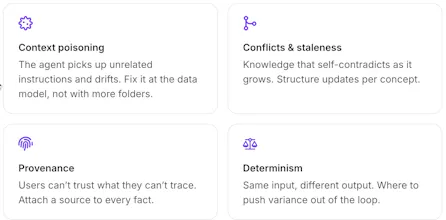
Managing markdown based context comes with challenges like context poisoning, contradictions, non-determinism and context navigation difficulties. Over time, we built out a structured context management layer at our company (DrDroid) - with Open Index, we are sharing it with the ecosystem!

We’ve spent a lot of time building AI agents, and somewhere along the way we realized something:
Giving an agent more context ≠ giving it better context.
So we built Open Index — and today, we’re open-sourcing it.
Think of it as a structured context layer for your agents. You define the entities that matter in your domain, connect the relationships between them, and give your agent a graph it can actually navigate.
We originally built this while working on DrDroid, but quickly realized the same idea could apply to agents in security, support, legal, insurance, sales, and pretty much any domain with complex context.
Instead of keeping it internal, we decided to put it out there and see what other builders do with it.
This is v1, and we’d love to build the next versions with the community.
Try it, break it, question the approach -- all feedback is welcome. ⭐
I'm curious how much the graph structure improves agent performance compared to just throwing the same data into a vector store?
Report
This hits a real agent problem: more context often creates more noise, not better decisions. Turning context into something agents can actually navigate feels much more scalable than endlessly expanding prompts.
DrDroid
Hey @sidphoenix
I'm curious how much the graph structure improves agent performance compared to just throwing the same data into a vector store?
This hits a real agent problem: more context often creates more noise, not better decisions. Turning context into something agents can actually navigate feels much more scalable than endlessly expanding prompts.