
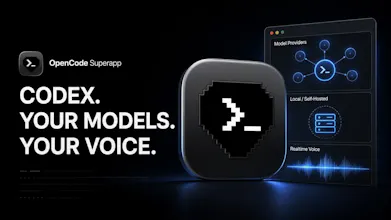
OpenCode Superapp brings the agentic power of Codex to the models and infrastructure you choose. Run cloud, local, or self-hosted models in a native workspace where agents understand your projects, work with files, Git, and terminals, speak with you through voice, and operate Mac apps through supervised Computer Use. Private by design and extensible through skills and MCPs, it gives you capable agents without giving up model choice or control. Built from the ground up with Codex and GPT-5.6.


Local + self-hosted model support is the interesting part here since most "Codex-style" tools assume you're piping everything through a hosted API — how are you handling context/tool-calling quality with smaller local models compared to the hosted ones, is there a capability cliff you have to warn users about? Also curious how voice mode integrates with the agent loop — is it just STT on top of the same prompt pipeline, or does it change how you handle multi-step tool calls?
@noctis06 Thanks. It is more than just STT, since it needs to understand pauses, utterance, tone and interruptions. It uses realtime voice apis and it has access to tools to launch/edit/read real task threads and manage it exactly like you would.
The bring-your-own / self-hosted model angle is the part I care about most — most agentic coding tools quietly assume a cloud endpoint, and the moment you want it fully local for private code, things fall apart. Two questions: how close is the local-model experience to cloud in practice (tool-calling reliability is usually where local models drop off), and with the supervised Computer Use driving Mac apps, what does the permission/sandbox boundary actually look like? "Private by design" is easy to say, hard to enforce. Nice work.
@alexander_shishkov1 Great question. Honestly the answer on the quality of local models varies a lot between models since you can run something really basic as a small language model or some of the newer more capable models but it depends on your hardware.
About the the permission/sandbox boundary the great thing is that it works exactly as Codex, you make the call if you allow things at the OS level, or at the app level, if you want to allow every single time, or if you want to go full Auto mode. You make the calls.
great but is it effective in long horizon plannimg and tasks like codex is? it works without internet?
@arnav_salkade Yes, that's the great thing. It runs on the same harness as OpenCode and with offline local models!
the supervised Computer Use part is what sells me on this over the fully autonomous agent tools, being able to keep a human check on the Mac app control while still getting local model privacy feels like the right default rather than something you have to dig through settings to enable. does the supervision step differ per app, like does it ask before every click in something sensitive like Finder or a banking app, or is it more of a coarse approve-this-session-once toggle
Hey @Product Hunt, Codex is my favorite app. However I do have 3 blockers to use it in certain circumstances:
- Offline, with local models. Like on long flights, I wish I could do some light weight work with local models (like gemma, qwen or gpt-oss).
- Self-hosted models. When handling private information like in healthcare scenarios where sharing PHI is not acceptable.
- Voice control. I wish I could use the power of Codex with my voice.
Well, with the power of GPT-5.6 I built something to solve this. OpenCode Superapp builds from the mature and robust OpenCode harness and makes it a Superapp with personality. Now I have an alternative when I am offline, I need to use self-hosted models/infra and when I want to dispatch tasks with my voice.
Give it a try if you think you will benefit from something like this.
Working offline and by voice is a great combo. The part that stood out to me is that it asks for nothing. Congrats on shipping!