
Launched this week

Pixel
Scale performance ads without juggling 7 ad platforms
618 followers
Scale performance ads without juggling 7 ad platforms
618 followers
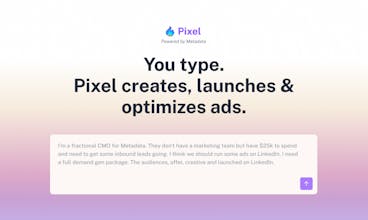
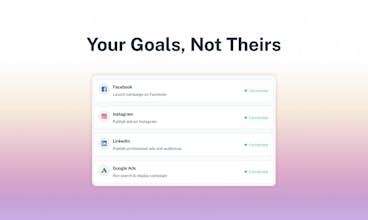
Create, launch, and optimize ads across LinkedIn, Meta, Google, Microsoft, Reddit & X from one prompt. Pixel generates creatives, unifies audiences, and shifts budgets/bids in real time so spend follows what works.


Pixel
Hey PH! 👋
I'm Gil, CEO at Pixel. Over the last 10 years we've managed billions in B2B ad spend and sourced $100B+ in pipeline for customers.
One thing kept bugging us: running ads is still painfully manual.
Jumping between platforms, rebuilding campaigns per channel, tweaking creatives endlessly.
Vibe coding changed how we build software. We think vibe marketing will change how we
run ads.
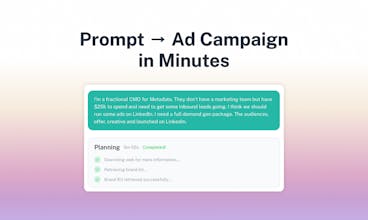
So we built Pixel — describe your product, set your budget, pick your channel. That's it.
Pixel will:
- Launch self-optimizing ads across LinkedIn, Meta, Google, Reddit, X, and Microsoft Ads
- Auto-generate ad copy and creatives
- Reallocate budget in real time
- Enrich every lead that comes in
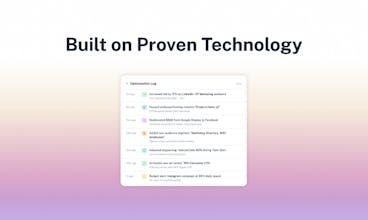
- Continuously improve performance — no manual tweaks
Powered by our proprietary B2B targeting graph, even "consumer" channels like Facebook
and Instagram become high-performing B2B engines with lower CAC.
This isn't another dashboard. It's a truly independent operator that lets you go from prompts
to live ads in no time.
Would love your feedback — and access is open if you want to give it a spin! You get FREE 1500 credits on signing up. That's enough to generate creatives, build audiences, and launch your first campaign.
Sign up at: getpixel.ai
@gilallouche
Too good to be true!
"relocate budget in real time" is it across all channels, or within one channel between ads?
Pixel
@olena_dopiro Hi - you can relocate budget across all social and search!
Love the cross-channel orchestration direction here. The strongest part for B2B teams is reducing the "channel tax" when testing one offer across LinkedIn + search + paid social. Curious about one thing: do you expose a per-channel learning log (what changed in bids/budgets/creative and why) so growth teams can audit and reuse winning playbooks instead of treating optimization as a black box?
@danielsinewe Great question! Pixel currently provides optimization logs and performance stats at campaign level. We don't have a consolidated channel level learning log at this point, but it is just a matter of data consolidation.
We'll take this back to our team for an internal review.
Pixel
@vouchy It's honestly not a specific campaign over the past year or two. It was more of a gradual process - roughly a decade of watching teams rebuild the same campaigns across platforms, manually adjust bids, juggle spreadsheets. The frustration compounds over time. When agentic AI started becoming real in late 2024, it clicked that we could finally solve this properly. Not as a feature, but as a fundamental rethink of how campaigns should work.
Pixel
@vouchy While there are platforms that automate many parts of the process, there's no single platform that does it all. Create ads, launch, and constantly optimize them.
I'd like to think that "one-stop-shop" kind of a solution for paid ads is what we're trying to do with Pixel.
minimalist phone: creating folders
Hey Gil, do you have any case studies with existing users? What results did it drive?
Pixel
@busmark_w_nika We launched last week, so formal case studies are still in the works. But users are already generating creatives, building audiences, and launching campaigns across almost all major ad platforms. Some have started seeing leads come through.
The tech that powers Pixel has however produced $100B+ in pipeline for several enterprise clients.
Here's what one of our customers, David Vainer, Managing Partner and CEO of Alliance Risk, said about their experience using Pixel:
"I launched my campaign on Pixel and within 12 hrs already had 2 meetings booked."
minimalist phone: creating folders
@gilallouche That's pretty awesome, I cannot wait for some solid case study! :)
Pixel
@busmark_w_nika Hi! Pixel is built on top of the patented technology by Metadata.io. They've managed more than a billion dollars in just pure B2B ad-spend and generated more than $100B in pipeline. So with Pixel, it's just an extension of the same tech in an LLM window.
Basalt
The multiplatform part and visual generation is super interesting, do you guys plan on adding API support so that I can launch this from my Claw Bot :) ?
Pixel
@francoisdefitte Hey there - thank you. API is definitely on the roadmap for the near future.
Pixel
@francoisdefitte Thanks for your support. API is on our road map. If you're already signed up with us, you'll get an email once we roll it out.
@francoisdefitte @gilallouche Last time I helped a B2B team launch ads across LinkedIn and Meta, the setup alone ate two days... same targeting rebuilt twice in different UIs, then a third time for Google. But the real time sink wasn't setup, it was the daily budget dance. Someone checking dashboards every few hours, making gut calls on where to shift spend. That's where Pixel's cross-channel reallocation saves the most hours. Surfacing why budget moved, which segment or creative drove each shift, would help teams build intuition alongside the automation instead of just trusting the output.
Know a few people on this team. They've been working on ad tech for years. This isn't a rush job or a wrapper. It's the real thing.
Pixel
@dmitry_kabanov2 Thank you 🙏
Pixel
@dmitry_kabanov2 Thank you for your support. 🤝
This is a sharp positioning. For e-commerce folks, the biggest pain point with multi-platform ads is rebuilding campaigns for every channel, resizing creatives, and guessing budget allocation.
Especially for high-SKU categories like apparel, each SKU needs individual ad optimization - impossible to keep up with new product launches.
Quick question: what signals drive your auto-bid/budget allocation? Is it pure conversion data, or do you factor in upstream metrics like add-to-cart, time-on-site? For multi-SKU scenarios with large price variance, does budget get sucked up by low-price/high-conversion SKUs?
@arron_young Great question!
Pixel optimizes bid and budget towards a defined goal using current and historic performance metrics of the campaign, including the conversion data.
While Pixel's optimizer algorithm can adapt to work with upstream metrics, Pixel doesn't yet ingest upstream metrics (like, add-to-cart, time-on-site etc.) to take that into consideration for optimization.
For multi-SKU scenarios, Pixel automatically assigns a budget group for each ad campaign based on the product (SKU) being promoted, only performance data of the campaigns within the group will impact the budget distribution in that group. So, by not mixing up campaigns under the budget group (from various SKUs), Pixel prevents low-price/high-conversion SKUs from impacting the budget allocation of other SKUs.