
PromptLayer
Trace AI requests, workflows, and costs in one timeline
56 followers
Trace AI requests, workflows, and costs in one timeline
56 followers
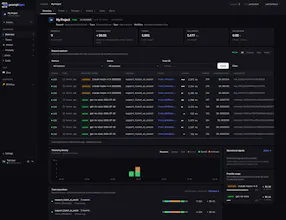
PromptLayer is AI observability for developers. Trace requests, workflows, token usage, latency, costs, and failures through a single timeline and waterfall view. Follow complete execution paths across multi-step AI systems, understand where failures occur, identify slow or expensive workflow steps, and debug AI applications with the same visibility developers expect from modern software systems.
Interactive


Free
Launch Team

Context.devAPI to scrape anything for AI, 20,000+ developers trust us.
Promoted


Synara
The waterfall visualization makes sense for sequential workflows, but agent loops introduce a wrinkle: the same step can execute dozens of times before terminating (or failing to). Does PromptLayer handle cycles in the execution graph, or does it assume DAG-shaped workflows? Specifically wondering whether it surfaces repeated-step patterns as a distinct signal rather than just summing token counts.
Synara
@binu_george Good question. We don't assume workflows are DAGs.
Internally, each execution is treated as a trace made up of individual spans/events, so a node can execute multiple times within the same run. Agent loops, retries, reflection steps, tool-calling cycles, etc. all show up as repeated executions rather than being collapsed into a single node.
Today the waterfall view visualizes the actual execution timeline, so if an agent calls the same step 20 times you'll see those 20 executions in the trace rather than one aggregated step with a large token count.
Where I think this gets interesting is surfacing loop behaviour as a first-class signal. Repeated-step patterns, excessive tool iterations, retry storms, and "agent got stuck thinking" scenarios are often more valuable than the total token cost. That's something we're actively exploring as part of trace analytics rather than treating it as a simple DAG visualization problem.
Out of curiosity, are you running agentic workflows where loops are expected (e.g. ReAct/tool use), or are you seeing accidental cycles and runaway costs?
We've noticed that once agents start calling multiple tools and sub-agents, debugging becomes harder than building the workflow itself.
Are you seeing people use PromptLayer mostly for observability after things break, or are teams actively using the traces to improve agent behavior during development?
Synara
@sambenson That mirrors what we've seen as well.
Once agents start making tool calls and handing work off to sub-agents, the biggest challenge usually isn't the model quality anymore—it's understanding why a particular decision was made.
Are teams mostly reviewing traces manually today, or are you seeing people build feedback loops on top of them to automatically catch regressions in agent behavior?
Synara
@sambenson Makes sense. The observability problem does seem to come before the evaluation problem.
We've found that once a workflow involves multiple tools and handoffs, people often struggle to even define what "good behavior" looks like consistently enough to automate regression detection.
It'll be interesting to see whether evals become a standard part of agent development or remain something only larger teams invest heavily in.
BetterClaw
where did these tokens go' is the question every team running agents eventually asks and nobody has a good answer for. the waterfall view for multi-step workflows is what makes this useful over just checking your api dashboard
Synara
Hey, Just came across PromptLayer and honestly it looks like something a lot of AI builders genuinely need right now.
One thing that caught my eye, the opening line "Observability for LLM apps" might be flying over alot of stressed users thinking "why did my AI just cost me $40 in one hour" or "why did it give that user a completely wrong answer"; not thinking in terms of observability.
I took a quick crack at a different angle for your hero section, happy to send it over if you want to take a look, no cost or anything, just thought it could be useful
Synara
Build Check
Congrats on the launch!!
Synara