
Launching today

Recost
Your API costs fully visible.
59 followers
Your API costs fully visible.
59 followers
Recost shows you exactly what code is burning money before your API bill explodes. It maps cost to endpoints, flags waste like duplicate calls and bad loops, and simulates scale impact. With AST analysis and runtime tracking, you don’t just track spend, you control it before it gets out of hand.




Recost
Hey Product Hunt! 👋
We’re the team behind Recost.
We built this after watching teams unknowingly blow through API budgets.
At a hackathon, a team shipped a feature making ~200 concurrent API requests. It worked perfectly… until their API key got revoked. No visibility. No warning. Just everything shutting off.
Recost gives you a cost intelligence layer for your APIs, so you can see and control cost before it becomes a problem.
What Recost does
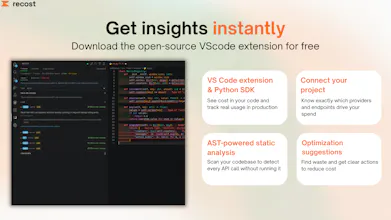
🔍 Static analysis (VS Code extension)
Detects API calls across your codebase
Maps endpoints to files, functions, and features
Surfaces cost risks before runtime
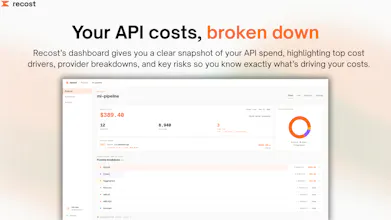
💸 Cost attribution
Cost per endpoint, provider, and feature
See what’s actually driving spend
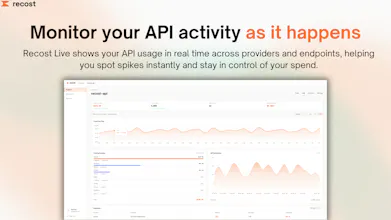
⚡ Runtime tracking (Python SDK)
Live request volume, latency, and cost
Real-time sync to dashboard
🚨 Waste detection
Duplicate calls, loops, polling issues
Suggestions to reduce cost
📈 Forecasting
Simulate scale and estimate feature cost
Catch worst-case scenarios early
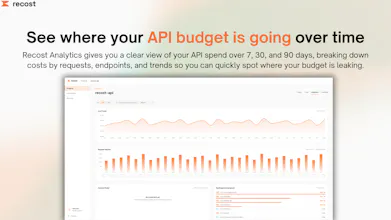
🌐 Dashboard
Unified view of API usage and cost
Trends and drilldowns
What’s coming next
MCP integration for API graph + cost intelligence
Built-in AI for better detection and estimation
Team pricing plans
Why we built this
Every part of engineering has visibility.
Logs. Metrics. Errors.
API cost doesn’t.
Recost makes cost visible at the same level as your code.
Free plan
6 projects
2 API keys
50 scans/day
100 endpoints/project
Live monitoring + analytics
We’re building fast and want real feedback.
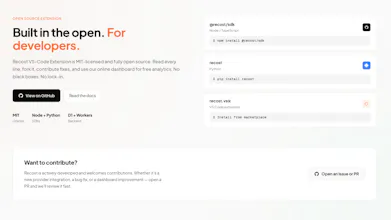
We’re also building this in the open, feel free to check it out or contribute on GitHub(https://github.com/recost-dev).
Where do API costs feel the most unpredictable right now?
@dong_recost Hi. How detailed does it show my API costs? Can I see exactly which call ate the most money? It was very tiny in the screenshot, I couldn’t make it out
Recost
@julia_zakharova2 Not down to a single exact call yet.
We focus on showing where cost actually accumulates. which endpoints, providers, and patterns are driving spend. That’s usually what matters when you’re debugging a spike or trying to cut costs.
The dashboard gives you recent request-level signals and cost breakdowns, while the extension flags issues early at the code level. So you can catch problems before they turn into a massive bill.
A full per-request ledger is something we can add, but in practice most teams care more about “what pattern is costing me” vs one isolated call.
Also yeah, screenshot is tiny, we’ll clean that up 👍
RaptorCI
This is a great idea especially for startups! I turned my attention recently to using codex and the aws cli to be able to figure out how much new infra is going to cost. Can Recost tell you how much staged changes are roughy going to cost before deploying them?
Recost
@jordan_carroll2 In some aspects, yes, one of the main features of Recost's VSCode extension is to give you an estimate on how much the API calls in your code infrastructure costs before deployment.
Additionally, there is a cost calculator built into the extension that simulates your API costs to X daily active users and X calls / user / day, giving you a more realistic estimate.
Giving you a cost estimate for just the new staged changes before deployment specifically is still a work in progress.
Would love to hear more about your current workflow if you're open to sharing! It would be useful as we scope out that feature.
brag.fast
Hey that's cool. I'm on a tight budget and use API's all the time, but you can't always set a maximum usage thus I have to monitor manually all the time. This can bring it all into one place right.
Recost
@rob_vb Yeah exactly.
Instead of checking dashboards all day, Recost puts everything in one place and shows you where your API cost is coming from in your code.
So you can:
see usage across all providers
know which features/endpoints are driving cost
catch spikes before they get expensive
Less guessing, less babysitting, more control.
My Financé
“At a hackathon, a team shipped a feature making ~200 concurrent API requests. It worked perfectly… until their API key got revoked. No visibility. No warning. Just everything shutting off.”
How do you prevent this? I.e do you see response codes and that I am getting 429 or whatever and warn, or is it strictly the telemetry of the number of concurrent events?
My Financé
Also I think your header is cut off on mobile (safari / iPhone 15)
Recost
@catt_marroll Thanks for letting us know! We just fixed it.
My Financé
Also I think your header is cut off on mobile (safari / iPhone 15)
My Financé
I have thought about this though. In a sprawling codebase it seems easily to loose track of which models are called where. (Also as new models roll out they often have cheaper pricing than old ones). Do you have a way to tell me my cost savings if I switch from model a -> b based on my token usage?
Recost
@catt_marroll Great question, this is core to what Recost does. Our SDK tracks exact token usage per model, then runs counterfactuals so you see "switching gpt-4o → gpt-4o-mini saves $X/mo" per route, plus a VS Code extension that AST-maps every model string back to where it's called (actively expanding language and call-pattern support). We sync pricing daily from provider APIs and changelogs, store versioned history (the price on the day of each call), and catch new model variants from live SDK telemetry within hours of release.
Recost
@catt_marroll The extension’s AST scanner flags risky patterns at code-time, like unbounded Promise.all, missing rate limiters, and fan-out in loops, before you even run the code. The simulation then replays those call sites against real provider rate limits, turning “this looks risky” into “this will hit OpenAI’s RPM ceiling at N=200” so you catch it before shipping, not after the key gets revoked.
Lukan AI Agent, IDE and workstation.
I like being able to centralize all the costs in an API, and not having to go to multiple places to monitor.
Recost
@enzoevn that was one of the main pain points we saw.
Costs are just scattered everywhere across different APIs and dashboards.
Recost puts it all in one place so you can actually see what’s costing you money and where it’s coming from!
Lukan AI Agent, IDE and workstation.
@dong_recost Yes, it's a headache.
Finally, a tool that stops a quick bug fix from accidentally costing more than my monthly rent!
Recost
@kelly_lee_zeeman We’ve seen it happen way too many times.
One bad loop, a retry gone wrong, or a leaked key and suddenly you’re staring at a $30k bill.
Recost is built to catch that early. It shows you where the cost is coming from in your code and flags weird spikes before they blow up.
So a small bug stays a small bug, not a financial disaster.