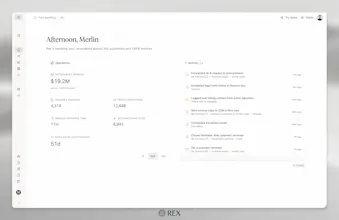
Hey Product Hunt, I'm Merlin, co-founder of Rex.
Lewis and I spent four years building AR software at Sequence. What we kept seeing: someone on the finance team copying data from a portal into a spreadsheet into NetSuite, every single day. Automation tools never fixed it because the work is full of exceptions and judgment calls.
So we built Rex to just do the work. Agents plug into your existing stack and run collections, portal uploads, and the AR inbox end to end. Anything sensitive gets routed to your team. Synthesia runs their AR on us today.
Ask me anything, including what the agents still get wrong.
Report
@merlin_kafka Congrats on the launch, Merlin. I just upvoted Rex because it's refreshing to see a product solving work that finance teams deal with every day instead of adding another layer on top. I'm curious, how does the agent decide when to hand a task over to a person instead of completing it on its own?
Report
Order-to-cash is a great wedge for agents — high-volume, judgment-heavy, and the "copy from portal → NetSuite every single day" drudgery you described is exactly where automation historically fell over. Taking you up on the "ask what they get wrong" invite @merlin_kafka:
How do the agents decide the boundary between acting and routing to a human — a confidence threshold, a fixed policy per action type, or something learned?
On portal uploads specifically — I do a lot of browser automation against sites that change without warning, and that's usually where things get brittle. How do you keep those flows stable across hundreds of customer portals?
And since a wrong AR action touches real money, how do you eval that an agent did the right thing before it goes out?
Report
Congrats on the launch @merlin_kafka! The Order-to-Cash process is notoriously tricky because writing incorrect data back into an ERP like NetSuite can wreck month-end close or mess up revenue recognition schedules.
When Rex agents handle exception resolution (like applying partial cash or mapping unmatched remittances), does the system maintain an immutable, step-by-step audit trail of the agent's reasoning right inside the ERP/CRM, or does it operate via a separate proxy logging layer for finance auditors?"
Report
you asked for it, so: what's the actual failure mode when an agent gets a judgment call wrong on a real invoice, does the customer just get an incorrect collections notice before a human catches it, or is there a hold step before anything customer-facing goes out
Report
The exception-handling angle caught my eye, since most AR tools just chase dunning emails. Curious how the agents handle messy real-world disputes vs clean test cases.
Report
order-to-cash is a good pick for agents specifically because the steps are so repetitive and rule-bound most days, and the exceptions are usually well-defined too. since this touches real invoices and payments, does finance get a full audit log of every action the agent took, or just the summary result? that matters a lot when someone has to explain a discrepancy to an auditor later.
Report
One thing that would help us a lot is a built-in dashboard showing which exceptions Rex resolved vs. flagged for human review, so we can track accuracy over time and identify any patterns in the cases it escalates.
Rex
@merlin_kafka Congrats on the launch, Merlin. I just upvoted Rex because it's refreshing to see a product solving work that finance teams deal with every day instead of adding another layer on top. I'm curious, how does the agent decide when to hand a task over to a person instead of completing it on its own?
Order-to-cash is a great wedge for agents — high-volume, judgment-heavy, and the "copy from portal → NetSuite every single day" drudgery you described is exactly where automation historically fell over. Taking you up on the "ask what they get wrong" invite @merlin_kafka:
How do the agents decide the boundary between acting and routing to a human — a confidence threshold, a fixed policy per action type, or something learned?
On portal uploads specifically — I do a lot of browser automation against sites that change without warning, and that's usually where things get brittle. How do you keep those flows stable across hundreds of customer portals?
And since a wrong AR action touches real money, how do you eval that an agent did the right thing before it goes out?
Congrats on the launch @merlin_kafka! The Order-to-Cash process is notoriously tricky because writing incorrect data back into an ERP like NetSuite can wreck month-end close or mess up revenue recognition schedules.
When Rex agents handle exception resolution (like applying partial cash or mapping unmatched remittances), does the system maintain an immutable, step-by-step audit trail of the agent's reasoning right inside the ERP/CRM, or does it operate via a separate proxy logging layer for finance auditors?"
you asked for it, so: what's the actual failure mode when an agent gets a judgment call wrong on a real invoice, does the customer just get an incorrect collections notice before a human catches it, or is there a hold step before anything customer-facing goes out
The exception-handling angle caught my eye, since most AR tools just chase dunning emails. Curious how the agents handle messy real-world disputes vs clean test cases.
order-to-cash is a good pick for agents specifically because the steps are so repetitive and rule-bound most days, and the exceptions are usually well-defined too. since this touches real invoices and payments, does finance get a full audit log of every action the agent took, or just the summary result? that matters a lot when someone has to explain a discrepancy to an auditor later.
One thing that would help us a lot is a built-in dashboard showing which exceptions Rex resolved vs. flagged for human review, so we can track accuracy over time and identify any patterns in the cases it escalates.