1,452 people started playing sanfransim at a 65% activation rate over the weekend.
REAL adspots are now open on the site, dm or send me an email to enquire, 500/month.
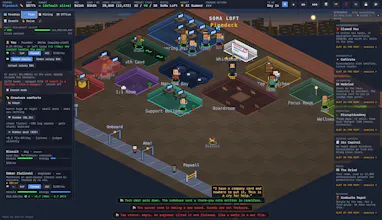
The game brings a sharp satirical edge to the startup tycoon genre by wrapping deep SaaS mechanics inside a nostalgic, retro aesthetic reminiscent of classics like RollerCoaster Tycoon and Theme Hospital. Operating completely free in the browser with zero account registration boundaries, San Fran Sim tasks players with scaling a software company from a messy garage setup all the way to a massive public IPO. Set in a legally distinct caricature of the Bay Area featuring parodies like Goggle, Chirper, and Hacker Mews, the game balances humorous corporate tropes with highly authentic operational loops. A dry, witty announcer narrates your strategic downfalls in real time as you juggle feature rollouts, bug outbreaks, burn rates, and vital team mechanics—including hiring support staff or a company dog to maintain moral.
The primary pacing friction stems from the game's high initial capital buffer, which gives players a substantial $25,000 runway right out of the gate and can lower the stakes during the early phase of the simulation. While this generous funding provides a safe playground to explore core systems, it softens the brutal survival element that usually makes early-stage garage operations feel so frantic and rewarding. Additionally, the game lacks a persistent macro dashboard or cross-session ledger to track cumulative performance records across different attempts; once your company goes bankrupt or gets successfully acquired, your specific statistical history clears completely, requiring a fresh seed initialization to try alternative growth strategies.
I’ve played traditional business simulators like Game Dev Tycoon and Startup Company, alongside educational management tools like GoPractice's Simulator. While legacy engineering sims focus heavily on generic progress bars and simple linear upgrade paths, they rarely force you to interact with genuine financial math. San Fran Sim stands out because it treats its underlying business metrics with absolute analytical rigor. Instead of chasing vague score counters, you are forced to manage live operational realities where expanding customer service lines directly influences user retention, and pricing pivots immediately recalculate dynamic growth trajectories.
Most business tycoon games lean heavily into fictional, gamified money abstractions. What makes San Fran Sim an absolute standout is that it treats SaaS economics as a core gameplay loop. You aren't just clicking a button to make arbitrary "cash" go up; you are actively balancing real-world operational metrics like Monthly Recurring Revenue (MRR), Churn Rate, Lifetime Value (LTV), and Customer Acquisition Cost (CAC). It manages to turn what usually feels like an intimidating spreadsheet into a highly addictive, high-stakes strategy game.
Starting in a humble garage and trying to survive the brutal burn rate while shipping features and squashing game-breaking bugs is incredibly engaging. The dry, sarcastic announcer who narrates your inevitable architectural failures, terrible hiring choices, and runway panics injects a perfect dose of Silicon Valley dark humor into the mix. Plus, being able to hire an office dog to boost morale is exactly the kind of nuance every startup veteran will appreciate. The fact that it runs completely free in the browser with zero signup friction makes it the ultimate "just one more run" micro-game.
VC Term Sheet Mechanics: It would be brilliant to introduce variable Venture Capital funding rounds where players have to weigh diluting their equity versus taking on demanding, impatient board members who enforce strict growth milestones.
Technical Debt Tracking: Adding a visible "Technical Debt" meter that builds up when you rush features out the door too quickly—leading to compounding bug rates or massive server infrastructure meltdowns down the line—would add an excellent layer of risk assessment.
Custom Sandbox Mode: A post-IPO sandbox mode where you can continue scaling your enterprise indefinitely, managing hostile takeovers, global marketing campaigns, and macroeconomic shifts after hitting the public markets.
Startup Company (Steam): A fantastic, deeply modular business sandbox game where you build out physical office layouts and manage server infrastructure. However, it requires a financial commitment, a local download, and can sometimes feel more like a middle-management logistics simulator than a fast-paced founder experience.
Game Dev Tycoon: The classic benchmark for developer sims, but its mechanics are firmly rooted in traditional retail game launches rather than modern, cloud-based continuous deployment and subscription metrics.
Idle Startup Tycoon: A fun browser-based clicker on platforms like Poki. While highly accessible, it relies on hyper-casual, hands-off idle progression rather than strategic decision-making and actual SaaS math.
I chose San Fran Sim because it hits the absolute sweet spot for tech professionals—it's accessible instantly in a single tab, completely free, and respects the actual mechanical realities of running an early-stage software venture.
The integration of real SaaS unit economics into a tycoon game loop makes it an excellent interactive case study for product development. Instead of abstract math, concepts like LTV to CAC ratios, churn impact, and technical debt are taught through direct systemic consequences. The inclusion of shared seed challenges is a clever framework decision. It allows indie developers and product teams to run the exact same operational simulation parameters and analyze where their resource management models diverged.
The core retention loops would benefit from long term telemetry and cumulative stat tracking across separate run seeds rather than treating every session as a completely isolated start. Additionally, the development engine could expand its team allocation mechanics. Introducing distinct developer specializations, such as infrastructure stability engineers versus frontend feature velocity roles, would simulate the real world challenges of balancing platform scale against market validation demands much better.
I evaluated standard business management simulators alongside passive SaaS educational resources like frameworks and text heavy startup case studies. While theoretical guides explain MRR dynamic models well, they lack immediate feedback loops. Most classic tycoon games skew too casual, trading accurate operational metrics for simple clicker mechanics. I chose San Fran Sim because the underlying simulation layer accurately punishes typical engineering short cuts three sprints down the line, balancing satire with genuine educational utility.


Quuu
Hi PH 👋
It's Theme Hospital meets RollerCoaster Tycoon, set in a lovingly legally-distinct San Francisco (Goggle, Chirper, Hacker Mews). The sim under the hood is real: raise prices and conversion drops, ship without QA and bugs breed, a rival will undercut you to "free, for now."
It's free, runs in the browser, no account. Every run has a seed you can share as a challenge. Would love your feedback! I'm here all day.
Happy Saturday!
@danielkempe Congrats on the launch !
The Theme Hospital and RollerCoaster Tycoon inspiration immediately caught my attention. I love games where every decision has real tradeoffs instead of just bigger numbers.
I'm curious, what's the funniest or most unexpected strategy you've seen players discover that completely broke your expectations? Those emergent moments are usually what make simulation games so memorable.
Wishing you an awesome launch and plenty of creative chaos! 🎮🔥
How deep does the simulation actually go on the metrics side - are churn and LTV calculated dynamically based on player decisions or do they follow fixed formulas?
Quuu
How long does a typical playthrough take, and does the dry announcer's commentary actually adapt based on the metrics you hit or is it kind of scripted throughout?
Quuu
the real sim under the hood is what turns a joke game into a compulsion loop. "ship without QA and bugs breed" should be the tagline of every SaaS post-mortem ever written.
real q: does the game track cumulative stats across runs, or is each seed a fresh start? asking because the deepest tycoon games are the ones where you learn a category-level rule ("never skip QA in month 3") and carry it into the next run.
As someone actually doing the startup thing, these games are either therapy or a personal attack, no in between. Does San Fran Sim model the boring failure modes (running out of runway, a cofounder walking, a launch that just flops quietly) or is it mostly the fun growth-curve fantasy? The unglamorous parts are the ones that would make me laugh.
Quuu
Quuu
YourSitee
This is dangerously relevant for anyone building a startup :))
The dry announcer narrating every bad decision might be the best part. learning MRR, churn, CAC, burn rate, pricing, hiring, and shipping tradeoffs through a game sounds much more memorable than reading another SaaS metrics guide. "A rival will undercut you to free, for now" also feels painfully accurate.
I can already see myself hiring the dog before the company can afford it :)