

Scindo
AI captures decisions, drafts plans, and opens matching PRs.
47 followers
AI captures decisions, drafts plans, and opens matching PRs.
47 followers
Your team agrees on a feature in chat. The AI agent captures every decision, drafts the plan, and opens a PR that matches what was agreed. No more "that's not what we discussed." Shared context between humans and agents — tasks, plans, GitHub, canvas, VS Code, CLI. One workspace from decision to shipped code.


Free Options
Launch Team / Built With


Scindo
Congratulations @kim1017 One thing that’d be great to see is a decision audit trail — a timeline showing what was agreed, who signed off, when, and what PR it generated. For post-mortems and onboarding new engineers, that institutional memory would be worth the tool alone.
Scindo
@jacklyn_i It's truly a good idea. We will what we can do about it. :) Thank you very much!
Scindo
@jacklyn_i Your great feedback is heard and now timeline is available on Scindo! Thank you for your sharing! Please let me know if you want to see anything else. :)
That’s not what we discussed. Rework. Again.” — every engineering team has lived this exact cycle. Question: how does Scindo handle decisions that evolve mid-sprint? If a signoff gets approved but the requirements shift two days later, is there a way to flag downstream PRs that were opened based on the old context? That traceability chain would be incredibly powerful. Congrats on the launch!
Scindo
@jerrybyday Thank you! Your invaluable feedback is on our task list :)
Scindo
@jerrybyday Plans change. That's fine — as long as nobody ships against a stale one.
When someone edits a plan after sign-off, Scindo revokes every existing sign-off automatically. Everyone sees it: "Plan was edited — all sign-offs have been revoked." No one moves forward without re-signing.
If there's already a PR open against the old plan, Scindo flags it in the thread. You can view what changed, close the PR and re-implement, or dismiss if the PR still applies. Your call.
Everything shows up in the Timeline — who revised the plan, when sign-offs were revoked, who dismissed the drift warning. Full history, no manual logging.
The plan can shift. The team doesn't get blindsided.
Can Scindo handle multiple features discussed at the same time without mixing context?
Scindo
@derek_julian great question!
Scindo handles this in two ways:
One task, one feature. Each task is its own thread with a dedicated lifecycle — created, planned, shipped, done. The plan file goes straight to your repo as a PR. No overlap with other tasks. Think of each task thread like a focused ticket.
Scoop off-topic messages into new tasks. If someone brings up something unrelated in a thread, any member can create a new task from that message in one click. Keeps the original thread focused and nothing gets lost.
Example attached.
@kim1017 That's a clean approach. How do you handle cases where two features are closely related or depend on each other?
Scindo
@derek_julian Great question!
When matches are found, Scindo classifies each one — is it a duplicate, does the new task depend on it, does it extend it, or is it just related? So if two features are closely tied, the user sees exactly how they connect (e.g., "Depends on: PR #42 — Add Stripe integration") and decides how to proceed. It flags the relationship, it doesn't block.
The hardest part of tools like this is getting the whole team to use the same workspace — one person going off-channel breaks the whole context chain. How are you thinking about adoption friction, especially for teams where some developers live in the terminal and others in Slack?
Scindo
@marianademchuk Excellent question/challenge. :) Thank you!
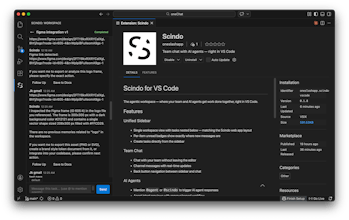
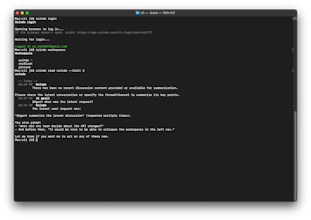
Terminal developers never leave the editor — Scindo runs inside VS Code and as a CLI. scindo send, scindo agent, same threads. PMs and designers stay in the browser. Three surfaces, one workspace. Nobody switches tools, everybody shares context.
The agent is the adoption hook. Once one person 'mentions' the agent in a task and the team sees a plan, a PR, and a deploy happen from one thread — the value is obvious. The second person joins because the first person stopped copy-pasting.
We're not replacing Slack. We're the workspace where agents and humans work together. Slack doesn't do that.
Scindo
📋 Week 2 maker update
Shipped:
Improved agent onboarding flow
Faster thread loading
Canvas rendering fix on smaller screens
Most common feedback:
"I didn't realize the agent could actually take actions — I thought it was just a chatbot." Working on making that clearer in onboarding. The "wow moment" (agent proposes PR → you approve → it opens) needs to happen faster in the first session.
If you tried Scindo and got confused, I specifically want to hear from you.
What broke the experience?
Scindo
Week 3 maker update:
Shipped knowledge base this week. Teams can now add documents, wikis, and reference materials that all agents in the workspace can access. So when your agent answers something, it's using your team's actual context — not just general knowledge.
Also shipped: any thread can now be exported as a structured document in one click. The agent handles the formatting.
What would make you switch your team to Scindo? Honest answers only. :)
Scindo
Your AI agent lives in one tab.
Your team lives in another.
Context dies every time you switch.
Scindo puts the conversation, the agent, the task, and the document in one thread.
The agent sees what the team sees.
Not a chat app with a bot.
The agentic workspace.
→ scindo.one