
Secret Key
Let your family unlock your passwords if you can't
107 followers
Let your family unlock your passwords if you can't
107 followers
Open-source, self-hosted emergency access for your password database. Split the master password into pieces for people you trust (e.g. any 3 of 5 unlock it). Access needs SMS verification and a 48-hour delay you can cancel with one click.




Free
Launch Team

AWS Activate CreditsCredits that fuel your startup’s next milestone
Promoted
Hi Product Hunt! 👋 I’m Mateusz, the maker of Secret Key.
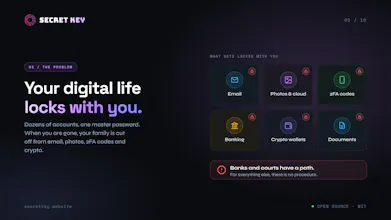
The problem: if something happens to you, your family is locked out of everything: email, photos, 2FA codes, crypto, bank. Most password managers offer no real way around that.
What Secret Key does: it protects your password database (e.g. KeePass) and splits the master password into pieces using Shamir’s Secret Sharing. You hand the pieces to people you trust, and you decide how many are needed to unlock it (for example, any 3 of 5). One piece alone reveals nothing.
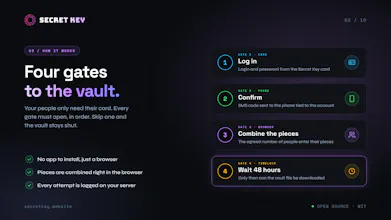
How access works:
A loved one signs in with their printed card.
They confirm with an SMS code.
The agreed number of people enter their pieces.
A 48-hour timelock starts. You get an email with a one-click Panic Button to cut access off if it’s a false alarm.
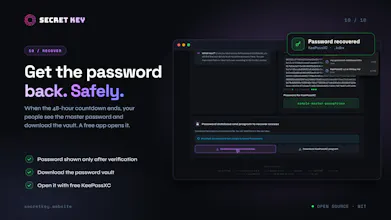
Only then can the vault be downloaded.
Details that matter:
Self-hosted: it runs on your own server, so no vendor holds your vault.
Pieces are generated offline, in your browser.
Printable cards (PDF with QR code) for each person.
Open source (MIT).
🌐 Heads-up: the live demo (app.secretkey.website) and the app itself are currently in Polish only, since I built the system for my own family first. The video is narrated in Polish by default, but it comes with English narration, English subtitles and several other languages: just pick them on YouTube (⚙ → Audio track / Subtitles). The project site, documentation and the slides above are in English.
Shamir’s Secret Sharing is done with the open-source secrets.js library (MIT), the same one used by iancoleman.io/shamir, so you can verify the shares independently, outside Secret Key. Big thanks to its maintainers!
I’d love your feedback, especially on the recovery flow and what would make you trust a tool like this with your own vault. Thanks for checking it out! 🔑
What's the point? If I understand correctly, other family members become dependent on other family members, who could also be vulnerable to something happening? Wouldn't it be easier to store your password somewhere family members can access it (for example, by entering the password and other security measures if necessary)?
@maxim100000 Fair question, thanks for asking! The point is that nobody has access to anything while you’re still around. If the password sits somewhere your family can already reach, then so can anyone who finds it, or any one relative you’d rather not trust fully. With Secret Key it takes a threshold (say 3 of 5 people), so losing one or two doesn’t lock everyone out, and no single person can open it alone. There’s also a 48-hour delay, so if someone tries while you’re alive, you get an alert and can block it.
It’s definitely more complex than a sealed envelope, and for many people that’s enough. This is for those who don’t want to rely on a single person or place.
@mateuszkarpierz If you're talking about a safe with jewelry worth a couple of million, then sure, it sounds reliable. But how often is that actually needed? In most situations involving a password, nobody else should have access to your personal information at all. If relatives do need access, you'll just tell the right people the password. The question remains: why would they need access to your personal information in the first place? If you're preparing to die, you'll share the password yourself, provided there’s anyone worth trusting. If you suddenly disappear and are declared dead, that's such a rare situation that your relatives will figure out how to deal with your safe.
@maxim100000 Fair point, and for many people sharing the password with one trusted person is the better answer. Secret Key is for a narrower case. The problem I had in mind is not “preparing to die” but a sudden accident or illness. You’re alive but can’t act, and nobody has the password, or the one person who has it can’t be reached either. Declaring someone dead or incapacitated can take months, and in the meantime bills, subscriptions, photos, and work accounts stay locked. The other case is when you don’t want anyone to hold the password today. With Secret Key, no one can open the vault while you’re fine: access needs several people together, SMS verification, and a 48-hour delay you can cancel with one click.
It’s definitely more complex than telling someone the password, so it’s not for everyone. Thanks for pushing on this, it helps me explain the use case better :)