Stop rebuilding wearables from scratch. SensWear is an open-source, modular platform for creating smart rings, wristbands, patches, and custom devices. Mix sensor modules, access synchronized raw data, run edge AI, and build with Python or TypeScript without vendor lock-in or a required cloud. The full stack is MIT-licensed. Back the ready-to-use development kit on Crowd Supply: https://www.crowdsupply.com/sensera-technologies/senswear-wearable-dev-kit
Most wearable devices are closed systems. Developers cannot freely access raw sensor data, modify the hardware, or decide how and where their data is processed. Building a new wearable often means starting almost entirely from scratch.
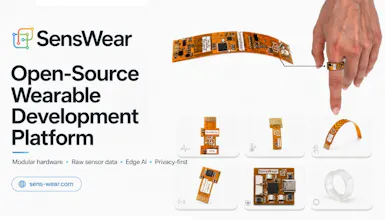
SensWear is a reusable, modular foundation for many kinds of wearables. Instead of creating another device with a fixed purpose, we built SensWear as an open-source platform with interchangeable sensor modules, unrestricted raw-data access, edge-AI support, and no required cloud connection.
The entire stack is open source under the MIT License and available on GitHub. Ready-to-use SensWear kits are also available for those who want to start building immediately.
We are now preparing to bring SensWear to a wider community through our Crowd Supply campaign. Follow the campaign to receive updates and be notified when it launches.
Our goal is to help researchers, makers, and product teams move from an idea to a working wearable prototype without rebuilding the entire hardware and software stack each time.
We would love to know what you would build with SensWear, and which sensors or modules you would like us to add next.
Report
@dariushsalami This is a really interesting approach. I especially like the idea of having access to the raw sensor data without being tied to a specific cloud or ecosystem.
Curious: what kinds of projects are people already building with SensWear? Have you seen any use cases that surprised you?
Report
Maker
@ir3ne Thank you for the interest! One concrete example came out of a summer school we ran at Aalto University in Finland. The students used SensWear’s raw IMU data to build a gesture-recognition system for simple hand gestures such as swipe left/right/up/down and tap.
What was nice about that use case was that they could go through the whole pipeline themselves, collect and label the raw sensor data, train their own ML model, and then run the recognition on top of the wearable stack without depending on a proprietary API or cloud service.
That is exactly the kind of experimentation we hope SensWear enables: treating the wearable as a development platform rather than a closed device.
@dariushsalami being able to just run pip install senswear to pull acceleration streams is a relief compared to fighting closed apis. how easy is it to flash custom python ml models directly to the board for local execution?
Report
@dariushsalami I love the idea of an open-source standard fro wearable devices. Not something I need today, but allows me to consider future products for the software I build. Best of luck with the launch.
Report
Maker
@codeandsea Thanks a lot! And yes, exactly, that’s actually one of the main ideas behind SensWear. Since the whole stack is open source, from the hardware and firmware to the SDKs and software interfaces, it can definitely be used purely as a platform for software development as well. You can build applications, algorithms, data pipelines, or new wearable experiences on top of it without having to design the hardware from scratch. Hopefully it can make experimenting with future wearable products much easier 🙂




Hi Product Hunt community,
Most wearable devices are closed systems. Developers cannot freely access raw sensor data, modify the hardware, or decide how and where their data is processed. Building a new wearable often means starting almost entirely from scratch.
SensWear is a reusable, modular foundation for many kinds of wearables. Instead of creating another device with a fixed purpose, we built SensWear as an open-source platform with interchangeable sensor modules, unrestricted raw-data access, edge-AI support, and no required cloud connection.
The entire stack is open source under the MIT License and available on GitHub. Ready-to-use SensWear kits are also available for those who want to start building immediately.
We are now preparing to bring SensWear to a wider community through our Crowd Supply campaign. Follow the campaign to receive updates and be notified when it launches.
Our goal is to help researchers, makers, and product teams move from an idea to a working wearable prototype without rebuilding the entire hardware and software stack each time.
We would love to know what you would build with SensWear, and which sensors or modules you would like us to add next.
@dariushsalami This is a really interesting approach. I especially like the idea of having access to the raw sensor data without being tied to a specific cloud or ecosystem.
Curious: what kinds of projects are people already building with SensWear? Have you seen any use cases that surprised you?
@ir3ne Thank you for the interest! One concrete example came out of a summer school we ran at Aalto University in Finland. The students used SensWear’s raw IMU data to build a gesture-recognition system for simple hand gestures such as swipe left/right/up/down and tap.
What was nice about that use case was that they could go through the whole pipeline themselves, collect and label the raw sensor data, train their own ML model, and then run the recognition on top of the wearable stack without depending on a proprietary API or cloud service.
That is exactly the kind of experimentation we hope SensWear enables: treating the wearable as a development platform rather than a closed device.
PicWish
@dariushsalami being able to just run pip install senswear to pull acceleration streams is a relief compared to fighting closed apis. how easy is it to flash custom python ml models directly to the board for local execution?
@dariushsalami I love the idea of an open-source standard fro wearable devices. Not something I need today, but allows me to consider future products for the software I build. Best of luck with the launch.
@codeandsea Thanks a lot! And yes, exactly, that’s actually one of the main ideas behind SensWear. Since the whole stack is open source, from the hardware and firmware to the SDKs and software interfaces, it can definitely be used purely as a platform for software development as well. You can build applications, algorithms, data pipelines, or new wearable experiences on top of it without having to design the hardware from scratch. Hopefully it can make experimenting with future wearable products much easier 🙂