
tash
The investment platform for trading cards
71 followers
The investment platform for trading cards
71 followers
tash gives investors access to professionally curated portfolios of high-end graded trading cards. tash manages sourcing, verification, vaulting, reporting, and the eventual sale of the underlying assets.


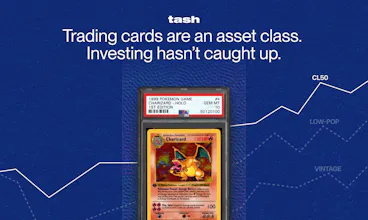

Hey Product Hunt 👋 We’re the team behind Tash (YC S26).
We’re building the investment platform for trading cards.
THE PROBLEM
Trading cards have evolved into a $50B+ global asset class supported by professional grading, extensive sales data, insured vaulting, and multimillion-dollar transactions.
But investing has barely changed.
Today, investors still have to research, source, price, verify, store, track, and eventually resell every card individually. Building diversified exposure often means becoming a part-time card dealer.
Real estate has REITs. Gold has ETFs. Equities have index funds.
The asset class exists. The investment product does not.
WHAT TASH DOES
Tash gives investors access to professionally managed portfolios of high-end graded trading cards.
Our initial portfolios range from broad market exposure through the Tash25 Index to focused strategies like GOATs, Rising Stars, Vintage, Pokémon, and TCGs.
Investors get diversified exposure while we handle sourcing, verification, secure vaulting, insurance, reporting, and the eventual sale of the underlying cards.
We’re actively pursuing SEC qualification to make these products available to more investors.
If this sounds interesting, join the waitlist at tash.cards. We’d love to have you be one of the first to get access.
WHY US
We grew up collecting cards and never stopped.
Victor, Nathan, and John met in high school before attending UC Berkeley, where we met Nico and became roommates. Together, we’ve bought and sold more than $1M of trading cards and collectibles.
Our backgrounds span finance, data, and marketplaces, alongside years spent buying at card shows, negotiating, tracking prices, and studying the market firsthand.
THE BIGGER VISION
Trading cards are the starting point.
Our long-term vision is to build the financial infrastructure needed to bring the broader $330B+ collectibles market into public markets, making cultural assets easier to access, evaluate, and invest in.
We’d also love to hear from the Product Hunt community: what part of the collectibles market would you want an index for first?
We’ll be here answering questions. Thanks for checking out Tash 🚀
For discussion purposes only. This is not an offer to sell or a solicitation to purchase securities. Any offering will be made solely through definitive offering documents and in accordance with applicable securities laws. Investments involve risk, including possible loss of principal.
the part I'd want answered before joining a waitlist is liquidity. with a REIT or an ETF you can sell your position on the open market whenever you want, price is whatever the market says right now. here it sounds like you're locked in until tash itself decides to sell the underlying cards - is there any secondary market for investor shares before that, or is the exit basically "wait for the fund's own timeline"? that's a very different risk profile even if the underlying asset class is legit
@galdayan Great question. Investors won’t have to wait for tash to sell the underlying cards, there will be a secondary market where positions can be bought and sold.
@nathanborshell good to hear that exists, that changes the risk profile a fair bit. the follow up I'd actually want answered before joining a waitlist though is depth, not existence - a REIT's secondary market works because there are always buyers at some price. is tash's the same, or is it closer to "we'll try to match you with another investor if one happens to want in at that moment"? those are very different things to call a "secondary market" and only one of them gets you your money back on your own timeline.
@nathanborshell @galdayan Early on the secondary market is investor-to-investor matching, and we’re not going to pretend that’s infinite exchange-level depth on day one. Though, we also aren't going to leave that matching up to luck. We're actively lining up institutional bids to sit on the buy side, and tash itself will also inject liquidity to keep exits moving. Every position is backed by graded cards with live comps (eBay, PSA, CardLadder), so there’s always a transparent (& independent) reference price instead of a bid-ask void.
@nathanborshell @john_ohannesian the "tash injects liquidity" part is actually the piece I'd want stress-tested more than the institutional bids. institutional demand can dry up in exactly the moments retail investors want out (that's basically what happened to every asset class in a downturn), so the real question is what tash's own liquidity injection is backed by and whether it has a cap. if too many people want to exit in a short window, does the reference price from eBay/PSA/CardLadder just become the price you're forced to sell at even if that's a temporarily depressed comp, or is there a mechanism to widen redemption timelines instead of forcing a bad-price exit? that distinction matters a lot more than whether a secondary market exists on paper
LETS GOOOOO
@yahia_bakour3 Thank you Yahia!