
Taste Lab
Extract any website's design DNA
709 followers
Extract any website's design DNA
709 followers
Point your AI agent at any website. Get back a complete design breakdown — colors, type, spacing, and the reasoning behind every decision — ready to use in your next build.




Free
Launch Team / Built With


ArticosTest your messaging on your audience, right inside Claude or ChatGPT
Promoted


@sunlinsen love it.
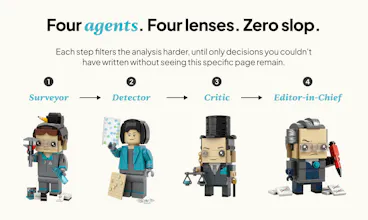
@sunlinsen The 'delete any principle that could've been written without seeing this site' rule is the sharp part. How do you stop it from over-fitting, treating one page's quirks as the brand's actual taste? Curious where you draw the line between a site's real signature and just noise on that specific page.
Very cool! Does it provide md files?
very cool idea! does it capture interaction and motion too (transitions, easing), or is it focused on the static layer for now?
The "why" behind design decisions is exactly what's missing when you hand off to AI agents. Tried it on a few sites and the output is way more useful than just extracting colors and fonts. Nice work, upvoted!
The part I'd try first is running this on a messy personal portfolio, then using the breakdown as a prompt for a redesign instead of starting from a blank style guide. I like that it tries to explain why the spacing and type choices work, not just list tokens. Does Taste Lab keep a reusable brief/history for a site, or is each scan meant to be a fresh one-off export?
Love the concept. Have you experimented with analyzing entire product ecosystems rather than individual pages? I'd be curious to see how Taste Lab handles consistency across marketing sites, product dashboards, and mobile experiences. 🤔
Websites are becoming increasingly animated, how does it captuer animations styles? and unconventional animations?