Vendo
Let your users build their own features inside your product
313 followers
Let your users build their own features inside your product
313 followers
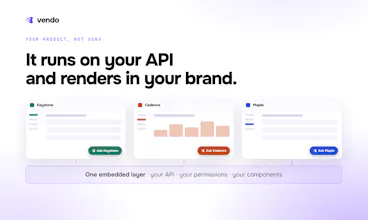
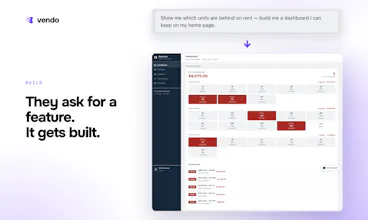
Vendo is the embedded layer that sits inside your SaaS product and lets your end users add the features they need, just by describing what they want. They build their own views and micro-apps, take real actions on your app, and connect the tools they already use, all on your API and in your brand. So you finally have a way to keep up with everything your customers ask for, and every one of them gets the product shaped to how they work.
This is the 2nd launch from Vendo. View more
Vendo
Launching today
Vendo is an open-source customization layer in your product that lets every customer add the features and micro-apps they need, just by describing what they want. Until now software has been rigid, and every customer had to adapt to it. Vendo makes it dynamic, so your product shapes itself around each customer, built on your own API and inside the guardrails you set.


Free Options
Launch Team / Built With


Vendo
@nourzahzah Congrats for the launch! haha clicked purely because of the headline. "Let your users build their own features" is the kind of thing most SaaS teams would never say out loud. The endless "can it work a little differently for us?" queue is painfully real, curious how the guardrails work when a user builds something that touches sensitive data.
I am wondering how the agent does not touch the source code but touches the database and possibly security design? Does the product owner get to know what has been added on by a user and who then is responsible when something does not work well?
Vendo
@richatsealedvault Great question! Everything the agent creates is stored in a seperate artifact per app, that is completely seperate to the source code. It only interacts with the API using the existing user authentication, so everything works within your existing security gaurdrails. And yes, we have an insights page in our console where you can see everything your users are creating.
Skriptr
Very interesting guys. I really like the idea, but I am curious to howthis really work in practice. Does the user request really buid a feature in realtime for just that particular customer? Have seen some cool demos of the new gimini for this lately. Definetly some potential here. Congrats on the launch!
Vendo
@prebenandersen Thank you Preben! And yes, it builds everything in realtime. We will be releasing some benchmarks soon demonstrating that we are not only faster than anything else out there at this, but the only ones able to hold accuracy as well.
Fabraix
Vendo
@zachx0 Great question Zach, and this is a problem we have worked hard to solve! We have a smart conflict resolution process that tries to re-apply the same user edits to the updated code and tries to resolve it as much as it can itself. If it is unable too though, we surface it to the user and let them know.
Very Interesting! Can this pull in data from tools outside our product, or is it only our own data?
Vendo
@i_hdesd Thanks! Both, actually. It runs on your API and data, and anything it generates is built from your own components so it doesn't invent anything. On top of that, your users can connect their own outside tools (we support hundreds of integrations), so the agent can pull from those too.
Fabraix
interesting - can def see adv of this as a way to add val to customers. hows it sandboxed tho ?
Vendo
@ibrahim_abdu1 Great question! We have two layers. For quick screens where there is no need for a backend, we have a QuickJS-based sandbox that runs everything and generates the UI for the user (this happens instantly, and it looks native on your site). For features/apps that need a backend or more advanced capabilities, we spawn an ephermeral sandbox where everything runs from.
Fabraix
@yousef_helal ok how does this impact latency?
Vendo
@ibrahim_abdu1 For the first layer (the QuickJS-based sandbox) it does not affect latency at all, and it is instant. This is since it is in-process so there is no noticeable delay. For more advanced applications requiring an ephermeral sandbox, there is a slight increase in latency (still sub-second). But we keep a warm pool to minimize this!
Fabraix
@yousef_helal nice!
WUPHF by Nex.ai
Congrats guys. How do you handle a PM's fear that customers will customize themselves into pure mess and it will be hard to take it back? and also generate support issues they aren't responsible for?