
Caimera
AI Visual Production Platform for Fashion Teams
331 followers
AI Visual Production Platform for Fashion Teams
331 followers
From sketch to sale — Caimera helps e-commerce brands go to market faster. Create stunning product photos, videos, and social content with AI.




Hey Product Hunt ,
Generative AI made fashion content cheap. It didn't make it usable.
Generative AI enabled you to create 1 image at a time. It didn't build actual bulk workflows for you.
If you've ever put an actual garment through an image model, you know the failure mode. The drape is wrong. The fit reads two sizes off. The color is off, the background is changing in every image, the model is not consistent and phew!! you need to do this image by image to get it right.
My co-founder Kirti ran over 200 physical photoshoots as CEO of Okhai. Every new style meant the same grind — ship samples, cast models, book a studio, wait on retouching, reshoot because the fit read wrong on camera. About $4,000 and several weeks per style.
Switching to AI seems like a no brainer, but tools are failing to provide consistency or the speed AI is supposed to bring to our workflows.
So we built Caimera: an AI visual production platform that takes a garment from sketch to sale.
Design — sketch to image with real texture, print and textile accuracy. Tech packs in minutes. Trend-ready designs from your own brand DNA. Batch produced.
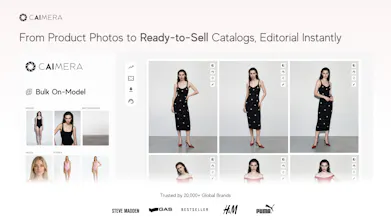
Ecommerce — flat-lay or sketch to a full on-model catalog, consistent backdrops, lighting and models. Batch Produced. Caimera also has a tool for creating ghost mannequin images, recoloring with texture intact, and batch resizing and background change.
Marketing — create editorial imagery with the largest library of AI fashion models, 20,000+ creative templates for editorial images and product videos. Caimera also supports 14K upscale for billboards.
Where it's landed so far: 99.3% lower cost per image, 10× faster to publish, ~50% lift in CTR. Teams at H&M, Steve Madden, Superdry, Dolce Vita, Kurt Geiger, Ioni Swim and Floafers are running their AI visual production pipeline on it.
What I'd genuinely love feedback on: where the workflow breaks apart. Bring us your hardest bulk workflow, you want to generate 100 sketches, then create tech packs and lifestyle images for all the styles to launch, but the workflow is shaking — tell us where we fall short. That's the only benchmark that matters to us.
Kirti and I are here all day.
— Prateek, co-founder & CTO
@prateek_gupte how much manual editing is still needed after a batch is generated, especially for ecommerce catalogs?
@reda_roqai_chaoui Depends on the product. Very detailed embroidery can still need some manual editing. We offer manual editing right there in the app with a team of retouchers
@tehreem_fatima5 You can set tuning per product and that gets carried into the knowledge graph whenever you use that product in any generation!
This looks fantastic for asset creation. However, most e-commerce platforms have specific dimensions, product placement and visual guardrails that can sometimes reject assets from high traffic placements (mastheads, etc.). The consequence of this is a longer lead time, missed branding opportunities and inefficient utilization of the fixed buy period. It would be fantastic if that was programmed by default for leading retailers in key markets. That way, it would solve 2 key challenges - asset creation and asset approval (best practices by the platform) in the same workflow.
The failure you describe is the expensive kind, because a wrong drape still looks like a good photo. Cost per image and CTR both look fine when the fit reads two sizes off, and you find out at the returns desk six weeks later. If H&M or Steve Madden will let you publish return rate on AI-shot styles against photographed ones, that's the number that ends the argument, not 99.3%. The rest is a procurement conversation.
We sell into indie consumer brands, so this is aimed squarely at people I talk to weekly. Two things from that side of the table.
The buying trigger is almost never "our photos could be better". It is a launch date with no shoot booked, or a marketplace listing rejected for image spec. Founders do not shop for a visual production platform. They shop for the thing standing between them and going live on Thursday. Whatever the equivalent of that is for you, that is the page they should land on.
The objection you will hit is not quality, it is whether they can use the output. Amazon, Shopify and the big marketplaces each have their own image rules, and a beautiful asset that fails a listing check costs more than no asset. If you already handle spec compliance per channel, say it loudly, because it is worth more to a small brand than another style preset.
The synthetic person label on that first image is a good instinct, by the way. Getting ahead of disclosure before anyone forces you to is going to age well.
This tool has the best best model selection. They even have a custom model making option which I tried my hand at, sooo easy to use. But the selection itself has such Authentic realistic variety of faces, body types; all with amazing skin texture, makes my work really stand out and look so edgy!