
ChatGPT Interactive Learning
Learn math and science with interactive visual explanations
154 followers
Learn math and science with interactive visual explanations
154 followers
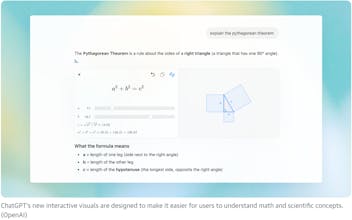
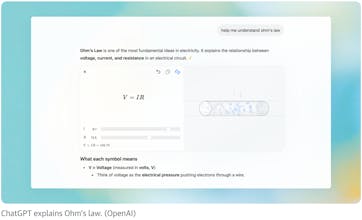
140M people already use ChatGPT to solve math and science problems. Now it actually shows you. Interactive Learning brings dynamic visual explanations to topics like the Pythagorean theorem, Ohm's law, and compound interest, no textbook required.
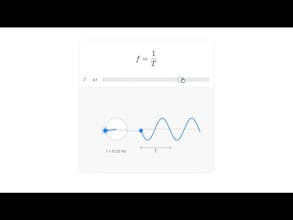
ChatGPT just got a powerful upgrade for learning math and science!
OpenAI is rolling out interactive visual explanations that turn abstract concepts into hands-on learning experiences.
Instead of just reading formulas, learners can now manipulate variables and instantly see how graphs, formulas, and relationships change in real time.
This tackles a big problem: many people struggle with math because concepts feel abstract. With these dynamic modules, ChatGPT helps users experiment with equations, explore relationships, and understand concepts more intuitively.
Starting with 70+ core topics like the Pythagorean theorem, PV=nRT, Coulomb’s law, exponential decay, and more, the experience makes learning far more interactive than traditional explanations.
Great for students, parents, and educators who want a more exploratory way to learn, teach, and understand math and science concepts.
The feature is rolling out globally to all logged-in @ChatGPT by OpenAI users starting today.
I hunt the latest and greatest launches in tech, SaaS and AI, follow to be notified → @rohanrecommends
@sunbash same here, can't find any info. Since when does ChatGPT release its products on PH?
@sunbash yes, it's the official asset that they had shared in their communication during the feature release.
This is exactly the evolution ChatGPT needed for education. The jump from reading about equations to manipulating variables and seeing real-time graph changes is massive for conceptual understanding. Starting with 70+ core topics covering Pythagorean theorem, PV=nRT, and Coulomb's law is smart - these are precisely the subjects where static textbook explanations fail most students. The ability to experiment with equations dynamically bridges the gap between memorization and genuine understanding. Would love to see this expand into chemistry molecular interactions next.