Launched this week

ClientJam
AI-powered lead generation for designers and agencies
77 followers
AI-powered lead generation for designers and agencies
77 followers
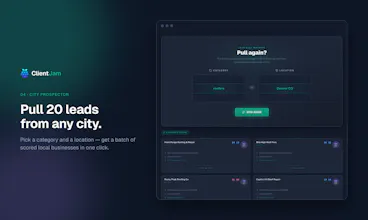
Most lead generation apps tell you who a business is. ClientJam tells you how badly they need you — then writes the pitch. Paste any URL for a plain-English audit (SSL, mobile, speed, SEO), an opportunity score ranking leads by ripeness, and 3 ready-to-send emails built from the site's real flaws. City Prospector pulls 20 leads from any city worldwide. Anyone can list contacts — ClientJam scores intent from a real audit and writes the outreach. The gap between a list and a booked call.




ClientJam
Hey Product Hunt 👋 Kevin here, solo maker of ClientJam.
The hardest part of running a web design business was never the design — it was finding clients. My process was brutal and manual: scroll Google Maps looking for businesses with rough websites, open 30 tabs to hand-audit each one (is it on mobile? is it slow? no SSL?), then stare at a blank screen trying to write a cold email that didn't sound like every other cold email. Hours of work to send a handful of pitches.
I kept thinking: every step here is something a computer should do for me. I already know what a "ripe" lead looks like — a real local business losing customers to a broken website. I just needed something to find them, score them, and help me say the right thing.
So I built ClientJam to collapse that whole funnel into one pass: paste a URL (or pull a batch from any city) → technical audit → opportunity score → three outreach emails grounded in that site's actual problems.
How it evolved: I started thinking it was an "audit tool," but every test user kept asking the same thing — "okay, but what do I say to them?" That reframed the whole product. The audit isn't the point; it's the evidence. The real value is turning a score into a sentence you can actually send. That's when the outreach generator went from a nice-to-have to the core.
It's free to start (no card), and I built it solo on Next.js, Vercel, Clerk, Stripe, and Neon.
I'd genuinely love feedback from other designers, freelancers, and agency folks: when you're prospecting, what's the step that actually wastes your time? Happy to answer anything in the comments 🫐
Curious whether you see this expanding beyond marketing sites to evaluate SaaS or native apps, scoring things like accessibility, information architecture, onboarding flows, and overall UX. The prospect company would obviously need to provide some level of access (a demo, free trial, etc.) for the agent to work with though. Maybe even analyzing customer reviews to surface common pain points if there is no product access? Asking because our agency is trying to shift away from brand design and toward more product design work, so that kind of analysis would be huge for us in lead gen on that side.
The cold email writing is a great feature. I'm a sales rep turned project manager but still carry a small level of sales outreach responsibilities at my new company, and a piece of my soul dies every time I have to write a cold outreach. If ClientJam can take that off my plate, that's a huge win. Have you thought about options for tailoring the tone to specific stakeholder roles? The messaging for a startup founder versus a CMO at an SMB versus a product director at enterprise level would probably vary pretty significantly. Could be a really compelling layer to add.
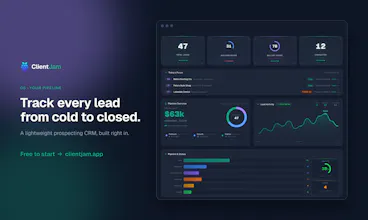
The basic CRM is a smart call too. We actually just cancelled our HubSpot account last week because we weren't using it and was a waste of money. Something simple to track outreach and manage follow-ups is all we really need, that's a great feature to include here.
If you could incorporate product analysis into ClientJam, I'd be very intrigued and would definitely give it a try. Best of luck on the launch, sending good vibes your way! Well done!
ClientJam
@connal_kelly Thank you for taking the time to write such a thoughtful comment!
On product analysis: you've mapped the exact tension I've been sitting with. Auditing a marketing site is easy because it's public; evaluating SaaS accessibility, IA, and onboarding needs access which breaks the "score a lead before you ever talk to them" magic that makes ClientJam useful for cold outreach. That's why your customer-reviews idea is interesting. Pulling recurring pain points from public reviews (G2, app stores, Reddit) is a no-access signal you can open a pitch with: "your users keep mentioning XYZ". That's a real wedge into product-design lead gen, and it's going on the list with your name next to it. The full in-product UX audit is a bigger lift, but it's exactly the direction I want to grow.
On tone-tailoring by stakeholder role: 100%, and this one's very doable. A founder, an SMB CMO, and an enterprise product director don't just have different titles they have different fears, and the email should speak to those. Role-aware outreach is a clean next layer on top of what's already there. (And I felt "a piece of my soul dies" in my bones. That line is the entire reason the cold-email feature exists.)
On the CRM: you just described the whole design philosophy. You shouldn't have to keep a HubSpot seat alive just to track who you emailed and when to follow up. Lightweight on purpose.
Run it on a few prospects and tell me where it falls short for product design work specifically. That feedback is gold right now, and I'd genuinely love to keep talking as your agency makes that shift.
Thank you for the good vibes! Right back at you. 🫐
@kevincoy Awesome thanks Kevin, looking forward to giving it a try!
lead gen for designers and agencies is a tough category because the quality of the lead matters way more than the volume. one warm intro to the right kind of client beats 50 cold contacts. curious how ClientJam scores lead fit before it surfaces it. is it scraping signal from a designer's portfolio and matching it to a prospect's recent activity, or is the matching more rules based?
ClientJam
@thenameisarian You're right that fit beats volume, and you've pointed at the exact line ClientJam sits on today.
Right now the matching is deterministic, not machine learning. It doesn't scrape a designer's portfolio or model a prospect's recent activity. What it does is pull up the prospect's actual website and run real checks on it (does it load, HTTPS, title and meta tags, an H1, mobile viewport, load time, page weight), then turn the gaps into a few scores: site health, SEO, and an opportunity score. That opportunity score is basically "how much measurable upside is sitting on the table here," so the leads that rise to the top are the ones with the most fixable, sellable problems.
So to be precise: today it scores opportunity, not fit. It tells you who has a clear problem you can solve, not whether that prospect matches your specific niche or just raised money or is hiring. That second layer, matching a designer's portfolio against a prospect's recent signals, is exactly where I think this gets powerful, and it's the direction I want to grow.
The reason I started with the deterministic audit is that it's transparent. You can see every reason a lead scored the way it did, no black box, and it hands you a concrete hook to open the conversation with. Genuinely good question. If you try it, I'd love to know whether opportunity scoring alone gets you close enough, or whether that fit layer is the piece you'd actually need.
Running an agency, the thing I've learned the hard way is that by the time you need more clients to work with, your lead pipeline has already dried up. The opportunity score is the part I find most interesting - does it weight issues by likely business impact, or mostly by technical severity? Curious how you're thinking about which flaw becomes the hook.
ClientJam
@sanjeev617 Totally with you on the pipeline drying up right when you need it. That's the itch I was scratching.
Today the score weights technical severity, not business impact yet. It blends site health and SEO, and leans hardest on the flaws a prospect's own customers feel, like the site not loading, no HTTPS, not mobile friendly, slow loads. Those double as trust and conversion killers, so it's a decent proxy for "this is costing them money," but it's still a proxy.
Where I'm taking it is real impact weighting. A missing meta description and a broken mobile checkout shouldn't carry the same number. The hook should be the flaw quietly bleeding revenue, not the one that's easiest to detect.
Curious how you'd weight it from the agency side. What's the flaw that actually makes a prospect say yes?
Agency lead gen is brutal. What channels are you finding work best for outreach right now?
ClientJam
@mohamed_hussein25 Warm outbound is still working best but only when it’s specific. The big shift is personalization. Generic agency outreach is brutal, but if you can point to a real issue on their site - slow mobile experience, weak local SEO, outdated design, confusing CTA - the conversation feels way less cold. Right now I’d say LinkedIn + email for direct outreach, X for visibility and relationship-building.
memi
Designers needing leads is painfully real. I like that this points at the boring business part agencies avoid until pipeline gets quiet.
ClientJam
@sarveshsea Exactly — you nailed the real trap. Prospecting is feast-or-famine: nobody touches it while they're busy, then the pipeline goes quiet and suddenly it's a panic. The whole idea behind ClientJam is to make that "boring business part" cheap enough to do consistently — a proposal in 60 seconds instead of an hour — so you're never starting from zero. Appreciate you getting it.