Launched this week
The faster your team ships with AI, the harder it becomes to keep production stable. Not anymore. Coldtea is an agentic IDE where your coding agents build, visual QA agents catch regressions, and AI monitoring watches production, so your team can keep moving at agent speed without breaking anything



Free Options
Launch Team / Built With


Coldtea.ai
Hi Product Hunt, Ohans here from @Coldtea.ai.
Coldtea brings your terminal, end-to-end testing and production monitoring into one agentic development environment.
Terminal: Run the agents you already use, in parallel, with shared context between them. No lock-in. Your workflows stay yours.
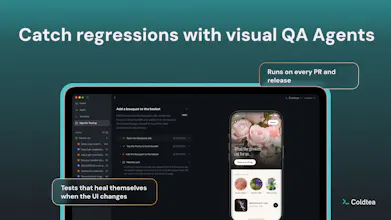
Visual QA agents: They drive your real app and catch regressions before your users do. And let you automate every release testing (supports iOS, Android and web)
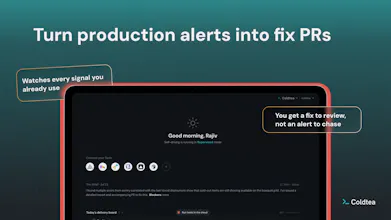
AI production monitoring: Watches production after the deploy and tells you what broke, in plain language. Connects your logging, observability tools, and agent traces in one place, so you wake up to investigated fixes, not blind alerts
Tasks: Brings your engineering tasks closer to where you work. One place your team and your agents both work from, whether locally or in the cloud
Try it now: coldtea.ai
Would love your feedback; I'm in the comments all day.
Thanks!
Shipping faster was never our hardest problem.
When I was a Staff Engineer at the world's largest meal kit brand, HelloFresh, what I personally obsessed over was the part after merging a PR: how do you know a regression didn't slip through, how do you know what production is doing right now, have we architected the product right, and where does the whole team go to see it all of this in one place? That question followed me home.
Then agents arrived and made it louder. I tried every tool out there, and my day turned into context-switching between them or stringing together a custom workflow. Orchestration in one tab, QA in another, monitoring somewhere else.
It took me a while to see why none of them fixed it. Every other agentic development environment out there is pointed at the same thing: build. Run more agents in parallel, ship faster, orchestrate better.
All of that is genuinely good, and all of it is the first act. Software delivery was never just building, so the tools that only do build hand the rest back to you to figure out.
So we spent the last five months rethinking what a holistic agentic development environment for engineering teams could look like, alongside some fast-moving teams.
This is how Coldtea was born.
Coldtea is an agentic development environment for the entire software lifecycle. Not bolted on, not an afterthought. Day zero. Agents can already work across the entire stack. The next era of development environments has to do the same. That's our thought process.
Would love your feedback, especially if you're the one who gets paged when the thing your agent shipped breaks.
PicWish
Coldtea.ai
@mohsinproduct Yes, on shell settings, nothing to configure. A Coldtea terminal pane runs your login shell, so your zshrc, aliases, PATH and env come along the same way they do in any terminal. Custom scripts behave exactly as they do today.
Context is a different thing; what's really shared is the workspace. An agent can read what's on another pane, so if your script dumped a stack trace two panes over, Claude can read it there instead of you copying it across. Agents in separate panes can message each other (good for agent teams, e.g., one reviewer, one implementer). The whole workspace is readable context whenever an agent needs to reach it.
And anything that needs to survive beyond the session lives on the task: the description, the implementation plan, and session logs. In Coldtea, agents can equally read and write to tasks natively.
ProdShort
@ohansemmanuel Congrats on your launch !! 🚀🚀
Coldtea.ai
@amraniyasser Thanks!!
Tabstack by Mozilla
@amraniyasser thanks for your support 🙏
Coldtea.ai
@ohansemmanuel @amraniyasser Thanks you very much :) Really appreciate your support 🙌
@ohansemmanuel To answer your launch thesis, the biggest gap in AI development today isn't code generation speed it's verifying that new code didn't silently break legacy features. Congrats for launch ,qq how does Coldtea integrate with existing observability platforms (like Datadog, Sentry, or Honeycomb) when pulling production incident context?
Coldtea.ai
@priya_kushwaha1 for observability, it came down to one question: what's the best way to give an agent real context and let it run the discovery loop itself?
Where we landed is persistent remote machines with the provider's native CLI installed. The agent queries the source directly, narrows down, and queries again.
It reasons through the incident rather than working off a wall of pre-fetched context sitting in its window.
That also makes new providers cheap to add. If it has a CLI, we can wire it.
This also means from a isolation from a security standpoint since you can expose read-only tokens for these integrations.
Tabstack by Mozilla
it's worth mentioning the full list in the docs here: coldtea.ai/docs/platform/integrations/observability-integrations
@ohansemmanuel Makes sense for keeping it lightweight and secure. Since Coldtea queries the provider directly what happens when older Sentry data ages out? Does Coldtea persist any incident context or summaries over time or is its historical view limited to whatever the provider still retains?
Coldtea.ai
@tehreem_fatima5 For most connections, it means one click, e.g., click to connect Sentry.
For Datadog, it means clicking to go to your Datadog account, creating an isolated key and pasting it into Coldtea.
So, relatively easy, I'd say.
But it varies per platform, as we adapt to what's possible given the platform's APIs.
Alconost Localization Lab
@ohansemmanuel Hi Ohans, congrats on keeping #1 of the day! (we are trailing at #3 but far from you 😀).
I checked out your product page and keep wondering: does it mean all QA is done entirely by AI, or am I missing something? From what I know, relying only on AI for QA can cause issues... would love to know how Coldtea solves this!
Coldtea.ai
@margarita_s88 Haha, firstly congrats on the launch!!!
Secondly, yes, the QA is automated via AI agents. But we apply some caching for some level of determinism.
But overall, we've built this to keep humans in control, not the other way around. So at any point in time, a human can jump in!
Alconost Localization Lab
@ohansemmanuel thank you! :)
And thanks for the reply! Great, so the point was not to exclude humans from QA - on the opposite, one can customize the QA process to their own needs.
Coldtea.ai
@margarita_s88 yeah, and you can generate shareable artefacts humans can review
Tabstack by Mozilla
Love this direction. When most dev environments focus on building faster, @Coldtea.ai takes a different, calmer approach, focusing on building better. Agentic QA and monitoring, terminal and tasks, all in one place for less context-switching, and beautifully crafted by @ohansemmanuel and team.
@naviradjou could name @Coldtea.ai "the frugal ADE."
Try it now: coldtea.ai
Congrats on the launch.. My big build issues lie upstream of the QA agent.
Where does the test intent come from? If the coding agent and the QA agent both work off the same idea of what the feature should do, the check is a mirror.
And can Coldtea catch a test that always passes? Mine sat green for a week while a bunch of stuff was breaking, because it was only checking that a metadata column was present. That column could never be null, so every run came back legit.
A check that has never failed once is the thing I want flagged.
Coldtea.ai
@himanshu_garg It all begins with intent! Because this is a connected system, context from the original task flows into the QA agent (when needed).
In general, intent is set by you. Always.
I'm not sure what you mean by "mine sat green ....", do you mean in some other software?
@ohansemmanuel Yes, I meant like the tests I made with claude code in my terminal. AI written tests are not complete a lot of times and need iterations. So I was kinda trying to understand that "upstream" of the QA cases - there would definition of QA requirements/product requirements where my agents normally screw up. May be you have your harness tuned for that, or any other things you noticed with making cases that look green on the surface but essentially they were probably not deep enough
Receded my incorrect paste earlier here. Thanks for pointing out. In my defence soloop were no 2 today and when the product crashed I came back and posted in the other tab that was open. :P Thanks for the response here
Does everything work as one integrated system, or can the different parts be used independently? We're currently developing with Claude Code and Claude Design, but we don't have any really good tools for QA. Could we use your service specifically for QA, independently of the other parts?
Coldtea.ai
@natalia_iankovych Yes, you can. And if you ever need to use Claude Code in the terminal, that's always available in Coldtea too.
However, the individual systems work equally well
The promise sound great , but "agent speed without breaking anything" is a bold claim. I'd be interested in seeing how it perform on large , real-world codebases.
Coldtea.ai
@craig_bennett1 It is indeed a bold claim. At the risk of stating the obvious, there's no such thing as 100% coverage (or when there is, there's a tradeoff elsewhere - design/speed/other resource)
So, the way we approach this is to give teams what we think are the required verification signals to stay shipping fast but let them make the required tradeoffs wherever they see fit.
First, post-deployment monitoring: There's no such thing as zero-bug software. Whether written by humans or agents, software inevitably breaks for different reasons.
The problem is that when shipping so fast, this typically rises and becomes more obvious. So, this is a bigger problem than, say, 2 years ago.
One solution is to simply stop shipping fast.
Slow down.
That's a valid solution.
Another is to react faster. Leverage agents as well further down the lifecycle, post-deployment. An incident is already too late.
This is the approach we've taken, or offer.
The second is automated regression testing: end-to-end testing gets a bad rep in general. They're slow, and historically we've needed fewer of them.
In a world where the speed of shipping's risen so high, I think a fair tradeoff is to balance that speed with the arguably slow automated visual regression testing (using slow as a reference to standard unit-type/ functional tests)
Agents actually clicking, and using the software like a real user would.
I've seen too many green PRs still break visually. And agents are a bad judge of their own work, and extended impact when intent is isolated to a specific problem.
Now a team can decide: do I want these visual agents on every PR, or would we rather ship fast and just do a single bug bash-style release-regression check with the QA agent every week, or end of day?
These sort of calls are for the engineering team to make.
We try to give the tools required to manage the speed of shipping with stability signals, but ultimately leave the tradeoffs to the team.
Personally, we fall in the camp of those who think LLMs in their current state aren't great at large codebases (or, to be frank, aren't great at architecting great software), hence why we couple these in a single agentic development environment.
That's our take. But it doesn't solve underlying LLM issues (that's a whole other conversation)
This turned out longer than I thought :) But I love the question and am happy to chat further!
Coldtea.ai
@craig_bennett1 Fair point! 😊 The goal isn't to promise perfection. It's to help teams ship faster with better guardrails through visual QA and production monitoring. We'd love to hear your thoughts if you give it a try!
DiffSense
Question: What are the 3 hardest things in software delivery that you managed to solve with this platform? thanks 🙏
Coldtea.ai
@conduit_design That's a difficult question. I can explain what we really set out to solve and have designed this for:
Stability: there's no shortage of tools to run 100s of agents in parallel. Even though you can do that in Coldtea, we think building isn't enough. So, we've also focused on tying together the rest of the lifecycle - automated regression testing with QA agents and post-deployment monitoring
Simplicity: just bolting on different things together is bloat. So we took a lot of care crafting what initially feels like standalone items to work seamlessly. Every bit of the system is visible to your CLI coding agent out of the box, and works and feels like a single system.
Context switch: agents already work across the entire lifecycle. Why shouldn't our development environment?
Tabstack by Mozilla
🐐
DiffSense
@fmerian
This is a very interesting design. How do the visual QA agents hold context of the actual intent?
Coldtea.ai
@zrk222 So intent is given. A test is a plain-language description of what should be true: what to open, what should be on the page, what should happen when you click.
The goal is to mimic how an actual users the application (web or mobile)
The agent checks that against the running app rather than guessing from the pixels what the screen was supposed to do.
Tabstack by Mozilla
@zrk222 @ohansemmanuel fwiw you can learn more about agentic testing in @Coldtea.ai here in their docs: coldtea.ai/docs/testing/overview
hope it helps