A free, browser-only workspace for performance marketers. Upload a campaign CSV or connect Google Sheets to diagnose performance shifts, budget headroom, creative fatigue, experiments, and marketing response(MMM,Regression Model and Cannibalization check)—without sending raw data to a server.
Hi, I’m the maker of Growth Opt Playbook.
I built this because performance marketers often have the data, but not a fast, trustworthy way to answer the next decision:
Why did performance move this week?
Which channel still has room to scale?
Is a creative getting fatigued?
Is an experiment actually conclusive?
What does the data say—and what can’t it say yet?
Growth Opt Playbook turns campaign CSVs or Google Sheets into practical answers for those questions.
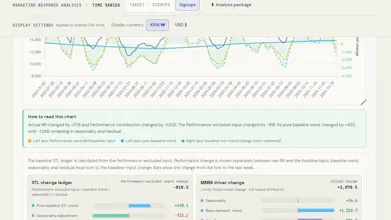
It includes an operations dashboard, budget-allocation simulator, campaign saturation and variance analysis, creative analysis, A/B and incrementality tools, marketing-response analysis, and an Aha-moment finder.
Using AI for analysis always requires tokens, and there's the issue of getting different results every time.
That's why I turned it into a single deterministic model.
A few principles mattered while building it:
• Free to start, with no signup required
• Raw marketing data stays in the browser—nothing is sent to a server
• Results should lead with a plain-language conclusion and next action, not just a chart
• When the data cannot support a confident answer, the tool should say so instead of manufacturing certainty
I’d especially love feedback from performance marketers and growth teams:
Which decision do you spend the most time making from CSV exports today?
Which analysis would make this more useful in your weekly operating routine?
Is the browser-only data approach important for your team?
Thanks for taking a look—I’ll be here all day to answer questions and learn from your feedback.
Report
@noelnme_gondry Running campaigns, the recommendation is rarely the bottleneck, trusting the attribution behind it is. If the "next move" depends on multi-touch data that's half-broken, the advice inherits that noise. Where does it pull from, and how does it deal with messy or conflicting attribution before suggesting a move?
@artem_fedorovich We don’t impose our own attribution model or reconcile multiple attribution sources into an artificial “single truth.” We analyze the data and attribution basis the marketer chooses to provide.
Our role starts from there: we validate the structure and quality of the dataset, flag issues such as missing periods, duplicate mappings, sparse coverage, and collinear channels, and then apply the appropriate statistical method.
If the evidence is weak, we label the result as exploratory or inconclusive rather than presenting it as a confident recommendation.
In short, we’re not an attribution platform. We’re a statistical decision-support layer built on top of the marketer’s chosen source of truth.
Report
Loaded a campaign CSV and it flagged creative fatigue on a couple of ad sets I had been eyeballing anyway. The fact that everything stays in the browser is a nice change from yet another login-required tool.
Because each user’s data is structured differently, i built it to work by uploading a CSV whenever needed.
There’s also a feature that lets you use data from a publicly shared Google Spreadsheet by entering its URL. If that spreadsheet is updated automatically—for example, by pulling data from BigQuery and refreshing on a schedule—you could also set up periodic checks and automations.
Thank you for using it! If anything feels off or inconvenient, or if there are features you’d like to see, please feel free to let me know anytime. i’d be happy to consider adding them.
Report
The browser-only approach is a nice touch for anyone nervous about sharing raw campaign data. Dragging in a CSV and getting the budget headroom breakdown in seconds felt pretty smooth for a free tool.
While having a dedicated server would be ideal for deeper, more accurate data analysis and smoother automation, I completely understand that many users might feel hesitant to share that kind of information with a small-scale, personal service.
Please feel free to reach out anytime if you have any feedback or notice areas for improvement after trying it out! :) Thank you!
Growth Opt Playbook
@noelnme_gondry Running campaigns, the recommendation is rarely the bottleneck, trusting the attribution behind it is. If the "next move" depends on multi-touch data that's half-broken, the advice inherits that noise. Where does it pull from, and how does it deal with messy or conflicting attribution before suggesting a move?
Growth Opt Playbook
@artem_fedorovich We don’t impose our own attribution model or reconcile multiple attribution sources into an artificial “single truth.”
We analyze the data and attribution basis the marketer chooses to provide.
Our role starts from there: we validate the structure and quality of the dataset, flag issues such as missing periods, duplicate mappings, sparse coverage, and collinear channels, and then apply the appropriate statistical method.
If the evidence is weak, we label the result as exploratory or inconclusive rather than presenting it as a confident recommendation.
In short, we’re not an attribution platform. We’re a statistical decision-support layer built on top of the marketer’s chosen source of truth.
Loaded a campaign CSV and it flagged creative fatigue on a couple of ad sets I had been eyeballing anyway. The fact that everything stays in the browser is a nice change from yet another login-required tool.
Growth Opt Playbook
@dana_tobias
Because each user’s data is structured differently, i built it to work by uploading a CSV whenever needed.
There’s also a feature that lets you use data from a publicly shared Google Spreadsheet by entering its URL.
If that spreadsheet is updated automatically—for example, by pulling data from BigQuery and refreshing on a schedule—you could also set up periodic checks and automations.
Thank you for using it! If anything feels off or inconvenient, or if there are features you’d like to see, please feel free to let me know anytime. i’d be happy to consider adding them.
The browser-only approach is a nice touch for anyone nervous about sharing raw campaign data. Dragging in a CSV and getting the budget headroom breakdown in seconds felt pretty smooth for a free tool.
Growth Opt Playbook
@xian_you
While having a dedicated server would be ideal for deeper, more accurate data analysis and smoother automation, I completely understand that many users might feel hesitant to share that kind of information with a small-scale, personal service.
Please feel free to reach out anytime if you have any feedback or notice areas for improvement after trying it out! :) Thank you!