Motionly
Motionly is an AI-native motion graphics editor.
77 followers
Motionly is an AI-native motion graphics editor.
77 followers
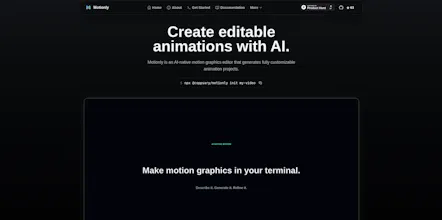
Motionly is an AI-native motion graphics editor where AI-assisted workflows create editable animation projects that you can refine visually. Edit timing, assets, animations, and layouts through a timeline and canvas editor before exporting the final result.
This is the 2nd launch from Motionly. View more
Motionly
Launched this week
Motionly is an open-source motion graphics editor built for the AI era. Instead of generating videos directly, AI generates editable .motion files that can be refined visually or in code. It combines a visual editor with a structured animation format, making motion graphics versionable, reusable, and easier for developers, designers, and AI agents to collaborate on.


Free
Launch Team / Built With


Motionly
Motionly
Motion graphics is one of the harder creative domains to make genuinely AI-native — most tools just bolt AI-generated assets onto a traditional timeline editor. Curious what "AI-native" means concretely here: is the AI driving keyframe/timing decisions directly, or is it more focused on asset generation that you still manually place and animate? And since it's open source, curious what's driving that choice — community/extensibility, or more about trust given how much of a black box a lot of AI creative tools are.
Motionly
@abhineetarora Great question! For us, AI-native isn't about using AI to generate a few assets and then dropping them onto a traditional timeline.
The core idea is that AI generates the entire motion project—a .motion file that describes the scene, timeline, asset placement, animations, easing, transitions, and effects. Think of it like how Photoshop has a PSD or Figma has a .fig file. Instead of outputting a rendered video, AI outputs an editable project that you can open, inspect, and refine visually or through code.
We're less focused on AI creating the assets themselves. In most real workflows, people already have their own logos, branding, illustrations, or media they'd like to animate. Of course, if you're using an AI provider that can generate assets (like SVGs), Motionly can incorporate those too. A workflow we imagine is asking AI to generate a specific animated SVG, then using that as part of a larger .motion project.
As for open source, it's both about extensibility and trust. We want developers to build custom renderers, plugins, AI integrations, and new workflows on top of Motionly. And because the project format is open, you're never locked into a black box—you own the project file and can edit or generate it however you like.
@promsereyreaksa That's a genuinely different model — outputting an editable project file rather than a rendered result means the AI's decisions stay inspectable and revisable, not just a black box you accept or regenerate from scratch. The PSD/Figma comparison makes it click immediately. And the "you own the project file, never locked in" trust angle resonates with me specifically — we've built ClipStudios around similar thinking on the video side (content provenance, not black-box outputs). Nice architecture, good luck with the launch!
Motionly
@abhineetarora Thank you so much!
Motionly
LottieFiles
The editable-.motion-file approach is the right call — AI generating a structured, diffable format instead of pixels is what makes motion actually maintainable at scale. Two genuine questions: (1) how does .motion relate to existing runtime formats like Lottie — can a project export to something that renders on web/mobile via an existing runtime, or is playback tied to your own player? (2) once AI generates a project and someone hand-tweaks timing/layout on the canvas, does the underlying file stay clean enough that versioning/diffs stay meaningful, or does regeneration tend to churn the whole file?
Motionly
@reallynattu Thanks for the thoughtful questions! Also, we love LottieFiles. 😊
Right now, playback is handled by Motionly's own renderer. The idea with .motion is to provide a structured, editable source format for motion graphics that both AI and humans can work with. Export targets and runtime integrations are something we're exploring as the ecosystem grows.
This is actually a really interesting challenge we're working through. When you make visual edits, they update the underlying .motion file, and currently users can choose whether to overwrite the same file or save a new version. We're exploring better approaches for diffs and versioning, especially around cases where a human is editing visually while an AI agent is also making changes. There are a lot of interesting questions around conflict resolution and keeping changes meaningful.
Also, we're exploring ways to work with existing animation ecosystems like LottieFiles, for example using Lottie animations as reusable components inside larger .motion compositions.
Thanks again for the thoughtful questions!
the pitch that's usually missing from AI motion tools is exactly what you're doing here, keeping it as an editable timeline instead of just a rendered clip you have to regenerate from scratch every time you want a small change. how deep does the editability go though, can you swap an easing curve on one layer without the AI touching anything else around it?
Motionly
@omri_ben_shoham1 Yes you can! You can change the keyframe, animation duration.. Without affecting the styling or its positions. Update color, change the text rotation or scale without messing up the current animation. But right now We’re working on the keyframe and making better, with graph visuals and more keyframe options and also custom keyframes. Hopefully We can rapidly make these all better than what they are soon!
Motionly
Hello everyone!
Motionly is open source! 🚀
If you’re interested in how it works or want to contribute, check out the GitHub repository:
https://github.com/COPPSARY/Motionly
We’d love your feedback and ideas as we continue building it. ❤️