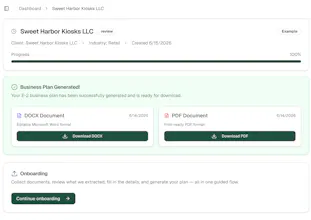
An AI E-2 Visa Agent interviews, reads their evidence (bank statements, leases, invoices), checks the core E-2 eligibility standards, and produces a submission-ready plan with real 5-year financials, charts, and use-of-funds — as a designed PDF and editable Word doc. Outside vendors charge ~$2,000 and paralegals spend a week on this. Plansera gives you a strong first draft to review in ~30 minutes. Flat $100 per plan, no subscription. (Built for U.S. immigration professionals.)
I build tools for immigration law firms, and the E-2 business plan keeps coming up as the same headache for everyone I talk to.
Today a firm has two options: pay an outside vendor around $2,000 per plan, or spend close to a week of a paralegal's time pulling figures, building the financials, and formatting something the consulate will actually accept.
Plansera is a third option. An AI agent handles all in plain language, reads their actual documents — bank statements, leases, invoices — extracts source-of-funds and use-of-funds, runs the core E-2 checks (substantial investment, capital at risk, non-marginal enterprise, directing role), and generates a submission-ready plan with deterministic 5-year financials and charts. You get a designed PDF and an editable Word file.
To be clear about what it is and isn't: it produces a genuinely strong first draft, not a finished filing. The workflow is roughly 30 minutes of careful review by the professional on the case — the attorney's judgment stays the attorney's judgment. It removes the blank-page week, not the oversight.
Flat $100 per plan, no subscription. There's an example plan already in the dashboard so you can see the output before paying for anything.
Would love feedback from anyone in immigration law or legaltech — especially on the eligibility checks and the financial model. What would make this defensible enough for your practice?
Report
Love the launch .. immigration attorneys are incredibly risk-averse. if the agent flags a weak spot during the core checks (like low source of funds tracking), qq. does it provide recommendations on what evidence is missing? @daniel_legaltech
@thamibenjelloun we dont store the document itself, we store the OCRed markdowns on AWS. There is no time limit for now but it is a good idea to add a time limit like maybe 3 months etc. Thanks🙏🏻
The $100 flat per plan is smart pricing for a per-matter workflow. It maps directly to how law firms think about costs, per matter, not per seat or per month.
Curious what typically changes during the 30 minutes of attorney review. Is it mostly checking the financials, or do the narratives usually need rewriting too?
@attacomsian Thanks! The financials need the least review; they're deterministic, so they hold. The 30 minutes is mostly case strategy: tailoring the narrative to the applicant and the consular post, framing the source of funds, positioning non-marginality, and the directing role. Less about fixing mistakes, more about judgment. And that judgment is exactly why the attorney stays in the loop before anything gets filed.
Report
@daniel_legaltech It’s brilliant that the agent explicitly pauses to prompt users for missing data like capital at risk or source of funds. But what happens if the extracted OCR markdown across multiple documents contains conflicting data like discrepancies between an active lease agreement value and an automated bank statement line item? How does the agent reconcile conflicting evidence before generating the final draft?
Report
Respect for being this upfront that it's a strong first draft and the attorney's judgment stays theirs, most launches oversell that. Does telling users the financials are deterministic actually make them trust the draft more, or does it just shift where the 30 min of review goes?
Report
Since the visa applications have to be accurate, and if the artificial intelligence makes a mistake by misreading something from the bank statements or making a mathematical mistake, then does it have an easy way of checking and finding out the mistake made?




Lovie Formation - Incorporation MCP
Love the launch .. immigration attorneys are incredibly risk-averse. if the agent flags a weak spot during the core checks (like low source of funds tracking), qq. does it provide recommendations on what evidence is missing? @daniel_legaltech
Lovie Formation - Incorporation MCP
Mailwarm
How do you handle sensitive client docs, like where the evidence gets stored and how long you retain it?
Lovie Formation - Incorporation MCP
StartupBase
The $100 flat per plan is smart pricing for a per-matter workflow. It maps directly to how law firms think about costs, per matter, not per seat or per month.
Curious what typically changes during the 30 minutes of attorney review. Is it mostly checking the financials, or do the narratives usually need rewriting too?
Lovie Formation - Incorporation MCP
@attacomsian Thanks! The financials need the least review; they're deterministic, so they hold. The 30 minutes is mostly case strategy: tailoring the narrative to the applicant and the consular post, framing the source of funds, positioning non-marginality, and the directing role. Less about fixing mistakes, more about judgment. And that judgment is exactly why the attorney stays in the loop before anything gets filed.
@daniel_legaltech It’s brilliant that the agent explicitly pauses to prompt users for missing data like capital at risk or source of funds. But what happens if the extracted OCR markdown across multiple documents contains conflicting data like discrepancies between an active lease agreement value and an automated bank statement line item? How does the agent reconcile conflicting evidence before generating the final draft?
Respect for being this upfront that it's a strong first draft and the attorney's judgment stays theirs, most launches oversell that. Does telling users the financials are deterministic actually make them trust the draft more, or does it just shift where the 30 min of review goes?
Since the visa applications have to be accurate, and if the artificial intelligence makes a mistake by misreading something from the bank statements or making a mathematical mistake, then does it have an easy way of checking and finding out the mistake made?