

Sonarly
The AI that fixes prod autonomously
237 followers
The AI that fixes prod autonomously
237 followers
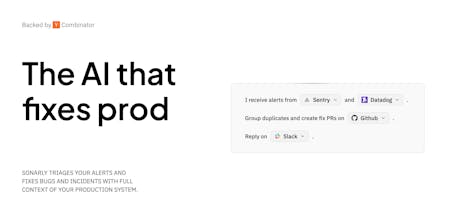
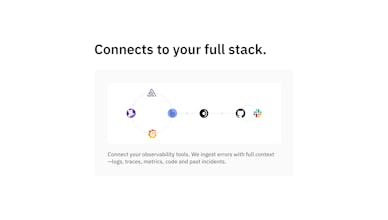
Connect Sentry, Datadog, or any monitoring tool. Sonarly's agents triage your alerts, deduplicate the noise, and fix bugs with full context of your production system. Autonomously! Most monitoring tools tell you what broke. Sonarly tells you why, groups the duplicates, and hands you a production-aware PR with evidence. Powered by Claude Code and Opus 4.6 with deep production context by Sonarly.

Free Options
Launch Team / Built With


Sonarly
Hey Product Hunters 🫶
I'm Dimittri, co-founder of Sonarly (YC W26)! Excited to introduce Sonarly, the AI that fixes your software autonomously.
More code than ever is being pushed, which means more bugs than ever arrive in production.
When production breaks, you don't see one alert, you see an avalanche. Sentry, Datadog and friends all light up at once. Some alerts are critical, some are duplicates, some are just noise. You click through them one by one, jump to logs, try to piece together a root cause, and end up wondering if your alerting is even worth paying attention to.
Sonarly solves all of that.
We bridge the gap between monitoring tools and coding agents to finally make software improve itself.
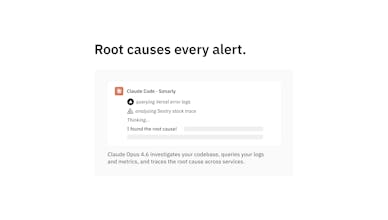
Powered by Claude Code and Opus 4.6, Sonarly is the most powerful AI agent to deduplicate alerts and fix bugs with an optimized context of your production system, including access to your codebase, logs, metrics, and traces.
Connect your monitoring tools and watch Sonarly investigate and deduplicate while you focus on shipping and talking to your customers!
What you get:
- An intelligent grouping to remove the noise and duplicates from your alerts
- Automatic investigation and fixes with PRs and evidence to ensure nothing is hallucinated
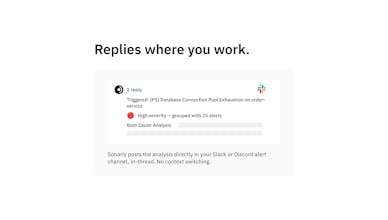
- Slack-native integration to fit directly into your workflow
We started Sonarly because we've been building products since we were 16, but were frustrated that no tool existed to bridge monitoring and fixing, it felt so obvious to us.
We work with fast-growing companies and help them cut their resolution time, and now we want to help you do the same.
We built the tool we wish we had when we started. Sonarly is the tool we dreamed about when we got our first users.
Try Sonarly at sonarly.com with 100% off for next 2 weeks, promo code SONARLYHN (only for Hunters!)
Sonarly
@dimittri We will respond to any question you have 🔥
Café
Sonarly
@tom_nguy hey Tom! curious to know if it can help you at Revo:)
Really cool that you're using Claude Code under the hood for this. The alert deduplication alone sounds like it would save a ton of time. Most teams I know just drown in Sentry noise and end up ignoring half of it.
One thing that pairs well with backend monitoring like this is collecting bug reports from actual users too. Something like Blocfeed lets users click on the broken element and submit reports with full context (CSS selectors, console errors, browser info). Helps you catch the stuff that monitoring tools miss because users experience things differently.
Congrats on the YC launch! How does it handle false positives? Like if Sentry fires an alert that's not actually a real issue, does Sonarly still try to "fix" it?
Sonarly
@mihir_kanzariya It finds the root cause, checks whether it impacts users, and if not, marks it as low severity so you only get alerted for real issues! The noise reduction also comes from grouping duplicate alerts, which we do by combining different alerts that share the same root cause.
Told
Curious how you handle the cases where the AI-generated PR fixes the symptom but not the root cause — that seems like the failure mode that would erode trust the fastest. The monitoring + auto-fix loop is interesting but it requires a lot of trust in the system, and most eng teams I know are still pretty cautious about auto-merging anything. What does the human review step actually look like in practice?
Sonarly
@jscanzi We run tests and give confidence scores based on evidence to ensure all PRs are reliable.
The review step depends on the changes: for small ones, engineers can merge directly. For bigger ones, they'll usually pull locally to test, then merge.
Finally, if you need updates to the fix, just @sonarly in a GitHub comment with full context of your prod system.
The "evidence to ensure nothing is hallucinated" framing is doing a lot of work in your pitch. What does that actually look like in the PR? Are we talking linked log lines, specific stack traces, a confidence score on the root cause?
Sonarly
@abayb Exactly!
Sonarly links specific logs, traces, metrics, code lines, commits, and deployments that caused the issue and validates if they're solid enough for root cause confidence.
The confidence score comes from the agent: obvious evidence = high confidence.
This also filters noise for human review!
Been using @Sonarly for a while and big fan. Really helps to cut through all the emails I get from Sentry. Spending much less time on alerts and fixes now. Thanks for building this @dimittri @alexandre_k_
Sonarly
@alexandre_k_ @maiuran14 Nice words! happy to count you among our early users!
WeWeb.io
Sonarly
@raphael_goldsztejn happy to onboard you and your team!
Sonarly
@raphael_goldsztejn 🔥
The alert deduplication that groups Sentry and Datadog noise by shared root cause is the part that actually changes on-call life... most engineers aren't drowning in real incidents, they're drowning in duplicate alerts for the same one. The fact that Sonarly returns a production-aware PR with evidence rather than just a diagnosis closes the loop properly. Curious how it handles incidents that span multiple services with separate owners... does it route the PR to the right team automatically?