Build AI agents that take real actions. Swytchcode provides production-ready execution across 2,000+ APIs with built-in reliability, policy enforcement, and state management.
Give agents reliable access to 2,000+ APIs w/ durable state
Write agent logic, and skip the plumbing. Give AI agents reliable access to 2,000+ APIs with retries, idempotency, policy enforcement, and durable state.
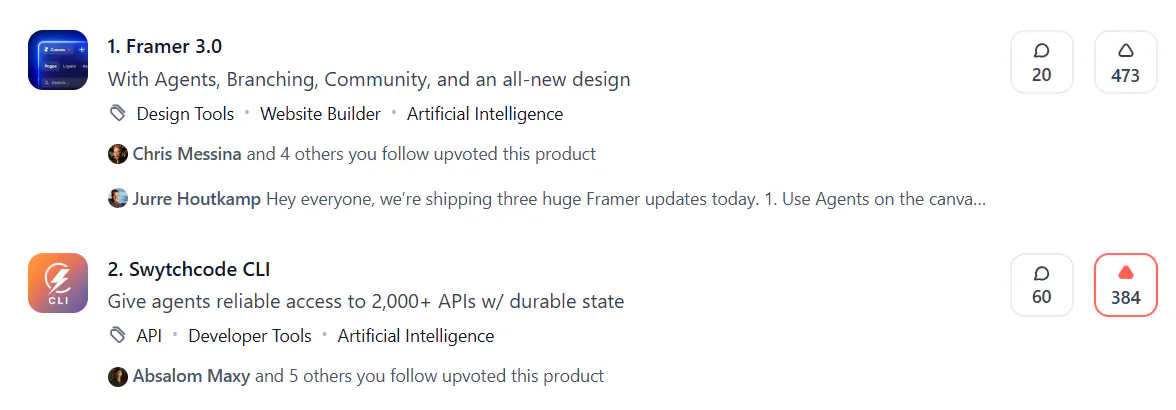
We ended up as the #2 Product of the Day, and we also got featured, right alongside some incredible products we genuinely admire like @Framer . Seeing @Swytchcode sit there still doesn t feel fully real.
Last November, @Swytchcode launched on Product Hunt and ended up as #1 Product of the Day.
At the time, our product looked very different. We were focused on a web-based integration experience and were still figuring out where we fit in a rapidly changing developer ecosystem.
Yesterday was a wild ride for us. Swytchcode ended up winning #1 Product of the Day on 16th Nov 2025, finishing with exactly 400 votes, something we genuinely didn t expect. We went in thinking the top product would land around 250 300 votes (on a Sunday) but three products crossed 300, and somehow we climbed all the way to the top.
Over the last year, we kept seeing the same pattern. Building AI agents was easy. Getting them to reliably execute actions in production was not.
Agents would call APIs with invalid payloads, fail because of auth issues, retry actions that shouldn't be retried, or break when an API changed. Debugging these failures quickly became a bigger problem than building the agent itself.
The agent wasn't the problem. The execution layer had zero protection.
That's why we built Swytchcode CLI.
Swytchcode sits between your AI agent and every API it calls.
Schema validation before every request. Field renames and breaking API changes don't silently break your agent.
Authentication handled. OAuth, API keys, and enterprise SSO without exposing credentials to the agent.
Idempotency guarantees so duplicate executions don't create duplicate outcomes.
Policy enforcement to keep agents operating within defined guardrails.
2000+ APIs out of the box, including Stripe, GitHub, Slack, Resend, HubSpot, Notion, Jira, Twilio, OpenAI, Anthropic, Gemini, Binance and many more.
Works with Claude, Cursor, Copilot, Openclaw, Gemini, windsurf , Hermes agents. No rewrites. No new infrastructure.
We believe the next wave of AI products will be defined not by how well agents think, but by how reliably they execute in production.
Try it now:
npx swytchcode
We'd love feedback from AI engineers, agent builders, and anyone experimenting with agentic workflows.
@chaitrali_kakde1 Congrats on the launch guys. may be add direct integration with popular secret vaults eg Doppler or AWS Secrets Manager for enterprise ICPs down the road?
Report
the npx approach is the right call - being able to drop this into an existing agent setup without architectural rewrites is exactly how this kind of tooling should work. durable state across API calls is the piece most CLI tools get completely wrong. curious how conflict resolution works when two agents are hitting the same endpoint concurrently - that's usually where state layers fall apart in practice
@galdayan Hey Gal, I think we didn't convey the messaging properly. The thing is, Swytchcode CLI helps agents write the integration code inside your project via MCP and rules. The generated integration code then calls the CLI to fetch data from the API (and all the rules are honored). So in a way, we are just a library that makes the API request for your project. Hence, the conflict doesn't appear.
Would be happy to show a demo and get feedback from you
This is a strong framing: the agent is not the hard part, reliable execution is. In B2B workflows, policy enforcement often needs business context, not just API/schema context. Can Swytchcode scope policies by role or risk level, for example allowing an agent to update HubSpot freely but requiring approval before sending customer-facing messages or changing billing data?
@rahulbhavsar Yes this is a brilliant idea. Today we are implementing the policies for individual methods and libraries. This should be up in our next release.
Do give the CLI a try and would love more such feedback
Report
@chilarai That's exciting to hear — policy enforcement at the method/library level is exactly the kind of granularity that makes AI agents actually deployable in enterprise environments. Will definitely give the CLI a try. One thing I'd love to see: visibility into which policies fired during a run, not just pass/fail. Audit trails matter a lot when you're putting AI agents in front of business workflows.
@crystalmei Thanks for your interest. Idempotency is inbuilt with Swytchcode CLI. We have a manifest file to manage idempotency, retries, and environment. Also, really soon we are coming up with custom rules for each workflow
Report
Hi Chaitrali, curious to know how you guys standardize idempotency handling when each external API has wildly different native mechanisms. great to see CLI launch
Idempotency is built into the Swytchcode CLI. We use a manifest file to standardize idempotency, retries, and environment configuration across APIs. We're also adding custom workflow rules soon for even finer control. 🚀
Solid niche to own! Curious about the long tail: for the APIs in your 2000 with no native idempotency key, are you synthesizing one off a payload hash and deduping on your side? Overall, congrats on the launch!
@artstavenka1 thanks a lot. We have a manifest file where you can define custom idempotency for your API calls along with retries and environment handling. Please feel free to try out our product. Happy to hear your feedback.
Report
Congrats on the launch. The direction makes sense: execution failures are usually boring plumbing until one creates a real business side effect.
I am curious about the multi-tenant edge. When the same agent pattern runs across different customer workspaces, do policies and credentials live per workspace, per user, or in the manifest?
@blah_mad It's as simple as a typical node project. We store all the information inside the ".swytchcode" folder. Whenever you ship the project, you ship the ".swytchcode" folder. Also, similar to the npm install command, we have the "swytchcode bootstrap" command so that we ship only the metadata (to reduce the overall package size).
Report
@chilarai Got it, so the boundary is the project config. For agency/client deployments, would you expect one .swytchcode folder per customer workspace, or a shared manifest with env-specific credentials and policies?
@blah_mad the folder contains integration specs, boundaries and policies. But it doesn't contain env. They are managed as it is... The standard security practices.
Would love to discuss, showcase and get your feedback as well.
@blah_mad policies live in the manifest, credentials are managed by user either locally or through a vault.
Report
@aditya_rohit That split makes sense. For client deployments, I’d want the manifest to declare allowed actions, and the local/vault layer to bind credentials per workspace. Do you expose that mapping in the run log, or is it mostly config state today?
Swytchcode
Hey Product Hunt, Swytchcode CLI is live today! 🚀
Over the last year, we kept seeing the same pattern. Building AI agents was easy. Getting them to reliably execute actions in production was not.
Agents would call APIs with invalid payloads, fail because of auth issues, retry actions that shouldn't be retried, or break when an API changed. Debugging these failures quickly became a bigger problem than building the agent itself.
The agent wasn't the problem. The execution layer had zero protection.
That's why we built Swytchcode CLI.
Swytchcode sits between your AI agent and every API it calls.
Schema validation before every request. Field renames and breaking API changes don't silently break your agent.
Authentication handled. OAuth, API keys, and enterprise SSO without exposing credentials to the agent.
Idempotency guarantees so duplicate executions don't create duplicate outcomes.
Policy enforcement to keep agents operating within defined guardrails.
2000+ APIs out of the box, including Stripe, GitHub, Slack, Resend, HubSpot, Notion, Jira, Twilio, OpenAI, Anthropic, Gemini, Binance and many more.
Works with Claude, Cursor, Copilot, Openclaw, Gemini, windsurf , Hermes agents. No rewrites. No new infrastructure.
We believe the next wave of AI products will be defined not by how well agents think, but by how reliably they execute in production.
Try it now:
We'd love feedback from AI engineers, agent builders, and anyone experimenting with agentic workflows.
Join our Discord community : https://discord.com/invite/zuSXSv5GWs
Explore the docs and get started : https://docs.swytchcode.com
Explore usecase examples: https://github.com/swytchcodehq
PicWish
@chaitrali_kakde1 Congrats on the launch guys. may be add direct integration with popular secret vaults eg Doppler or AWS Secrets Manager for enterprise ICPs down the road?
the npx approach is the right call - being able to drop this into an existing agent setup without architectural rewrites is exactly how this kind of tooling should work. durable state across API calls is the piece most CLI tools get completely wrong. curious how conflict resolution works when two agents are hitting the same endpoint concurrently - that's usually where state layers fall apart in practice
Swytchcode
@galdayan Hey Gal, I think we didn't convey the messaging properly. The thing is, Swytchcode CLI helps agents write the integration code inside your project via MCP and rules. The generated integration code then calls the CLI to fetch data from the API (and all the rules are honored). So in a way, we are just a library that makes the API request for your project. Hence, the conflict doesn't appear.
Would be happy to show a demo and get feedback from you
@chilarai would you mind sharing a demo video?
This is a strong framing: the agent is not the hard part, reliable execution is. In B2B workflows, policy enforcement often needs business context, not just API/schema context. Can Swytchcode scope policies by role or risk level, for example allowing an agent to update HubSpot freely but requiring approval before sending customer-facing messages or changing billing data?
Swytchcode
@rahulbhavsar Yes this is a brilliant idea. Today we are implementing the policies for individual methods and libraries. This should be up in our next release.
Do give the CLI a try and would love more such feedback
@chilarai That's exciting to hear — policy enforcement at the method/library level is exactly the kind of granularity that makes AI agents actually deployable in enterprise environments. Will definitely give the CLI a try. One thing I'd love to see: visibility into which policies fired during a run, not just pass/fail. Audit trails matter a lot when you're putting AI agents in front of business workflows.
Swytchcode
@rahulbhavsar Yes. Would love to talk more and explore your feedback. Sending a linkedin request
Congrats! Curious how does Swytchcode standardize idempotency handling when each API has wildly different native mechanisms or none at all?
Swytchcode
@crystalmei Thanks for your interest. Idempotency is inbuilt with Swytchcode CLI. We have a manifest file to manage idempotency, retries, and environment. Also, really soon we are coming up with custom rules for each workflow
Hi Chaitrali, curious to know how you guys standardize idempotency handling when each external API has wildly different native mechanisms. great to see CLI launch
Swytchcode
@vikramp7470 Great question, Vikram!
Idempotency is built into the Swytchcode CLI. We use a manifest file to standardize idempotency, retries, and environment configuration across APIs. We're also adding custom workflow rules soon for even finer control. 🚀
Solid niche to own! Curious about the long tail: for the APIs in your 2000 with no native idempotency key, are you synthesizing one off a payload hash and deduping on your side? Overall, congrats on the launch!
Swytchcode
@artstavenka1 thanks a lot. We have a manifest file where you can define custom idempotency for your API calls along with retries and environment handling. Please feel free to try out our product. Happy to hear your feedback.
Congrats on the launch. The direction makes sense: execution failures are usually boring plumbing until one creates a real business side effect.
I am curious about the multi-tenant edge. When the same agent pattern runs across different customer workspaces, do policies and credentials live per workspace, per user, or in the manifest?
Swytchcode
@blah_mad It's as simple as a typical node project. We store all the information inside the ".swytchcode" folder. Whenever you ship the project, you ship the ".swytchcode" folder.
Also, similar to the npm install command, we have the "swytchcode bootstrap" command so that we ship only the metadata (to reduce the overall package size).
@chilarai Got it, so the boundary is the project config. For agency/client deployments, would you expect one .swytchcode folder per customer workspace, or a shared manifest with env-specific credentials and policies?
Swytchcode
@blah_mad the folder contains integration specs, boundaries and policies. But it doesn't contain env. They are managed as it is... The standard security practices.
Would love to discuss, showcase and get your feedback as well.
Will send you a LinkedIn request.
Swytchcode
@blah_mad policies live in the manifest, credentials are managed by user either locally or through a vault.
@aditya_rohit That split makes sense. For client deployments, I’d want the manifest to declare allowed actions, and the local/vault layer to bind credentials per workspace. Do you expose that mapping in the run log, or is it mostly config state today?