
Vidaya turns your wearable data, labs, and habits into a real Healthspan score and a personalized longevity plan. Built by founders tired of dashboards that show numbers but never tell you what to actually do next.
Interactive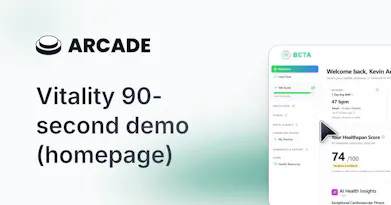



Payment Required
Launch Team / Built With


Framer AI AgentsDesign and publish professional sites with AI
Promoted

A health dashboard that finally connects every signal you generate. That sounds simple, but the work is in the connecting.
I’m Kevin Amrelle, Founder and CEO of Vidaya (you may have known us as Vitality AI Health, same product, same team, new name).
The problem: Your health data is everywhere, and none of it talks to each other. Your meals are in MyFitnessPal. Your supplements are in SuppCo. Your blood work is in a PDF from Quest. Your DNA report is in your Ancestry account. Your medical history is locked in Epic. Your steps are in Apple Health. Your air quality is on a government EPA dashboard. Your prescriptions are at CVS. Every one of those tells you a piece of the truth. None of them tell you what’s actually happening to your body, or what to do about it.
I learned this the hard way. I was in a winter bike race when my heart rate capped at 120 BPM. My cuff confirmed stage 2 hypertension. None of my health apps caught the trend. I built Vidaya so that never happens to anyone again.
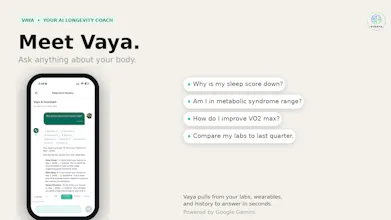
What it is: Vidaya is the AI longevity dashboard that unifies every health signal you generate, wearables, blood work, DNA, nutrition, supplements, environmental exposure, and your Epic medical records, into one place. Vaya, our AI coach, finds the correlations no single app can.
What makes it different: Most consumer health apps aggregate one or two data categories. We aggregate every category you actually generate, including the medical-grade ones (Epic FHIR, Labcorp, Quest, 23andMe, AncestryDNA). The product was built HIPAA-compliant from day one, and the underlying cross-source correlation engine is the subject of a patent application.
Key features:
Vaya Chat AI for natural-language questions across all your data (ask “how did my sleep change after starting Lexapro” and get a grounded answer in 10 seconds)
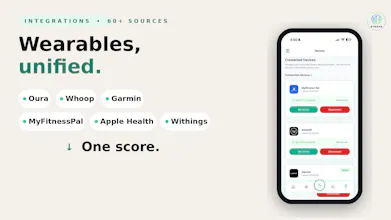
60+ integrated data sources unified in one dashboard: wearables, labs, DNA, nutrition, supplements, environmental, and medical records
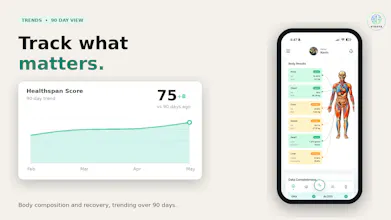
Healthspan Score across five longevity pillars, plus the VAI Score (0-100) showing how complete your health picture is
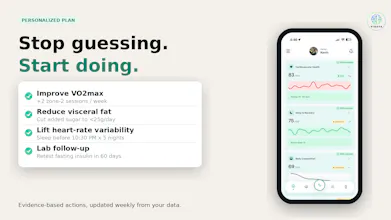
Trend lines for every biomarker across 7d / 30d / 90d / 1y, so you catch problems early, with a personalized plan of evidence-based next actions
Benefits: Stop logging into eight apps to answer one health question. Catch trend changes early instead of in a clinic six months later.
Who it’s for: Anyone who has tried to quantify themselves and given up because the data was scattered.
Launch offer: For Product Hunt launch week only, $50 off the annual plan with code VIDAYA50 ($89/year becomes $39). Code expires [date, launch day plus 6 days]. Live on iOS, Google Play, and the web. Install in 60 seconds, connect your devices in 5 minutes. Includes a 30-day money-back guarantee.
Try it at https://vidaya.ai and let us know what data correlation surprises you. We read every comment.
Kevin Amrelle, Founder and CEO, Vidaya
@kevin_amrelle Health data has become incredibly fragmented, so bringing wearables, labs, nutrition, DNA, and medical records into one context feels like a genuinely useful step forward. The personalized action layer is the part I’d be most interested in trying.
@angelaaa Thank you, Angela. Fragmentation is exactly the enemy, and you picked the part we care most about. Data without a "so what" is just prettier fragmentation. The action layer looks at your own trends and says what to do next, and Vaya cites which of your sources each answer draws from, so the reasoning is always visible. Would love to hear what you think if you try it.
Great question, @imtiaj_ahmad , and yes, the foundation for this is already live. We built Squads, shared dashboards for small groups (originally athletes, pilots, military teams) where a captain, coach, or trainer can see the group's data, with privacy controls so every member chooses what they share.
Family is a natural next step on that same foundation, and managing a parent's health data is one of the use cases we hear most. An adult child watching a parent's trends is basically a two person squad with the right permissions. Children are a different story. Pediatric health data carries extra regulatory and ethical obligations, COPPA among them, so we are not going to rush it. If we do it, it gets done properly.
Is your use case more the parent side or the kid side? That genuinely helps us prioritize.
How transparent is the scoring model when Vaya recommends a particular action based on someone's health data?
@hamza_afzal_butt Great question, Hamza! Transparency is something we designed for at two levels.
At the answer level: every Vaya response cites which of YOUR data sources it drew from (which lab panel, which wearable, which date range), so you can always see the basis for a recommendation rather than taking it on faith. If the data isn't sufficient, Vaya says so and tells you what's missing instead of guessing. And recommendations come with the evidence framing, target ranges, and the "why". This is drawn from a curated library of 1,000+ citations from medical literature, not free association.
At the scoring level: the scores are deliberately explainable rather than a black box. The VAI Score (data completeness) shows you the per-category breakdown, you can see exactly which categories are pulling it up or down and what to connect next. The Healthspan Score is broken into five labeled pillars (cardiovascular, metabolic, sleep & recovery, body composition, resilience), each traceable to the underlying markers.
And a boundary we're explicit about: Vaya gives you direction, not diagnosis, anything clinical gets redirected to a medical professional. Every response is also scored in production by our observability layer (9 LLM-as-judge evaluators at 100% sampling), so "is this answer grounded in the user's data?" is checked on every single response, not just at test time.
@priyankamandal Thank you, Priyanka, you can actually do this today! Vidaya generates a downloadable PDF health report from your dashboard covering your yearly trends across all your connected domains, plus dedicated exports for blood panels (full marker tables with reference ranges, formatted so a doctor can read them at a glance) and DEXA results. It's exactly the use case we built them for, walking into an appointment with a year of your data instead of describing things from memory. We're continuing to expand what's included (raw CSV/JSON export of everything is on the roadmap). If you try it with your doctor, I'd love to hear how the conversation goes!
How does Vidaya handle conflicting measurements when different devices report different values for the same biomarker?
@nir0b Good question. We have a few layers for it: wearable data comes in through a normalization layer that maps every device's output to standardized metrics, so we're comparing like with like. From there, we keep source attribution on every data point, you can always see which device a number came from, rather than silently averaging devices that measure differently (a wrist-based HR and a chest strap genuinely aren't the same measurement). For trends, consistency within a source matters more than absolute agreement between sources, so trend lines respect provenance. And when you ask Vaya about a marker, it cites which sources it drew from, so a device disagreement is visible instead of hidden. The honest answer is that no one should be blending conflicting sensors into one fake-precise number, showing you the provenance is the trustworthy version.
I like that Vaya isn't positioned as just another AI chatbot. Being able to ask questions across your own health history and get answers grounded in the underlying data could make AI genuinely useful for personal health.
@tanjum Thank you, Tanjum, that distinction is the whole product. A generic chatbot can only give you generic advice; Vaya answers against YOUR history and cites which of your sources each answer drew from (which panel, which device, which date range), so you can see the basis rather than trust a vibe. And when your data can't support an answer, it says so instead of guessing. That grounding is what makes AI actually useful for personal health, in our view. Appreciate you looking closely!
Hi, Venkata here, Co-Founder and Head of AI and Data Science at Vidaya.
Kevin told you why we built this. I want to tell you how we made an AI you can trust with your health data.
The problem with health AI: Most consumer health AI claims safety but cannot prove it. We decided to earn ours.
How we tested it: Over 120+ chat-quality iterations, we tuned Vaya Chat against a 32-question health stress suite covering lab trends, emergency symptoms, prescription requests, hallucination traps, and adversarial prompts, until every safety-critical category passed.
How we monitor it: We built a continuous observability layer on Arize AX with 9 LLM-as-judge evaluators and 9 production monitors scoring every response in real time at 100 percent sampling, not just at test time. On May 15 we ran the full 32-question suite against live production Vaya. The audit: 0 hallucinations across 32 questions, 10 out of 10 correct clinical-safety redirects on emergency and prescription prompts, and 4 out of 4 correct“data not available” answers on hallucination-trap questions. The full audit is available on request.
How it stays fast: Vaya uses smart routing between two model tiers. Roughly 80 percent of queries take a fast path that answers in 1 to 2 seconds, and complex clinical analysis goes to a deeper grounded path that cites your actual data.
The data engineering: We normalize 60+ sources into one longitudinal record: wearables through a vendor wearable-normalization API, labs, DNA, nutrition, and Epic medical records over SMART on FHIR. Correlations get computed from unified data instead of guessed from fragments.
Security: The platform was built HIPAA-compliant from day one with guidance from Denis Galkin, our vCISO, who brings twenty years of healthcare security experience.
Ask me anything about the evaluation stack, the routing, or the data model. I read every comment.
Venkata Ramana Duddu, Ph.D., Co-Founder, Head of AI and Data Science, Vidaya (https://vidaya.ai)