
Tencent WorkBuddy is an AI agent built for everyday office work. Make a request. Guide your AI expert team. Bring in a second opinion. Get sharpened, ready-to-use results.





What's great
the multi-expert setup actually holds up once you push on it, which is rare for this kind of demo. I spent a while going back and forth with the makers on how disagreement between experts gets handled in the merge step, and their answer (an editor/moderator pass rather than just averaging outputs) matches what I saw when I tried a task with genuinely conflicting expert takes. the thinking-process view where you can watch the debate happen is the single best trust signal I've seen in a tool like this, way better than just trusting a summary
What needs improvement
the debate/thinking-process trace is great but you have to go dig for it, most people won't open it every single time even though that's exactly where the trust actually comes from. would like to see it auto-surface a short flag whenever the experts genuinely disagreed on something material, instead of only being visible if you go looking for it after the fact
vs Alternatives
just running the same prompt through a single strong model multiple times and comparing outputs myself, which is basically the free version of this but takes way more manual effort and doesn't converge into one deliverable. also looked at building a simple LangGraph setup with a few custom prompted roles, but wiring up the approval/synthesis logic myself would have taken longer than the actual task I was trying to solve
Ratings
Ease of use
Reliability
Value for money
Customization
Report
62 views
Hey Product Hunt,
I'm part of the team that built WorkBuddy.
AI made the thinking part faster, but you still spend hours turning "the response" into an actual file. WorkBuddy closes the execution gap with a team of AI experts that helps produce sharpened, ready-to-deliver results.
Here's how it works:
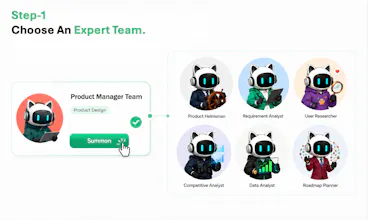
Pick an expert team.
Describe what you need in plain language.
The team gets to work in parallel, dividing the task, cross-checking each other, and synthesizing everything into sharpened, ready-to-deliver results.
Not sure which way to go? You can also bring in another expert opinion to guide the direction.
Why you want WorkBuddy:
A team, not a bot: experts cross-check each other into sharpened results
100+ Pre-built Expert Teams: across every domain, call them like a colleague, not a tool
You stay in control: bring in another opinion and guide the direction, at any point
Parallel by default: multiple agents run in parallel, no waiting in line
Real deliverables: finished files in your folders, not trapped in a chat
To celebrate our launch, we're giving the first 300 users who come from Product Hunt an extra 500 Credits. First come, first served. Claim by July 20 🎉 Claim here → [link]
Try WorkBuddy today 👉 workbuddy.ai
@sherina_chen Congrats on the launch! The framing of "execution gap" really resonates — I think a lot of AI tools solve the thinking bottleneck but leave you alone with the "now turn this into something deliverable" part. Curious how the cross-checking between experts works in practice — does the system flag disagreements between agents to the user, or does it resolve them internally before showing the final output?
@mavoungou_malahim_kiamet_zenou Both, actually, depending on what you ask for. The team synthesizes into a final output, but if you want the disagreements surfaced, just say so in your brief and each expert's take stays visible. The "execution gap" you mentioned is exactly why we built it this way. Getting to a deliverable shouldn't mean losing the nuance along the way. Best way to see it is to run one real task through it. Grab your free credits at workbuddy.ai and watch a team debate something you'd normally do solo. Would love to hear how it holds up!
@sherina_chen Thanks for the detailed answer — that's a smart default (synthesize by default, surface disagreement on request). Most tools I've seen force one behavior or the other, so letting the user choose per-brief is a nice touch. Will give it a spin on a real task and let you know how it goes.
@sherina_chen @mavoungou_malahim_kiamet_zenou the execution gap is real. most people's relationship with AI tools is: ask, accept, move on. having agents actually challenge each other's output before it reaches you is a better default than trusting a single pass. curious how you handle edge cases where the experts give genuinely conflicting recommendations -- does the user always see that tension or can they choose to resolve it themselves?
@sherina_chen Congrats on the launch! I was wondering: if a team of experts runs in parallel on a single task (say, research, drafting, and QA), is it possible to assign a different model to each expert?
the cross-check between experts is the part i'm most curious about - when one expert flags something, does that actually change the final synthesized output, or does the merge step just blend everyone's take together and the disagreement quietly disappears? in my own multi-agent setups the hard part was never getting different perspectives, it was making sure a real objection survives the final combine step instead of getting smoothed over
@omri_ben_shoham1 Great point — and I completely agree. The hard part is not getting multiple perspectives; it’s making sure a real objection doesn’t get averaged away in the final combine step.
In WorkBuddy, we don’t want synthesis to behave like a simple blender. When one expert flags something, that signal should affect the final output: it may lead to a correction, a caveat, a reframed recommendation, or an explicit note that there is a tradeoff or unresolved disagreement.
So the merge step is closer to an editor/moderator than a voting mechanism. It looks at the user’s goal, task context, constraints, and the reasoning behind each expert’s input. If an objection is valid, it should survive into the final result rather than disappear quietly.
This is also an area we care a lot about and are continuing to improve — especially around making objections more traceable, so users can see how expert feedback changed the final deliverable.
@omri_ben_shoham1 Just to add, you can actually watch the experts debate it out in the thinking process, and every perspective stays laid out in the final result, so you can trace how the conclusion came together.
appreciate both replies. the editor/moderator framing makes sense and being able to watch the debate in the thinking process is actually the part that would sell me, that's a much better trust signal than just trusting a summary. only thing i'd add is that most people won't read the full debate every time, so the trace needs to surface itself automatically when there was real disagreement, not just be available if you go dig for it
@omri_ben_shoham1 Honestly a really good point and something we're actively thinking about. Appreciate it!
glad to hear, good luck with the launch
The disagreement-survival question Omri raised is the one that bit me hardest building this stuff. What worked for me wasn't a smarter merge prompt, it was giving each expert a flag field the synthesizer literally can't drop, so a minority-of-one objection still renders in the final output. The moment I let the combine step weigh objections by confidence, the useful contrarian take got averaged into mush. Do your experts write to a shared structured object, or hand back prose the synthesizer re-reads and re-summarizes?
@dipankar_sarkar The way it works in WorkBuddy is closer to your flag-field instinct. You can ask for it directly in your brief: preserve dissenting opinions, show unresolved objections, keep each expert's take visible. The clearer the expectation, the better the team calibrates.
The part I'd poke at: asking in the brief is prompt-level, and in my runs a plain-language 'keep the dissent' held up fine until the context got long, then the minority take quietly vanished maybe 1 in 5. Is preservation actually enforced in the synthesis step, or is it the model choosing to honor the instruction each time? That gap is what decides whether I'd trust it on anything with a real decision attached.
@dipankar_sarkar Fair poke. Honestly it's the model honoring the intent, not a hard rule, so what you saw (minority take thinning out on long context) is a failure mode we've hit too. What helps is the debate stays visible in the thinking process and each take is kept separate instead of pre-blended, so it survives the merge better. But I won't oversell it as guaranteed. For a real decision, a tighter brief still holds dissent better than one long run.
Congrats on the launch! This looks like it could save a lot of time for managers. Do you have examples of tasks where WorkBuddy performs better than a single-agent workflow?
@sandy_liusy
Thanks so much for the support and the great question!
Yes,we've seen many tasks where a multi-expert workflow outperforms a single-agent approach, especially for more complex, end-to-end work that involves planning, research, execution, and delivery.
We've shared some real-world examples on our X account here:
https://x.com/WorkBuddy_AI/status/2068979159284826129
Feel free to give them a try—we'd love to hear what you think or which workflows you'd like to see next!
@sandy_liusy Great question! Tasks that benefit most are ones where different angles actually matter — like a go-to-market plan (where you want a strategist, a content person, and a data analyst all weighing in), or a competitive analysis (where one agent researches, another challenges the assumptions, and a third synthesizes). Single-agent gets you a draft. A team gets you something you can actually use. Give it a try and let us know what you're working on. Happy to suggest which expert team fits!
Really like finished files in folders instead of answers trapped in chat! The last mile is where agent tools usually stall. QQ - when 2 experts genuinely disagree at synthesis, who wins? Congrats on the launch!
@artstavenka1 Thank you! We feel the same — the last mile should be finished work in the right place, not just another answer trapped in chat.
When two experts genuinely disagree, no one automatically “wins.” The synthesis step weighs the disagreement against the user’s goal, task context, constraints, and the reasoning behind each view.
If one side is clearly better supported, the final output follows that direction. If it’s a real tradeoff, we try to preserve that in the result by showing the recommendation, the alternative, and the reason for the choice. The goal is for disagreement to sharpen the final work, not get smoothed away.
@artstavenka1 Thanks! Just to add to Caddy's point, you can actually watch the experts debate it out in the thinking process, and every perspective stays in the final result, so you can see exactly how the conclusion came together.
This looks like a huge time-saver! I've been struggling to coordinate different AI tools for my projects, so having a unified team of AI experts sounds ideal. How exactly do the different AI "experts" communicate with each other within the platform?
@doganakbulut Good question! It's simpler than wiring a bunch of bots together. In the same chat you can switch between experts on the fly, whatever the task needs. And if you summon an Expert Team instead of a single expert, they collaborate directly, so one's work carries into the next without you copy-pasting between them. If you want to see how they think through disagreements, just ask and every take can stay visible in the final result. Less a pile of tools you coordinate, more a team you can call on right where you're working.
@doganakbulut Thanks so much!
Our expert teams collaborate through structured workflows. Each expert is responsible for a different part of the task based on their domain knowledge and specialized skills. They share context, pass along intermediate results, and coordinate their work so the next expert can continue seamlessly.
The goal is to make complex tasks feel as effortless as working with a well-coordinated professional team.