using it to actually get around in japan rather than pass a test, so the context-first approach fits how i actually need it. it teaches the phrase for the situation you're in (reading a sign, checking a price) instead of a flashcard deck disconnected from real life. importing my wanikani progress instead of starting from zero was the thing that got me to actually stick with it past day one.
would like a way to mark a phrase as 'heard this in the wild' and have it show up more in review, since some of what it teaches i haven't actually encountered yet and some real situations i keep running into aren't covered.
was using duolingo's japanese course before, but it's built for general vocab not for what actually shows up in day to day life here - store signage, train announcements, polite forms for specific situations.
Hi Product Hunt, I’m James, the person behind Yokoso.
I started building it after moving to northern Japan and realizing that most beginner apps were teaching Japanese in an order that had very little to do with the life happening around me. I needed to read signs, understand prices, recognize counters, and make sense of the grammar inside useful phrases. I also did not want to start over every time I tried a new tool.
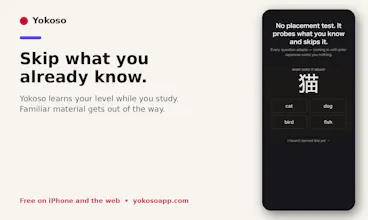
Yokoso opens directly into learning and adapts around what you already know. New material arrives as a lightweight probe. When you know it, the app skips the lesson. When you do not, it teaches the answer and explains why. It can also import WaniKani progress so those learners keep the work they have already done.
The app is free forever, with no ads, streaks, lives, paywalls, or locked lessons. Every learning feature stays free. On the web, supporters can choose an optional Glass look as a thank-you, and it does not change the lessons or progress.
I would especially value feedback on two things:
1. Does the first five minutes make it clear why Yokoso is different?
2. Which real-life Japanese situation should the app teach better next?
The web app works offline and without an account, and the iOS app is live. Thanks for taking a look.
@james_ketola Hi James, kudos on making a practical language learning product! Though I am not studying Japanese, I used to study Chinese (and a few other languages). I remember the frustration over books and apps NOT being adapted to everyday practical speech. I am pretty sure the app is very useful, the fact you built it to match your own situation (living in Japan) and that the app adapts to your level says it all for me ^__^
Good luck on the launch, hope Yokoso gets noticed by learners of Japanese!
@margarita_s88 Thank you, Margarita. That frustration with learning a language on paper and then not recognizing the shape of a real interaction is exactly what pushed me to build Yokoso. I appreciate the encouragement, especially from someone who has tried several languages. I’m hoping the practical order and the way it adapts around what someone already knows make that gap a little smaller.
@james_ketola Exactly, that's the issue with many textbooks and courses made 'the old-fashioned' way. You know, one of my first shocks about how fast one can dive into a new language was when I discovered ChinesePod. It's a fantastic podcast designed with the practical approach in mind. I wish all language podcasts were this way.
Btw, I just launched our language-related product today - Nitro, online human translation platform - and will be happy if you'd like to check it out :)
ChinesePod is a really good comparison. The practical context isn't treated as a shortcut around learning; it is what makes the vocabulary stick. That's close to what I'm trying to do with Yokoso, especially now that people can choose a situation and learn new material from it.
And congratulations on Nitro 4.0. I saw the new agent-to-human translation angle on your profile. That's a genuinely interesting use of human translation rather than treating it as a fallback. I'll take a proper look. Thanks for sharing it, and for coming back to the thread.
Congratulations on the launch, James! 🎉
I'm Japanese, born and raised, and I just want to say — seeing someone move to northern Japan and build something this thoughtful for learners made me really happy. The name made me smile too (ようこそ!).
What resonated most with me is the philosophy: no streaks, no lives, no paywalls, and respecting what learners already know. That's rare. And as a native speaker, I can confirm that counters, prices, and signs are exactly the things textbooks skip but real life throws at you on day one.
For your second question — a few situations I'd love to see Yokoso teach, because they trip up every foreign friend I've helped:
The pharmacy / clinic: describing symptoms and understanding dosage instructions (食後, 1日3回, etc.)
City hall paperwork: 住民票, 保険, 年金 — the vocabulary is brutal but unavoidable
Garbage separation rules: 燃えるゴミ vs 資源ゴミ, and the collection-day signage
Train delay announcements: 遅延, 運転見合わせ, 振替輸送 — these are stressful even to half-understand
Rooting for you from Japan. 応援しています!
@shun_build Thank you, especially for the perspective as someone born and raised here. Those are four excellent suggestions. I already have broader stations and paperwork practice on the web, but the details you named are what make the difference: dosage timing, 住民票 and insurance, collection-day signs, and what to do when 運転見合わせ appears. I don’t want them to become vocabulary lists. They should feel like the situations themselves. I’m saving all four for the next scenario pass. 応援ありがとうございます!
Congratulations on the launch!
I've been learning Japanese for 6 years so far, and I've been satisfied with how my sensei teaches, but I must admit I'm still afraid to use the language in everyday situations. And I think it's mostly because I try to speak it the European way; I'm still not good at aizuchi, so all my conversations feel a bit stiff, like taken straight from a workbook. Watching anime doesn't help at all, maybe because seiyuu are doing a great job articulating... Reading the launch desc, I feel like Yokoso may be the help I need, so I'll definitely give it a try ;)
@olarybacka Six years of study and still feeling stiff in everyday conversation is exactly the gap I’m trying to close. Aizuchi is a very good call because the problem isn’t just knowing words; it’s knowing how to sound present without turning every response into a full textbook sentence. Yokoso has some of those short reactions in the material now, but not a focused conversation-rhythm session yet. I’m adding that to the product feedback list. If you try it, I’d love to know where the app still feels too much like a workbook.
the "no streaks, no lives, no locked lessons" line is what got me, most language apps are optimized to keep you opening the app rather than to make you actually capable in the country. one situation I'd add to the pharmacy/city hall/garbage list already here: phone calls for redelivery when you miss a parcel. it comes up constantly, it's pure listening under pressure with no visual context, and almost every learner I know just avoids answering the phone entirely instead of dealing with it.
@galdayan This is a really good example because it has everything learners hate at once: no visual context, set phrases, fast audio, and a task you can’t quietly postpone once someone answers. I hadn’t considered redelivery calls as a focused situation, but it fits Yokoso extremely well. The useful version would practice both sides: understanding the driver and giving a time window or address confirmation without pretending the call is more open-ended than it really is. I’ve added it to the scenario list. Thank you.
PS: I'm still avoiding phone calls for exactly that reason! Every phone call I've had since moving here has been absolutely traumatic.
@neuroartist Thank you! That is exactly why I built it. I could study for a long time and still freeze when the thing in front of me was a sign, a price, or a short interaction happening faster than a lesson. Yokoso tries to teach the situation along with the Japanese, then get out of the way. If you try it, I’d genuinely like to hear which real-life situation makes the idea click for you, or where it doesn’t yet.


Yokoso
Thanks for taking the time to use it and write this. “Heard this in the wild” is a genuinely good idea. It could let real encounters influence review priority without turning every sighting into a separate queue. I also like the distinction between material the app thinks is useful and situations you actually keep running into.
If you have one example of a phrase or situation Yokoso is missing, I’d love to hear it. That would help me understand whether this should be a simple review signal, a way to add your own note, or both.