

Do you really need a dashboard? Or do you need someone to tell you what to do?

You have dashboards. Lots of them. Google Search Console. Google Analytics. Your CRM. Your email platform. Your ad manager.
They show you numbers. Rank positions. Traffic volume. Bounce rate. Session duration. Conversion rate. Backlink count. Domain authority.
You spend hours looking at them. You compare numbers that will never match. You try to find the signal in the noise.
Then what?
Most of the time, nothing. You close the tab. You move on. You do not know what to do next.
The dashboard is not the problem. The problem is that the dashboard is passive. It shows you where you are. It does not tell you where to go. It does not tell you what to fix first. It does not tell you which opportunity to chase.
We realized this when we looked at our own dashboards. We had 267 keywords tracked. 78 pages audited. 25 competitors detected. Zero AI citations. Zero backlinks indexed.
The numbers were interesting. They did not tell us what to do.
So we built something different. Not a dashboard. A strategy engine.
It starts with a profile. Who you are. What you sell. Who you compete with. Not numbers. Context.
Then it generates a strategy. Not a report. A list of tasks. Prioritized. Actionable.
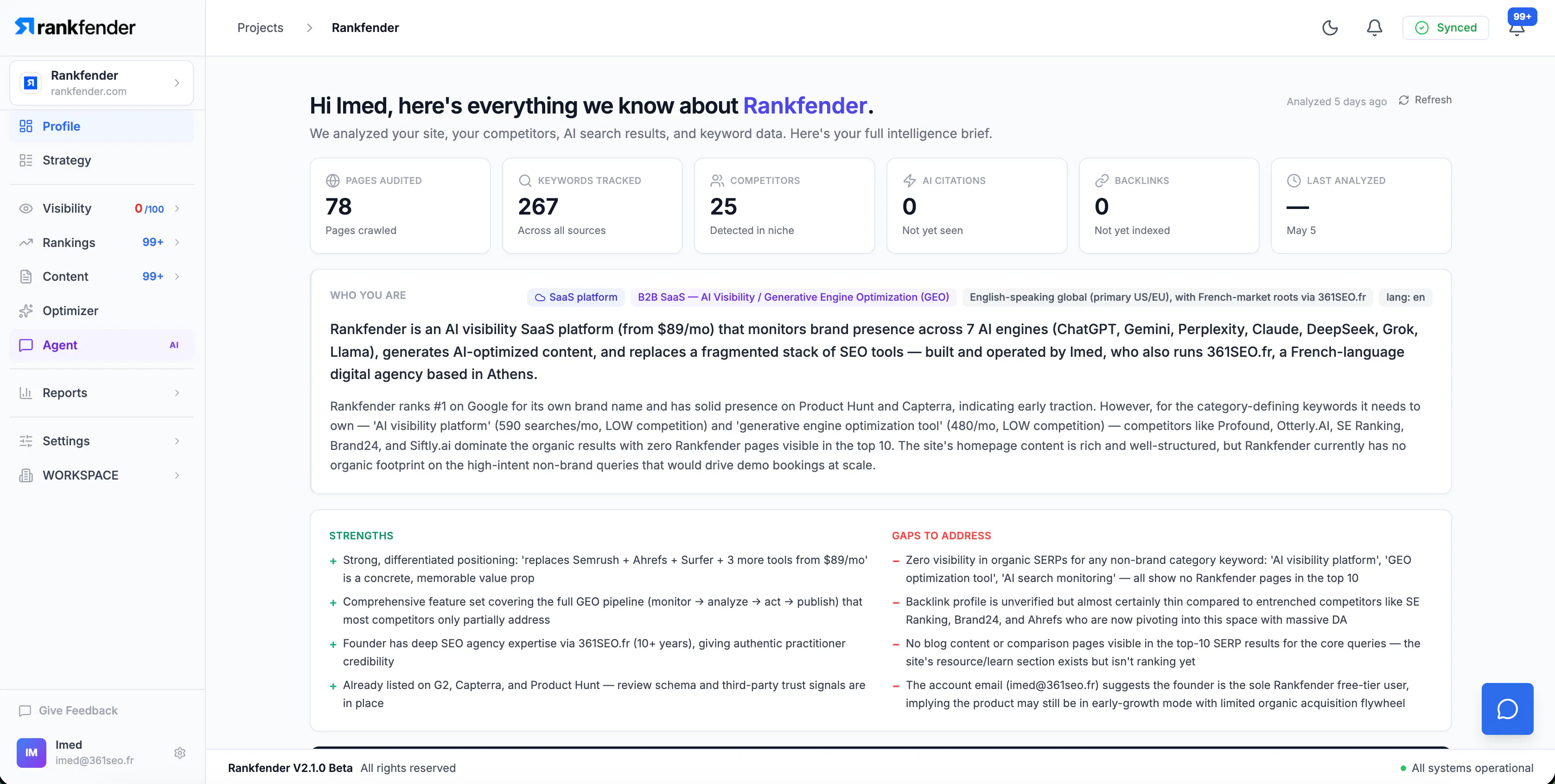
"Own the category keywords before big incumbents consolidate them. AI visibility platform. 590 searches per month. Low competition. Zero Rankfender pages in the top 10. Here is what to write."
"Build a comparison content page for category queries. The SERP for AI visibility tools is already filling up. Here is the gap."
"Rewrite your features page. Expand with keyword-rich H2s matching search queries like 'monitor brand in ChatGPT' and 'AI citation tracking.'"
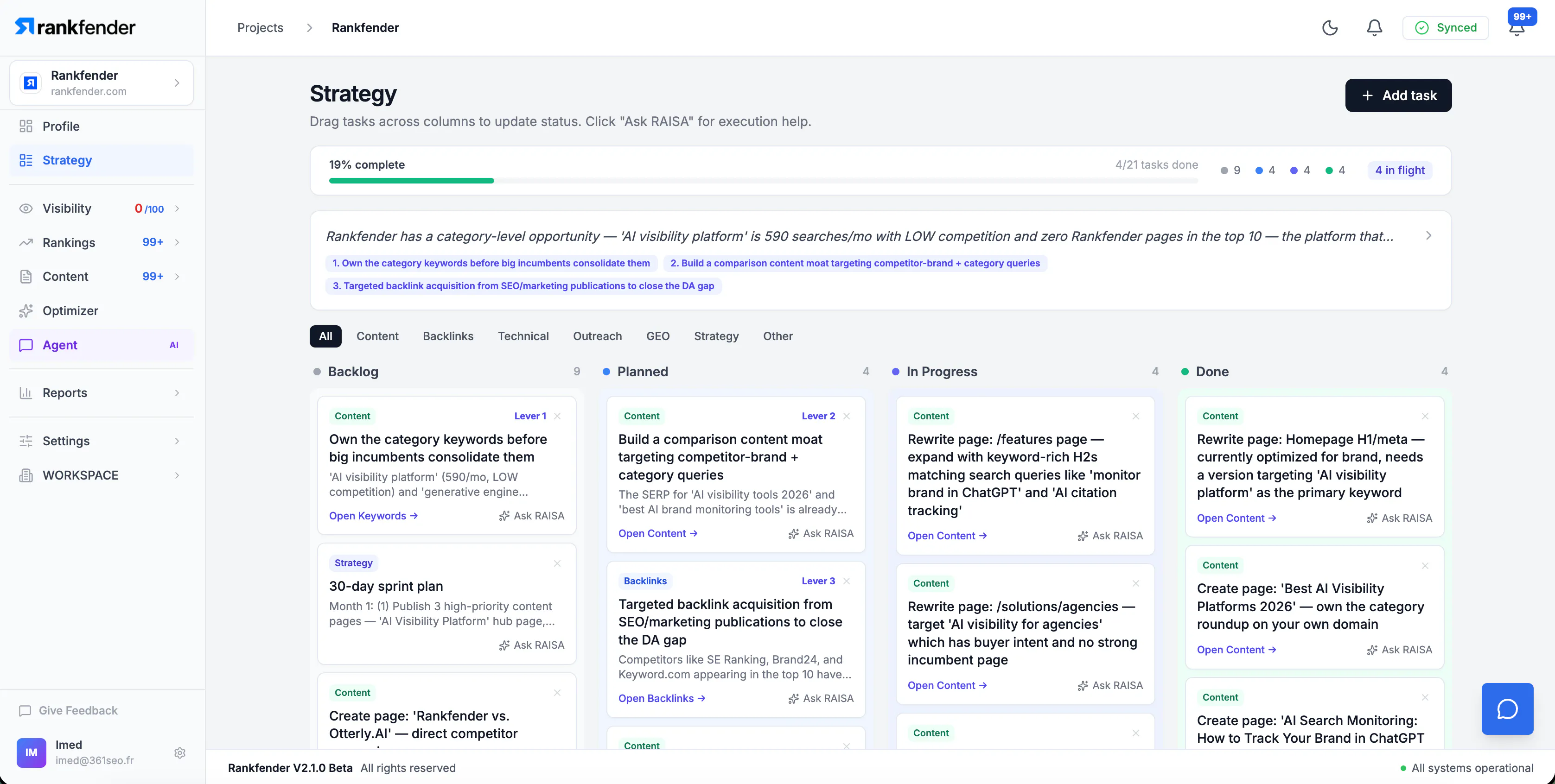
Each task has a button. Ask RAISA. Click it. The AI helps you execute.
Not a dashboard. A SEO GEO copilot.
Dashboards show you how you are doing. Strategy tells you what to do about it. Most tools stop at the first part. We are building the second.
What is the most useless number on your dashboard right now? The one you look at every week and never act on.
Imed Radhouani
Founder & CTO – Rankfender
Replies
This framing makes sense , most tools don't lack data , they lack clear prioritization. Turning signals into actionable next steps is usually where the real value starts.
Rankfender
@ian_maxwell That is exactly it. The data is everywhere. Everyone has it. The advantage is not in having more numbers. It is in knowing which numbers to act on and in what order.
Most tools assume you already know how to prioritize. They show you 50 problems. You have to figure out which one matters most. That is the hard part. That is where most teams get stuck.
Turning signals into next steps is not a feature. It is the product. Without it, you just have a more expensive way to feel overwhelmed.
The best tools do not give you more data. They give you fewer, better choices.
What is the most overwhelming dashboard you have ever used? The one where you closed the tab because you did not know where to start.
@imed_radhouani Very sorry for that much reply , I am just got free and saw your message , that's exactly the trap most dashboards fall into , high signal density , low decision clarity . I think the real step forward is not just ranking or filtering metrics, but tying each signal to a clear "if this , then do that " path so prioritization is already embedded , not left to the user.
This hits a real pain point most dashboards aren’t lacking data, they’re lacking prioritization. The shift from visibility to next best action is where analytics actually becomes useful instead of just informational noise.
Rankfender
@julia__klemenc That is exactly it. The dashboard tells you something is wrong. It does not tell you what to do about it. Or worse, it tells you everything that is wrong, and you have to figure out which one matters first.
The jump from "here is the problem" to "here is the next action" is where most analytics tools stop. They hand you a diagnosis and leave the prescription to you. That is the hard part. That is where most people get stuck.
Turning visibility into action is not a nice to have. It is the whole point. If the data does not help you decide what to do next, it is just informational noise.
What is the most actionable insight you have ever gotten from a dashboard? The one that made you close the tab and open your editor.
The most useless/confusing metric is the “average session duration", because it mostly comes with zero context. A 40-second session can mean the page answered the question instantly, and sometimes 6-minute session can mean the UX is confusing. Most dashboards optimize for observation, and our approach optimizes for decisions.
If we could go from: “Here’s what happened” to “Here’s the highest-leverage thing to do next", that's when it creates value. That’s the layer most SEO tools still miss. Let me know if there's a free trial ;-)
Rankfender
@shahana_rasheed You nailed it. A 40-second session could be success. The user found what they needed and left. A 6-minute session could be failure. They were lost. They gave up. Same number. Opposite story. Context is everything.
Most dashboards are built for observation. Here is what happened. Here is the trend. Here is the comparison. They leave the hard part to you. You have to figure out what it means and what to do next.
The shift from "here is what happened" to "here is what to do about it" is where value lives. That is the layer almost every SEO tool misses.
Yes, there is a free trial. No credit card required ! You can see for yourself if we actually close the gap or if it is just more noise + we have a 70% of the first year for Pro and Business
What you unlock in Year 1 on Business
720
AI Articles
52
Weekly Reports
10
LLMs Tracked
5
Brands
Interesting perspective, though kinda. A lot of businesses get snagged on collecting analytics, and then building dashboards without actually turning the data into decisions that can be used, you know. The part about needing clarity + direction instead of just more numbers really lands. It feels like a good reminder that strategy and execution matter much more than simply tracking metrics, not just because it looks shiny, but because it actually moves something forward.
Rankfender
@it_cures You are right. The trap is collecting because it feels productive. You add another source. You build another dashboard. You look at the numbers. You feel informed. Nothing changes.
The shift from tracking to deciding is the hard part. It is also the only part that matters. A dashboard that does not lead to action is just an expensive screensaver.
The shiny numbers are the danger. Page views go up. You feel good. But page views do not pay the bills. They do not fix the onboarding flow. They do not answer the support ticket that has been open for three days. They just make you feel like you are doing something.
The real work is not in the dashboard. It is in what you do after you close it.
What is the most expensive dashboard you have ever seen that led to zero decisions?